
Christmas Savings Challenge: A Printable Tracker for Weekly and Biweekly Paydays
December rarely brings one big expense. It brings a lot of small ones, and they all land in the same few weeks. A christmas savings challenge spreads that cost out, so the money is already waiting when the gift list comes out.
The lights go up and the gift list gets longer. The grocery bill for the holidays easily doubles too.

Then January arrives with the card statement.
The hard part isn’t spending less at Christmas. It’s paying for it before it happens.
How much should we put aside? Is it too late to start in October? And how do we keep the money from quietly disappearing into everyday bills?
They come back every autumn, right around the time the first Christmas ads appear.
If you’re looking for a christmas savings challenge that actually fits your paycheck, the secret is to pick a number from your own list and split it by the paydays you have left. Then make every deposit something you can see and color in.
In this post I show you 8 simple challenges with the real math for weekly and biweekly paydays, plus a free printable tracker to color in.
Disclosure: This post contains affiliate links. If you make a purchase through these links, I may earn a small commission at no extra cost to you. Thank you for supporting my blog!

Why does Christmas money feel so hard to find every year? Because it doesn’t have its own place. It comes out of the same account as rent and groceries, in the same few weeks.
The numbers say we’re not alone in this. In a LendingTree survey from December 2025, 37% of Americans took on holiday debt, and the average was $1,223. 63% of them expected it to take 3 months or longer to pay off.
That’s spring before the bill for December is gone.
In Hungarian we have a lovely everyday word for this whole idea: spórolás (it simply means saving money, and it comes from the German sparen). My honest opinion is that spórolás works best when it doesn’t feel like a sacrifice at all, just a small habit with a clear finish line.
And Christmas is the clearest finish line of the whole year.
What Is a Christmas Savings Challenge?
A christmas savings challenge is a simple plan to put aside a set amount on every payday between now and the holidays, so the cost of Christmas is covered before December starts.
In practice, it’s a goal split across your paydays, with a tracker you color in after every deposit.
The way I see it, it’s the calm, modern version of the old Christmas club accounts that banks offered for decades.
How Much Should You Save for Christmas?
Before we pick a challenge, we need a number. And the best number comes from your own list, not from what everyone else spends.
✦ WORTH KNOWING ✦
According to the National Retail Federation’s 2025 holiday survey, Americans planned to spend $890.49 per person on the holidays. $627.93 of that was for gifts, and $262.56 went to food, decorations, cards and other seasonal things. 42% of shoppers planned to start before November.
That’s an average, and averages hide a lot. A family of 5 and a single person living alone don’t need the same number.
So here’s the simple way.
1.) Write down every person on your gift list with a realistic amount next to each name.
2.) Then add a line for food and decorations, plus anything else you know is coming, like travel or a family dinner you’re hosting.
The total of that list is your goal. Nothing more, nothing less.
Then count your paydays between today and about December 15, so the money is ready when you need it. Move the sliders below to see what that means for each payday.
Your Christmas savings plan in 10 seconds
Move the 2 sliders: what you want to have by Christmas, and how many weeks you have left. You’ll see the weekly, the biweekly and the ladder version side by side.
A calm, doable goal. Set the transfer for payday and let it run in the background.
Where the numbers come from: the average of $890.49 per person (gifts, food, decorations and cards) is from the NRF 2025 holiday survey. The payday count assumes one payday every 2 weeks. The ladder raises the deposit by the same amount every week, like the first Christmas club in 1909.
Related post: If your list keeps growing every year, my post on how to have a minimalist Christmas without losing the magic helps you decide what really belongs on it.

8 Christmas Savings Challenges for Every Kind of Payday
These challenges start with the ones that work best from mid-October, when there are about 10 weeks left. The last ones are for anyone who wants to start fresh in January and never worry about December money again.
1.) 10-Week Countdown
How it works:
- divide your goal by 10,
- move that amount every week, on the same day,
- color in one ornament on your tracker after each deposit.
This is the simplest christmas savings challenge of all, and from mid-October it fits almost perfectly. There are about 10 weeks until Christmas.
A $500 goal means $50 a week. A $300 goal means $30. A $1,000 goal means $100 a week, which is a lot for many of us, and that’s an honest sign the list needs a second look.

| Your goal | Every week for 10 weeks |
|---|---|
| $300 | $30 |
| $500 | $50 |
| $750 | $75 |
| $1,000 | $100 |
Pick the same weekday every time. Friday works well if that’s when you get paid. Sunday evening works if you plan your week then.
A glass jar on the kitchen shelf makes the progress hard to ignore, especially for kids. Cash in a jar is also harder to spend by accident than a number in an app.
SHOP IT ON AMAZON
Set a weekly reminder on your phone today, named after the thing you’re saving for.
2.) Biweekly Payday Plan
How it works:
- count the paydays left before December 15,
- divide your goal by that number,
- move it the same day the paycheck lands,
- mark the payday on your tracker.
If you’re paid every 2 weeks, there are usually about 5 paydays left from mid-October. That’s where this christmas savings challenge biweekly version comes in.
A $500 goal means $100 per payday. A $750 goal means $150.

The trick is timing: move the money the morning your paycheck arrives, before anything else touches it.
Most banks let you set this up as an automatic transfer in a few minutes. If yours doesn’t, put the transfer at the very top of your payday to-do list.
If you’re paid monthly, it’s the same idea with 2 deposits left, so a christmas savings challenge monthly plan really works best when it starts in summer. That’s what challenge 8 is for.
Check the date of your next payday now and write the amount next to it on your tracker.
✦ FREE PRINTABLE ✦
Christmas Savings Challenge Tracker
4 pages to color in: the 10-week countdown, the biweekly payday plan, the 1909 ladder and the 52-week Christmas fund.
Download the free PDFUS Letter size, prints fine on A4 too. For personal use.
3.) The 1909 Christmas Club Ladder
How it works:
- start with a small amount in week 1,
- add the same small amount every week after,
- finish with the biggest deposit just before Christmas.
This one has a lovely story behind it, and I’ll tell it in full a little further down. In short, it’s how the first Christmas club worked in 1909: start tiny and grow the deposit by the same amount every week.
For a 10-week ladder, start with $10 and add $10 each week. Week 1 is $10, week 2 is $20, and week 10 is $100.

Together, that’s $550, and the first weeks barely hurt at all.
| Weeks | Deposits | Total |
|---|---|---|
| Weeks 1 to 5 | $10, $20, $30, $40, $50 | $150 |
| Weeks 6 to 10 | $60, $70, $80, $90, $100 | $400 |
| All 10 weeks | $550 |
It suits anyone who expects some extra money later in the year, like a year-end bonus or holiday overtime. The big deposits land when there’s more to put in.
Write the 10 amounts on your tracker in pencil, so you can see the whole ladder before you start.
4.) Reverse Ladder
How it works:
- start with the biggest deposit now,
- lower it by the same amount every week.
This is the 1909 ladder turned upside down, and for many families it’s the smarter one. December is expensive on its own, and the last thing we need is the biggest savings deposit landing in the same week as the gift shopping.
Start with $100 in week 1 and go down by $10 each week. Week 10 is $10.

It’s still $550 in total, but the hard part is over by early November.
If you miss a week, don’t try to double up the following week. Just keep going down the ladder from wherever you are. A missed $40 is far better than a challenge you abandon because it suddenly feels impossible.
Look at your calendar for December and mark the week you know will be the most expensive.
5.) Envelope Split
How it works:
- divide your goal into 3 or 4 named categories,
- give each one its own envelope or savings pocket,
- put a photo or a name on each one.
This challenge comes straight from research, and it’s my favorite on the list. Instead of one big Christmas pot, the money goes into smaller, named parts.
In a field study published in the Journal of Marketing Research, Dilip Soman and Amar Cheema followed 146 workers in rural India who were paid in cash every week. When the money set aside was split into 2 envelopes instead of 1, they saved noticeably more, and putting a picture of their children on the envelopes helped even more.

Opening a second envelope simply felt harder than dipping into one big pile.
A named envelope is much harder to borrow from than a general savings account.
For Christmas, the categories might be Gifts, Food, Decorations and Travel. Or one envelope per child, with their name on it. A budget binder with zip envelopes keeps the cash flat and in one place, and some binders come with savings challenge pages already printed inside.
Write your 3 or 4 categories on a piece of paper tonight and give each one its share of the goal.
6.) Swap Weekend Challenge
How it works:
- choose 4 weekends between now and December,
- replace one paid outing with a free one,
- move the exact amount you didn’t spend into your Christmas savings.
Some weeks there’s simply nothing extra in the budget. This challenge finds the money inside what we already spend.
Look at a normal weekend. Maybe it’s takeout on Friday and a trip to the shops on Sunday afternoon.

Swap just one of them for something free, and move that exact amount the same evening.
A homemade pizza night instead of delivery. A walk with a thermos instead of the mall. Whatever you’d have spent goes straight to Christmas.
The rule that makes it work is the same evening. If the transfer waits until Monday, the money usually finds another job.
Related: If the pull to buy things is what eats the budget, my post on how to stop wanting new things and start living a simple life is a good companion to this challenge.
Pick this weekend’s swap now, and write the amount you’ll move on your tracker.
7.) Sell One Thing a Week Challenge
How it works:
- sell one thing a week you no longer use,
- put every dollar into the Christmas fund.
This is the most minimalist challenge on the list, because it works in two directions at once. The house gets lighter while the Christmas fund grows.
Good things to start with are the ones that hold their value. Think of winter coats and boots the kids have outgrown, or kitchen gadgets that were used twice.

Don’t count the money before it comes in. Only what you actually sold goes on the tracker, so the number on paper is always the real one.
I’ll be honest, this one only works for some weeks. But one good sale can cover the gift for a whole branch of the family.
Walk through one room this week and set aside 3 things you’d be happy to sell.
8.) 52-Week Plan for Next Christmas
How it works:
- start in the first week of January,
- save the same small amount every week,
- or follow the classic $1, $2, $3 ladder all year.
This is for everyone who’s reading this in October and thinking: I wish I’d started earlier. You can, for next year.
A flat $10 a week from January gives you $520 by Christmas. The classic 52-week savings challenge starts at $1 and adds $1 each week, ending at $52 in the last week of December.

That ladder adds up to $1,378, and most weeks you won’t even notice the deposit.
It works as a christmas sinking fund too. Every January, look at what December really cost, divide it by 52 and that’s your weekly number for the year.
The printable below has a 52-week page for exactly this.
Put a note in your calendar for the first week of January: start the Christmas fund.
Your Free Printable Christmas Savings Tracker
Every challenge works better when you can see it. That’s why I made a free printable christmas savings tracker with 4 pages, one for each kind of plan.
✦ FREE PRINTABLE ✦
Christmas Savings Challenge Tracker
4 pages to color in: the 10-week countdown, the biweekly payday plan, the 1909 ladder and the 52-week Christmas fund.
Download the free PDF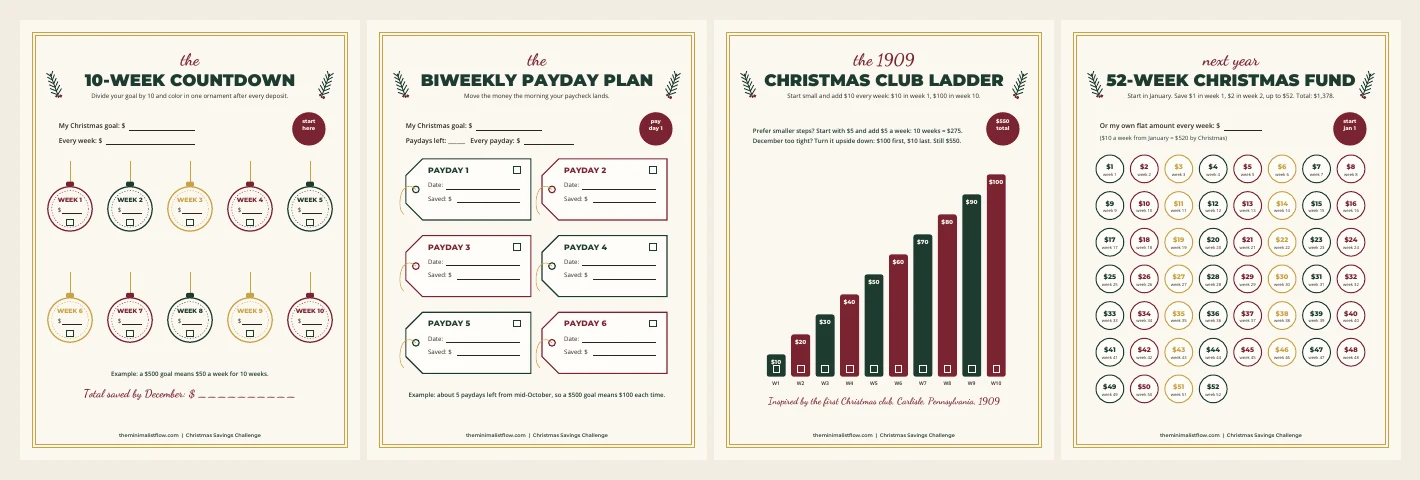
US Letter size, prints fine on A4 too. For personal use.
The pages are made to be colored in. A few soft highlighters or colored pencils turn every deposit into a tiny Christmas moment, and kids love doing it too.
WORTH KNOWING: You do not need to provide your email address to download the PDF, as it is available for free download.
SHOP IT ON AMAZON
Print it on thicker paper if you can, and stick it on the fridge or inside a kitchen cupboard door. Somewhere you’ll walk past every single day.
Every Amazon Find From This List in One Place
These are the only things from this post that might be worth buying, and only if you don’t already have something similar at home. An old jar and a pack of envelopes work just as well.
| Find | Best for you if | Shop on Amazon |
|---|---|---|
| Glass money jar | you save in cash and want to see it grow | Glass money jars |
| Budget binder with envelopes | you want to split your savings into named parts | Budget binders |
| Savings challenge book | you like a ready-made challenge with envelopes inside | Savings challenge books |
| Pastel highlighters | you want to color in the printable tracker | Pastel highlighters |

The Christmas Club Started With 3 Factory Workers in 1909
The idea of saving a little every week for Christmas isn’t new at all. It’s more than a hundred years old, and it didn’t come from a bank.
According to a history of Christmas savings clubs from the New Jersey Digital Newspaper Project at Rutgers, the first Christmas club began in December 1909 at the Carlisle Trust Company in Pennsylvania. 3 workers from a local shoe factory asked the bank’s treasurer, Merkel Landis, to help them save together.
Together they worked out a simple plan. They started with 1 to 5 cents a week and raised the deposit by the same amount every week, for 50 weeks. Just before Christmas, the money was paid out.
So the ladder in challenge 3 is really a 117-year-old idea, and it still works.
What I love about this story is who started it. Not financial experts, just people with a weekly wage who wanted a calmer December. That’s exactly who a christmas savings challenge is for today.
✦ ONE THING TO TRY ✦
Tell one person in your family which challenge you’ve picked and what your goal is. Saying the number out loud makes it real, and it’s much easier to keep going when someone asks how the Christmas jar is doing.
Making Your Savings Challenge Stick Until December
This is the practical part, from where to keep the money to what to do when a week goes wrong.
Where to keep your Christmas savings
| Place | Good for | Watch out for |
|---|---|---|
| A separate savings pocket in your banking app | automatic transfers on payday | it’s easy to move the money back with one tap |
| A high-yield savings account | larger goals started early in the year | transfers can take a day or two |
| Cash envelopes in a binder | the Envelope Split and families with kids | keep them somewhere safe and out of sight |
| A glass jar | small weekly cash deposits | only for amounts you’re comfortable keeping at home |
The best place is the one you can’t reach in 2 seconds on a bad day.
Mistakes to skip
| Mistake | Do this instead |
|---|---|
| Picking a goal from the average instead of your list | Add up your own list first |
| Starting 2 challenges at once | Choose 1 and finish it |
| Doubling up after a missed week | Skip it and keep going |
| Keeping the savings in your everyday account | Give the money its own named place |
| Using the Christmas fund for everyday bills | Move only the exact amount, never round down |
| Stopping the plan on December 26 | Start next year’s fund in the first week of January |
Recommended: If you’re still planning the gifts themselves, my 17 Christmas gift ideas for women who say they want nothing are thoughtful and gentle on the budget.
When a week goes wrong
A missed deposit: skip it and keep going. One empty week on the tracker is fine, and an abandoned tracker isn’t.
An unexpected bill: lower the deposit for that week instead of skipping it completely. $5 still keeps the habit alive.
The goal suddenly feels too big: go back to the list and take one thing off. Shrinking the list is better than borrowing in January.
Extra money comes in: put half of it toward Christmas and keep the other half for the everyday budget.
How to get kids involved
Let them color the tracker: one ornament per deposit, and they’ll remind you on payday.
Give them their own small jar: even a few coins a week teaches them that gifts are planned, not just bought.
Talk about the list together: ask each child for their top 3 wishes, and let them see how the list and the jar fit together.
3 small things to do this week
- Write your Christmas list with an amount next to each name,
- open a separate savings pocket and name it Christmas,
- print the tracker and stick it where you’ll see it every day.
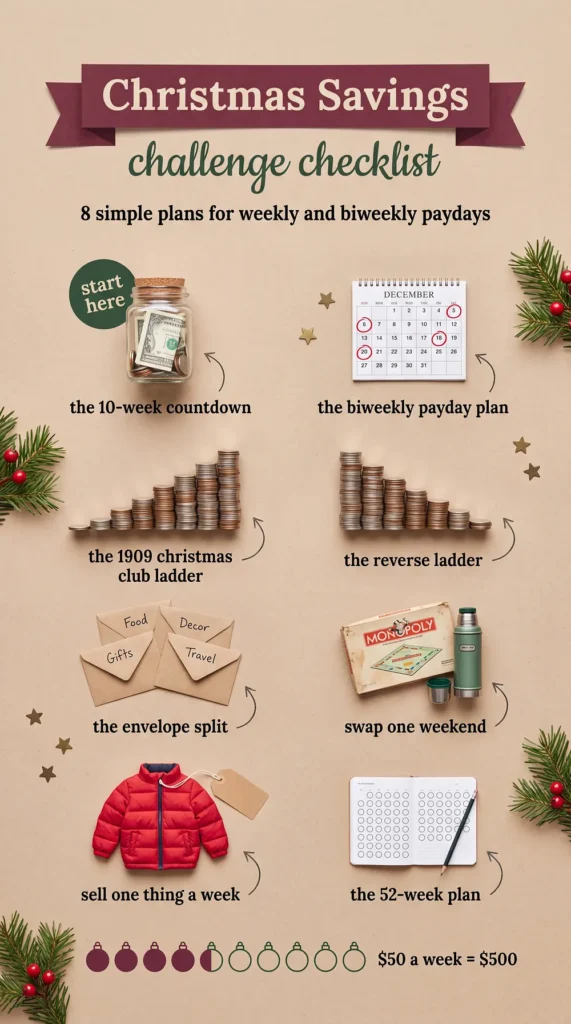
Your Christmas Savings Challenge Checklist
Save this pin for later on your Pinterest board!
Christmas Savings Challenge – What Readers Ask Me Most
Is it too late to start a christmas savings challenge in October?
It isn’t too late to start a christmas savings challenge in October, because there are still about 10 weeks left. A $500 goal works out to $50 a week, or about $100 per biweekly payday. Start with the 10-Week Countdown or the Reverse Ladder, so the biggest deposits are behind you before the December shopping starts.
How much should I save for Christmas?
How much to save for Christmas depends on your own list, not on what others spend. The NRF found Americans planned to spend about $890 per person in 2025, but that average hides very different families. Add up every gift plus food and decorations, and travel if you’re going away. That total is your goal.
How do I save $500 for Christmas?
To save $500 for Christmas from mid-October, put aside $50 a week for 10 weeks, or $100 on each of about 5 biweekly paydays. Move the money the day you get paid, into a separate account or envelope. A printable tracker helps you see your progress and makes the weekly deposit harder to skip.
What is a christmas savings challenge biweekly plan?
A christmas savings challenge biweekly plan sets aside the same amount on every second payday until the holidays. You divide your goal by the paydays left, then move that amount the morning each paycheck arrives. With about 5 paydays left from mid-October, a $750 goal means $150 each time.
What is the 52 week savings challenge?
The 52 week savings challenge is a yearly plan where you save $1 in the first week, $2 in the second and so on up to $52 in the last week. Together, that adds up to $1,378 by the end of the year. Starting it in January is an easy way to have next Christmas fully paid for.
Is a separate account or cash envelopes better for Christmas savings?
Both a separate account and cash envelopes work for Christmas savings, as long as the money has its own named place. A separate account is safer and easy to automate. Cash envelopes are more visible, and research by Soman and Cheema found that splitting savings into named envelopes helped people save more.
What was a Christmas club account?
A Christmas club account was a special savings account where people deposited a small amount every week and got the money back just before Christmas. The first one started in December 1909 at the Carlisle Trust Company in Pennsylvania. Some banks and credit unions still offer Christmas club accounts today.
How do I stop my Christmas savings from disappearing?
To stop Christmas savings from disappearing, keep the money somewhere you can’t reach in 2 seconds, like a separate account with no card or a sealed envelope. Name it Christmas, and move it the day you get paid. If a bill comes up, lower that week’s deposit instead of borrowing from the fund.
Recommended Reading
9 Black Friday Shopping Tips That Keep Your Closet Small
How to Have a Minimalist Christmas Without Losing the Magic
20 DIY Christmas Ornaments You’ll Still Love in 10 Years
The Best Christmas Gift Might Be an Easy January
When we think about Christmas, we picture the tree and the table. Nobody pictures the second week of January.
But that’s where a christmas savings challenge really pays off. No statement to dread, and no 3 months of paying for one evening.
The gifts are the same, and so is the dinner. The only difference is the timing of the money.
For me, that’s the most precious gift of all: a December we enjoy fully, and a January that starts calm and free.
✦ FREE PRINTABLE ✦
Christmas Savings Challenge Tracker
4 pages to color in: the 10-week countdown, the biweekly payday plan, the 1909 ladder and the 52-week Christmas fund.
Download the free PDFUS Letter size, prints fine on A4 too. For personal use.
You Might Also Like
-
Sweater Outfits: 11 Fresh Ways to Wear One Burgundy Sweater All Winter
In this post I’ll show you how to wear one burgundy sweater 11 different ways, from a Monday at the office to Christmas Eve dinner. You’ll also find color pairs, the mistakes that make a knit look tired, and simple care tips that keep it soft for years.
-
Christmas Savings Challenge: A Printable Tracker for Weekly and Biweekly Paydays
This christmas savings challenge turns the cost of December into small, planned amounts you set aside from now until the holidays. You’ll find 8 simple challenges with the real math for weekly and biweekly paydays, plus a free printable tracker to color in.
-
Christmas Mantle Ideas: 13 Calm Looks With Zero Clutter
These christmas mantle ideas help you build an elegant fireplace display that looks calm instead of crowded. You’ll find 13 looks, from a lush garland with burgundy velvet to a mantel with a TV above it, plus color pairs and the mistakes worth skipping.