18 Christmas Traditions Around the World You Can Start This Year
Every country has its own way of waiting for Christmas, and that’s what makes christmas traditions around the world so lovely to read about.
Somewhere a child is polishing boots on December 5, somewhere else a family won’t sit down to dinner until the first star shows up.
At our house, the first sign of the season isn’t the shop windows. It’s the morning in early December when my daughter asks if we can get the wheat grains out again.
And still, every year I catch myself wondering if our December needs something new.
Is it worth adding a custom from another country? Will the kids still care about it next year? Or will it just become one more thing on a list that’s already too long?
I have a feeling we’re not the only family asking.
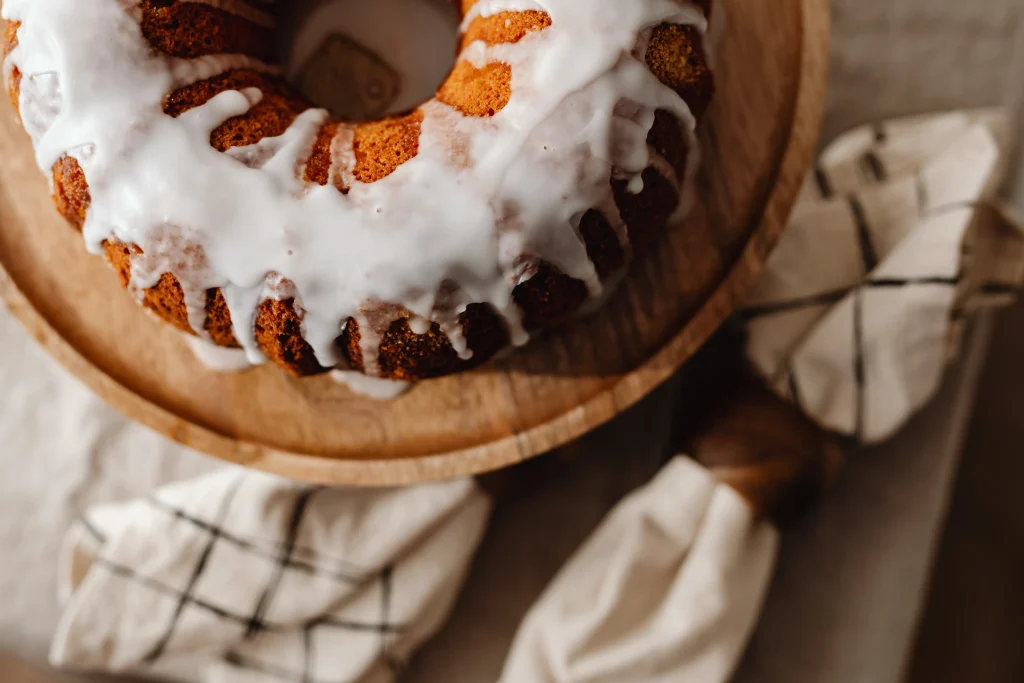
Christmas traditions around the world are full of small, cheap and surprisingly beautiful ideas, from a dish of wheat on the windowsill to a book in bed on Christmas Eve.
In this post I show you 18 of them, and every one is simple enough to start this December.
Disclosure: This post contains affiliate links. If you make a purchase through these links, I may earn a small commission at no extra cost to you. Thank you for supporting my blog!
Why do so many family christmas traditions end up feeling like a chore? Usually because they’re about doing more. More baking, more parties, more presents, more photos for other people.
The truth is, I used to collect traditions like ornaments. Every year I added something new I saw online, and I never took anything away.
One December we had a gingerbread house, an elf on the shelf, 2 Advent calendars and a Christmas movie list with 24 titles. By the 15th, my son was sick of all of them. So was I.
What stayed with us? The quiet ones. The wheat my grandmother sowed on December 13, and the moment on Christmas Eve when we wait for the little bell.
What Are Christmas Traditions Around the World?
Christmas traditions around the world are the customs, foods, decorations and small rituals that people in different countries repeat every year between early December and early January.
Many of them are tied to a specific date, like St. Nicholas Day on December 6, St. Lucia Day on December 13 or Epiphany on January 6, and most cost little or nothing.
The way I see it, the best ones aren’t the most spectacular. They’re the ones a family can keep for 20 years without getting tired of them.
So if you only have a minute, here’s the one thing to remember.
Choose only one new tradition this year, and tie it to a date. A tradition with a fixed day, like December 13 or Christmas Eve, has a much better chance of coming back next year than a nice idea with no day attached.
18 Christmas Traditions Around the World to Start This December
1. Light one more candle every Advent Sunday, like in Germany
What you need:
- a simple wreath or a tray,
- 4 candles,
- a few sprigs of greenery.
The Advent wreath comes from Germany. In 1839, a Hamburg teacher named Johann Hinrich Wichern put 24 candles on an old cartwheel, so the children in his home could count the days until Christmas.
Today most homes use 4 candles, one for each Sunday of Advent.
It’s the slowest countdown I know, and that’s exactly why I love it. One candle in the first week, then 2, then 3. The table gets a little brighter every Sunday.
We light ours at Sunday dinner. My daughter is in charge of the matches now (with supervision, of course, she’s 6 :).
You don’t need a fancy one. 4 candles on a wooden board with a bit of fir from the garden is enough. If you’d like a ready base, a simple Advent wreath candle holder lasts for decades.
Mark the first Sunday of Advent in your calendar today, and have 4 candles ready by then.
2. Put clean boots in the window on December 6, the Hungarian way
You’ll need:
- a pair of boots, polished the evening before,
- a few tangerines, walnuts and a little chocolate.
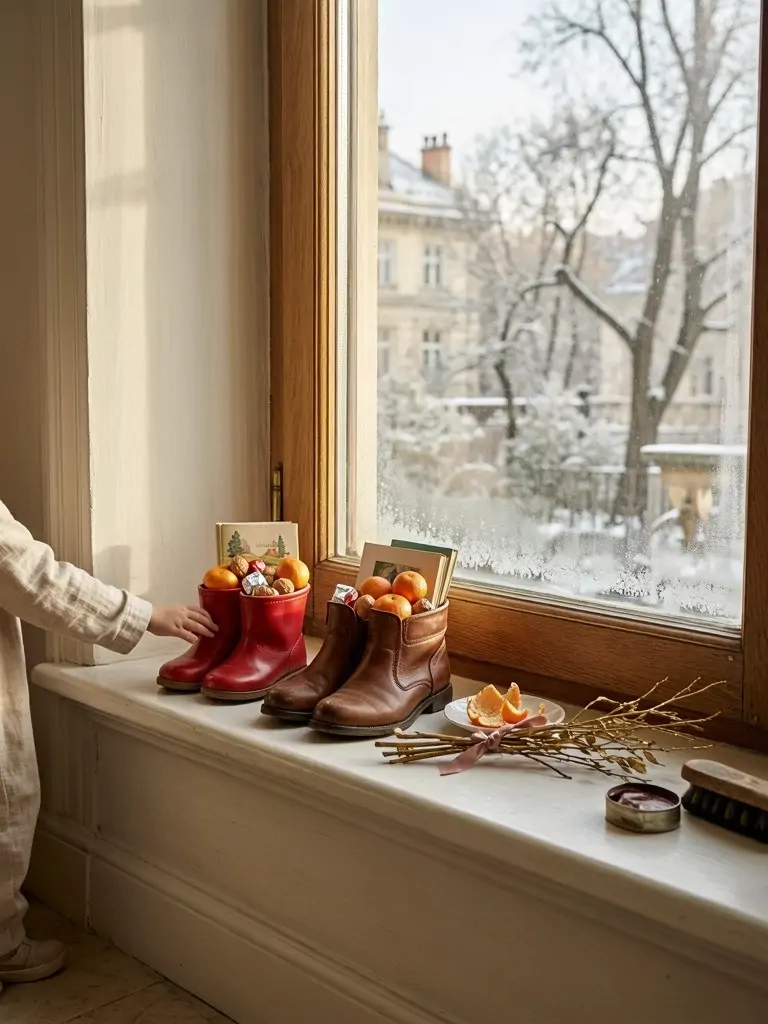
In Hungary, Christmas season really starts with Mikulás (it’s our St. Nicholas, who comes on December 6, separately from Christmas). On the evening of December 5, children clean their boots until they shine and put them in the window.
In the morning the boots are full of tangerines, walnuts, chocolate and sometimes a small book. Next to them there’s often a virgács (a little bundle of twigs, usually painted gold), as a gentle warning to behave.
I still remember polishing my boots with my sister at my grandmother’s kitchen table. We did it so seriously, as if the whole outcome depended on how they shined.
The Netherlands and Germany have the same idea with shoes. It’s one of the easiest christmas traditions to start with kids, because it’s small, it’s early, and it doesn’t compete with Christmas Eve.
Keep the filling small: one tangerine, a handful of nuts and one sweet is more than enough.
3. Write a funny poem with every gift, like the Dutch do
You’ll need:
- paper and a pen,
- a sense of humor,
- about 10 minutes per poem.
In the Netherlands, the big gift evening isn’t Christmas but December 5, called pakjesavond (it means present evening). And the presents often come with a poem.
The poems are signed by Sinterklaas, not by the real giver. They gently tease the person who gets the gift, about their messy desk, their love of coffee or the fact that they’re always late.
The poem is read out loud before the present is opened, and that’s half the fun.
I love this one for adults. It turns a small, cheap gift into something everyone laughs about. And it works for new christmas traditions with adult children too, who often don’t need more things anyway.
The poems don’t have to be good. Ours are terrible, and that’s the point.
Choose one person this year and write them 4 short rhyming lines instead of a card.
4. Sow Luca wheat on December 13 and watch it grow until Christmas
You’ll need:
- a shallow dish or a small pot,
- a handful of wheat berries,
- a little water and a ribbon.
This is my favorite on the whole list. In Hungary, December 13 is Luca nap (St. Lucy’s Day), and people sow wheat in a small dish. Neighboring countries like Croatia have the same custom.
You soak the grains overnight, spread them in a dish on a wet paper towel or a bit of soil, and keep them moist. By Christmas Eve you have a little green meadow on your table.
Old people said a thick, green wheat meant a good harvest and a good year. My grandmother put a red, white and green ribbon around hers and a candle in the middle.
We do it every year, and the kids check it every morning. If you can’t find grains in a local shop, wheat berries for sprouting are cheap and a bag lasts for years.
Set an alarm for December 13 now, so you don’t remember it on the 20th.
5. Bake saffron buns for St. Lucia morning, the Swedish way
You’ll need:
- a basic sweet yeast dough,
- a pinch of saffron,
- raisins.
On the same day, December 13, Sweden celebrates St. Lucia. Early in the morning, a girl in a long white dress with a red sash and a crown of candles walks in, singing, with coffee and lussekatter (golden saffron buns shaped like an S, with a raisin in each curl).
Schools and towns have whole processions, and many families do a small version at home.
It’s one of the most beautiful christmas traditions around the world, and the whole thing is about light in the darkest time of the year. In Sweden it’s dark by about 3 pm in December, so you can feel why it matters.
You don’t need a candle crown (please don’t, with kids). Breakfast in bed with warm buns and battery candles is plenty.
Real saffron threads are expensive, but one small jar is enough for several batches.
Bake the dough the evening before and keep it in the fridge, so the morning stays slow.
Related post: If you love the idea of a slower December built on small daily habits, I wrote about it in Slow Living, European Style: 10 Habits.
6. Give a book on Christmas Eve and read in bed, like in Iceland
You’ll need:
- one book per person,
- warm socks,
- something sweet to nibble.

In Iceland, books are the classic Christmas present, and people open them on Christmas Eve, then spend the night reading. They even have a word for it: Jólabókaflóð (it means the Christmas book flood). You can read more about it on the Iceland page of WhyChristmas.
The custom started during the Second World War, when many imports were limited but paper wasn’t, so books became the gift.
This is the one I’d recommend to every tired mom reading this. No screen, no cooking, no visitors. Just a new book and permission to do nothing else.
This year we’re trying it with the kids too. My son already said he’d rather have his phone. We’ll see 🙂
A small clip-on book light is a nice addition if someone in your family reads late.
Buy or borrow one book for each person in your home, and hide them until December 24.
7. Set an extra plate for an unexpected guest, the Polish way
You’ll need:
- one extra plate, glass and chair,
- a little openness.
In Poland, Christmas Eve dinner is called Wigilia. Families wait until the first star appears in the sky before they eat, then share a thin wafer called opłatek, breaking off a piece from each other while saying a wish.
And there’s always an empty place at the table, for an unexpected guest, a stranger or someone who couldn’t be there.
I think it’s the most generous tradition on this list. It says the door is open, even on the most private evening of the year.
Some families use the extra place to remember someone they’ve lost. Others really do invite a lonely neighbor. Both are beautiful.
You can keep it very simple. The extra plate costs nothing, and it changes how the whole table feels.
Think of one person you know who might spend Christmas Eve alone, and ask them this week.
8. Cut an apple in half after dinner, like they do in Czechia
You’ll need:
- one apple per person,
- a sharp knife,
- walnut shells and tiny candles, if you want the second part.
After Christmas Eve dinner in the Czech Republic, everyone cuts an apple in half, across the middle, not from top to bottom. If the core shows a nice star, it means good health and a good year. The Czech page of WhyChristmas lists a few more of these little fortune games.
Every apple has a star inside if you cut it this way, which is the nicest secret on this list. Unless the apple is wormy, of course.
There’s a second custom too. People put tiny candles in empty walnut shells and float them in a bowl of water. If your little boat sails, the year will be good.
We did this after dinner last year, and the kids talked about their walnut boats for days. My husband’s sank immediately. He’s still not over it.
Mini tea light candles are small enough to fit into half a walnut shell.
Save a few walnut shells when you crack nuts for the Christmas baking.
9. Hold hands and walk around the tree, Danish style
You’ll need:
- your tree,
- everyone in the room,
- 2 or 3 carols you all know.
In Denmark, after Christmas Eve dinner, the lights on the tree are lit and the family holds hands, walks around the tree and sings carols together. Yes, around the tree, so it has to stand in the middle of the room for this one.
It sounds a bit strange until you try it. Then it’s hard to stop smiling.
It’s the most hygge christmas moment I can imagine, and nobody needs to be a good singer. The teenagers roll their eyes, then sing anyway.
The Danes also hide one whole almond in their rice pudding, called risalamande, and whoever finds it gets a small present. If you want to add that, a marzipan pig is the traditional prize.
If your tree stands in a corner, move it out for one evening. It’s worth it.
10. Put a candle in the window on Christmas Eve, as in Ireland
You’ll need:
- one tall candle, or a safe battery candle,
- a window that faces the street.
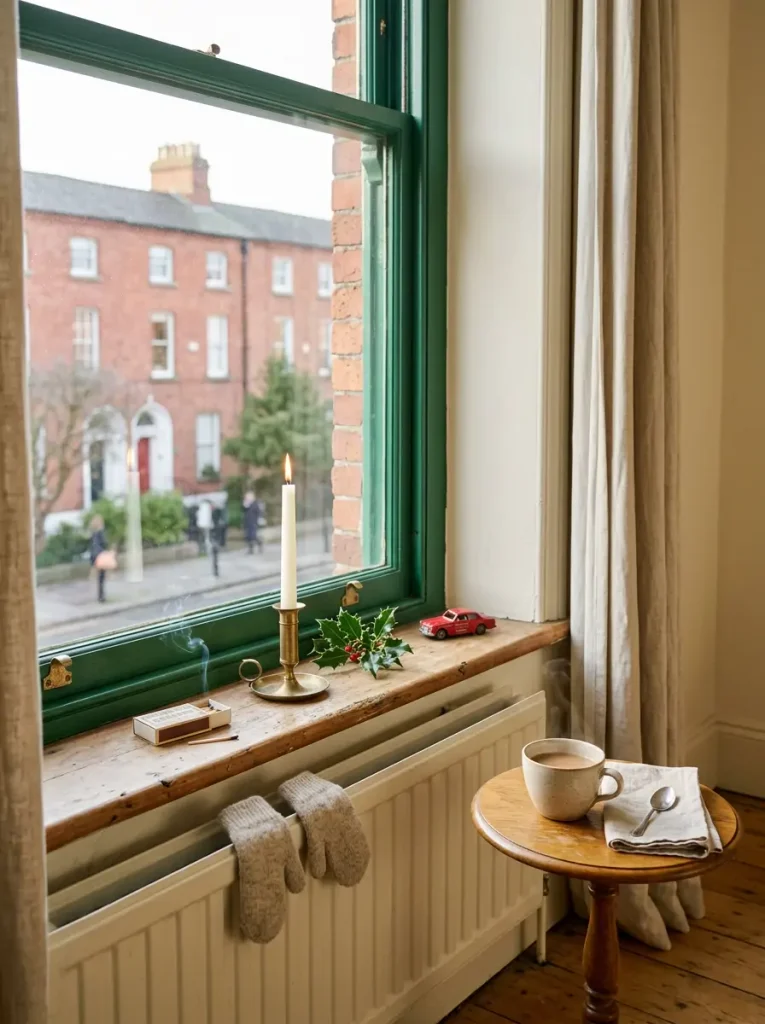
In Ireland there’s an old custom of placing a tall candle in the front window on Christmas Eve. It was a welcoming light for Mary and Joseph, and for any traveler looking for shelter that night. Traditionally the youngest child in the house lights it.
Not many homes still use a real candle all night, and I understand why.
But a single light in the window says something that a whole house full of decorations doesn’t: you’re welcome here.
I like that it faces outward. Most of our decorating is for us, this one is for the people walking past in the dark.
LED window candles with a timer are the safe version, and they switch themselves off at night.
Choose one window this week and let the youngest person in your home decide which one.
11. Hang a spider web ornament, the Ukrainian way
You’ll need:
- thin silver wire or white paper,
- a few beads,
- one small spider, if you’re brave.
In parts of western Ukraine, Christmas trees are decorated with little spider webs. They’re made of paper and silver wire and called pavuchky (it means little spiders). The Ukraine page of WhyChristmas tells the story behind them.
The legend is about a poor widow who couldn’t afford decorations for her children’s tree. During the night, spiders covered it with webs, and in the morning sunlight the webs shone like silver.
I love a tradition that turns the least wanted guest in the house into the luckiest one.
My daughter was not convinced at first. Then she heard the story and now she wants 3 of them.
You can make one from wire and beads in 15 minutes, or look for a handmade Ukrainian spider web ornament.
Tell the spider story to your kids this December, then hide one small web on the tree for them to find.
12. Build the nativity scene slowly, like in Italy
You’ll need:
- a simple nativity set, wooden or clay,
- a shelf or a windowsill,
- patience until December 24.
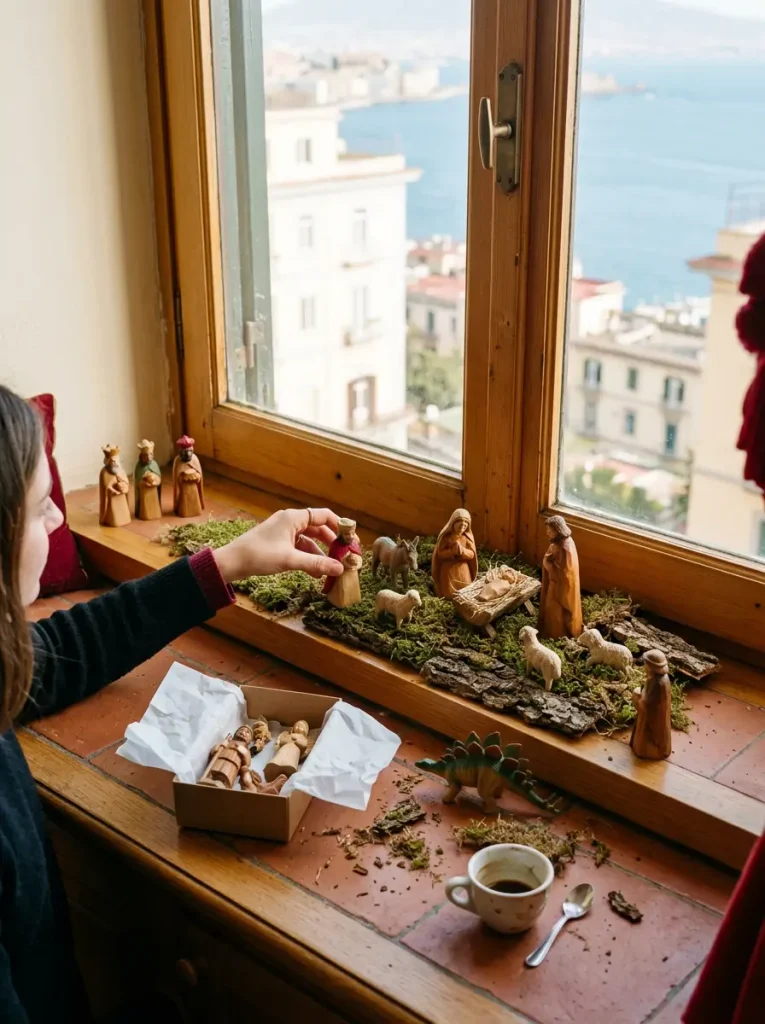
In Italy, the presepe (the nativity scene) is often more important than the tree. Naples has a whole street, Via San Gregorio Armeno, full of workshops making nativity figures all year round.
St. Francis of Assisi set up the first living nativity in the small town of Greccio in 1223, and Italians have been building them ever since.
The part I love is that the baby Jesus is only put into the manger at midnight on Christmas Eve. The empty manger waits for weeks, and the kids keep asking when.
Some families move the 3 kings a little closer every day, and they only arrive on January 6.
A small wooden nativity set is one of those things you buy once and use for 30 years.
Set up the scene on the first Sunday of Advent, and keep the baby and the kings hidden for now.
13. Walk with lanterns for 9 nights, the Mexican way
You’ll need:
- paper lanterns or jars with candles,
- a few neighbors or friends,
- something warm to drink.
In Mexico, Las Posadas are celebrated on the 9 nights from December 16 to 24. Every evening, a small procession walks with candles to a different house, singing and asking for shelter, like Mary and Joseph did in Bethlehem. The last house lets them in, and there’s food, warm punch and a piñata for the kids.
It’s a neighborhood tradition first, and that’s what makes it special.
You don’t have to do 9 nights. One evening walk with lanterns around the block, ending with hot chocolate at your house, already has the feeling.
We did a small version with 2 other families from our street. 6 kids, 3 jars with candles, and an awful lot of giggling. They want to do it again this year.
Write to 2 families you like this week and suggest one evening walk before Christmas.
A review of 50 years of research on family routines and rituals found that regular family rituals are linked to stronger family relationships, and to a clearer sense of identity in teenagers. You can read the review by Barbara Fiese and her colleagues on PubMed. The size of the ritual mattered less than the fact that it was repeated.
14. Hang a star lantern in the window, the Filipino way
You’ll need:
- bamboo sticks or thin wooden dowels,
- colored paper or tissue paper,
- a small battery light.
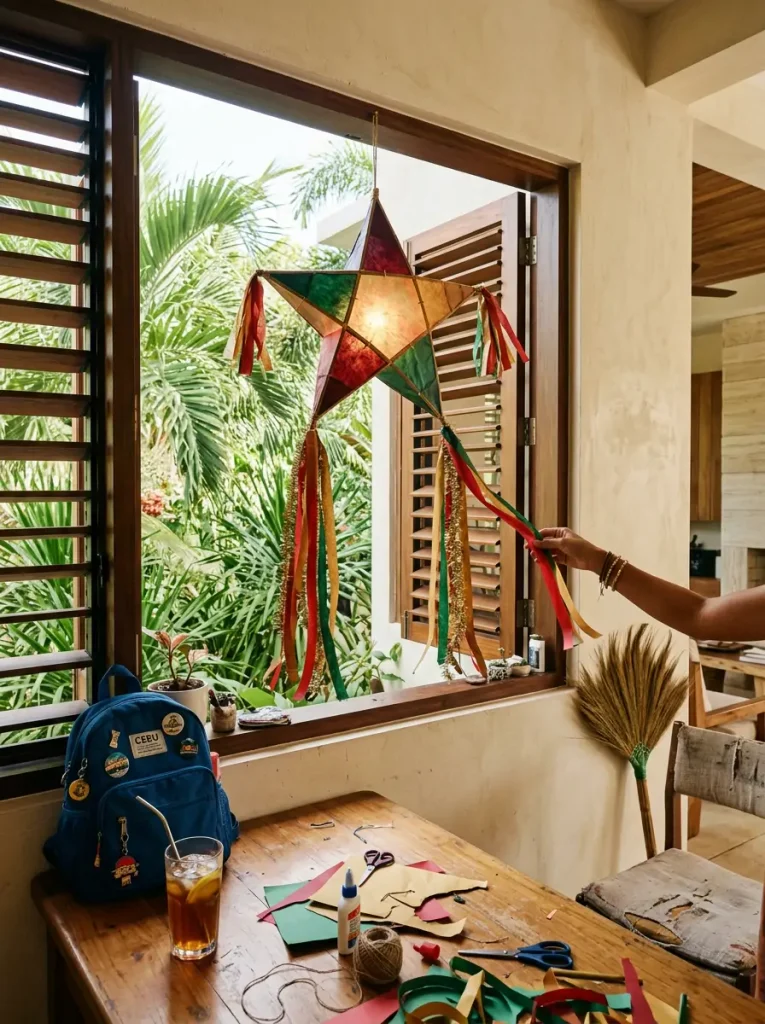
In the Philippines, the Christmas season starts very early, often in September, and the symbol of it is the parol. It’s a star-shaped lantern, traditionally made from bamboo strips and colored paper, and it stands for the star that guided the 3 kings.
In San Fernando, Pampanga, there’s a whole Giant Lantern Festival with parols several meters wide, lit up in changing patterns.
At home, one simple paper star in the window is enough to bring the feeling in. With a warm light behind it, it glows like stained glass.
We made one from kraft paper a few years ago, and it’s still our window star. A ready paper star lantern works too, if crafting isn’t your thing.
Hang your star in the window on the evening you light the first Advent candle, so the 2 start together.
15. Light a candle for those who are gone, as Finns do
You’ll need:
- a grave candle or a lantern,
- a warm coat,
- a quiet hour on Christmas Eve.
In Finland, families go to the cemetery on Christmas Eve, often in the afternoon, to light candles on the graves of their loved ones. Whole cemeteries glow in the snow. Some are so big that the police help with the traffic.
It sounds sad, but the people who do it describe it as one of the most peaceful moments of the whole Christmas.
In Hungary we usually visit the graves on All Saints’ Day in November, not at Christmas. But I’ve started taking a small candle to my grandparents’ grave in December too. It makes the evening feel complete.
If the grave is far away, a candle at home next to an old photo works just as well.
Choose one photo of someone you miss and give it a place near the tree this year.
Related: If December tends to feel heavy and dark for you, my post on Slow Living in Fall and Winter has gentle habits for exactly these weeks.
16. Take a long walk on December 26, the British way
You’ll need:
- good boots,
- a thermos of tea,
- nothing planned for the morning.
In the UK, December 26 is Boxing Day, and in Ireland it’s St. Stephen’s Day. The name Boxing Day probably comes from the boxes of money and gifts given to servants and workers after Christmas. Today, for many families, it simply means a long walk after 2 days of eating.
In Hungary, December 26 is also a holiday, the second day of Christmas, so it fits well here too.
After all the cooking and visiting, a walk in the cold air feels like opening a window in your head.
We go to the forest near our house, and the rule is simple: no phones out, except for one photo.
A good insulated thermos flask is the only gear you need, plus leftover bejgli (a Hungarian rolled pastry with poppy seed or walnut filling) in a paper bag.
Decide on your Boxing Day walking route now, and tell the family it’s already planned.
17. Keep Christmas going until January 6, like Italy and Spain
You’ll need:
- a stocking or a pair of shoes,
- a few small sweets,
- a little bit of coal candy, if you’re feeling cheeky.
In Italy, on the night before January 6, an old woman called La Befana flies on her broom and fills children’s stockings with sweets. Naughty children get carbone dolce (black sugar candy that looks like coal). In Spain, the 3 kings bring the presents on the same night.
I love that Christmas doesn’t end on December 26 in these countries. The tree stays up, the lights stay on, and there’s one more small celebration when the rest of the world is already back to work.
In Hungary too, many families take the tree down only around January 6, on Vízkereszt (Epiphany).
A small surprise on January 6 makes taking the decorations down feel less sad. For kids, it’s the best part.
Keep one small gift back from Christmas and give it on the evening of January 5.
18. Wait for the little bell on Christmas Eve, the way we do in Hungary
You’ll need:
- a small bell,
- a door you can close,
- someone to keep the kids busy in another room.
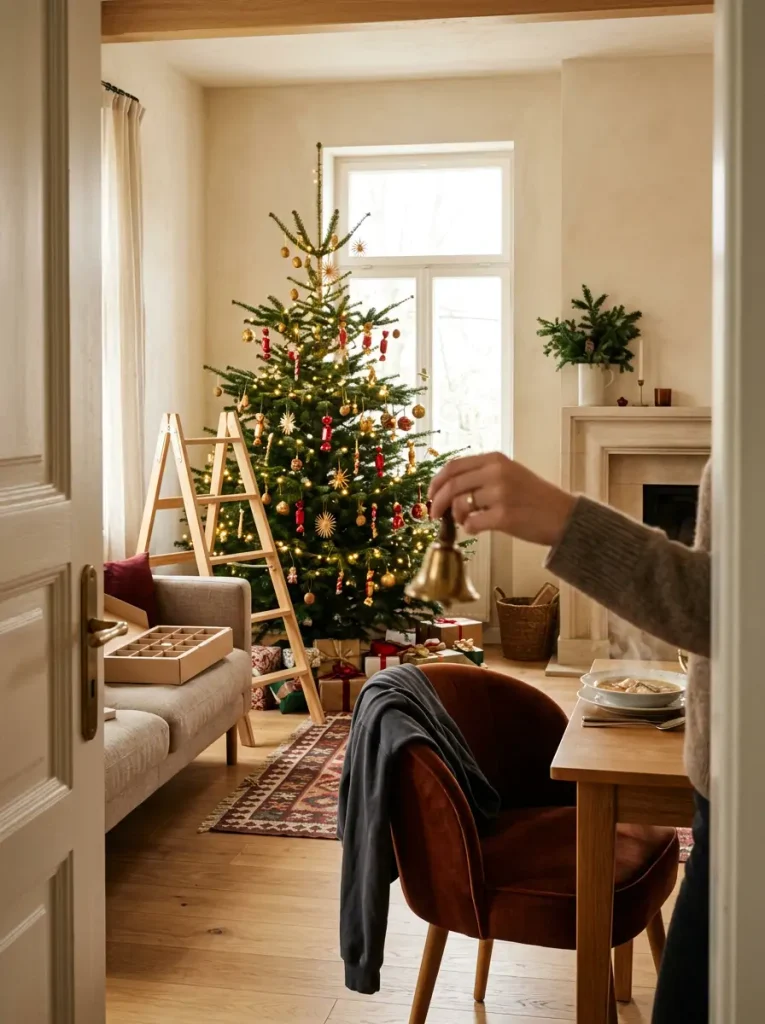
I saved the most personal one for last. In Hungary, the presents aren’t brought by Santa but by Jézuska (the Little Jesus) or the angels, on the evening of December 24. In many families the children don’t see the decorated tree until that evening.
While the kids wait in another room, the adults decorate the tree and put the presents under it. Then a small bell rings, the door opens, and the tree is just there, lit up.
Even in my late 40s, I still feel that bell in my stomach.
Dinner is often fish soup called halászlé, and the tree is hung with szaloncukor (it’s a traditional Hungarian Christmas sweet wrapped in shiny paper). In our house, my teenage son now helps decorate in secret for his little sister, which is my favorite part of the whole evening.
You don’t have to hide the whole tree. Just close the door for 10 minutes, light the candles and ring a bell.
Find a small bell in a drawer or a market this week, and keep it only for Christmas Eve.
My Honest Opinion: We Don’t Need 18 New Traditions
I know, I just gave you 18. But please don’t start all of them this year.
Every tradition was new once. The Advent wreath is from 1839. In Japan, eating KFC on Christmas Eve started with an advertising campaign in 1974, and now millions of families order their bucket weeks ahead. Traditions are made by people, and they’re kept by people who aren’t exhausted.
A tradition only works if you still want to do it in year 5.
I learned this the hard way. That December with 2 Advent calendars and 24 movies, nobody remembered any of it by January.
What we did remember was the wheat. 10 minutes on December 13, a little water every morning, and a green dish on the table on Christmas Eve.
There’s real research behind this feeling. Tim Kasser and Kennon Sheldon asked people about their Christmas and found that those who focused on family and meaningful experiences had a happier holiday, while spending and receiving a lot of gifts didn’t make it merrier.
Another study from Harvard and the University of Minnesota showed that even a tiny ritual before eating made people enjoy the food more and pay more attention to it. Cutting an apple across the middle, waiting for the first star, ringing a little bell. That’s the same thing on a family scale.
So my rule is simple: one new tradition a year, and only if it fits into our real December.
Here in Hungary, December is the busiest month for most working people. The end-of-year rush at work, school concerts, the shopping. A tradition that needs 3 free evenings simply won’t survive here.
That’s why I picked the small ones for this list. Most of them take 10 minutes and one thing you already have at home.
Related: If you’d like to want less in general, not only at Christmas, I wrote about it in How to Stop Wanting New Things.
Tonight, ask everyone at dinner one question: which Christmas moment do you want to keep forever? Write the answers down. The tradition you’re looking for is probably already in that list.
How to Make a New Tradition Actually Stick
This is the practical part. Here’s how to pick, combine and keep the christmas traditions to start with family, so they don’t fade after one year.
Which tradition fits your family
With small kids:
- Mikulás boots in the window,
- Luca wheat on the windowsill,
- the walnut shell boats,
- the hidden spider on the tree.
With teenagers:
- the Icelandic book night,
- the Dutch gift poems,
- the Boxing Day walk without phones.
For couples and adults:
- the Advent wreath at Sunday dinner,
- the candle in the window,
- a candle for someone you miss.
For the whole neighborhood:
- the lantern walk,
- the extra plate at the table.
Traditions that go well together
Light and darkness: the Advent wreath, the star lantern and the candle in the window. All 3 start small and get brighter as Christmas comes closer.
Growing things: Luca wheat and the slow nativity scene. Both are about waiting, and kids can watch the change every day.
Christmas Eve at the table: the extra plate, the apple star and the walnut boats. They fit into one dinner without any extra time.
The quiet days after: the Boxing Day walk and the Befana surprise on January 6. They make the end of the holiday feel gentle instead of empty.
Mistakes to avoid
| Starting 5 new traditions in one year | Start one, and add another next year if it stuck |
| Choosing a tradition that needs a free evening in mid-December | Choose one that takes 10 minutes or happens on a holiday |
| Buying a lot of special things for it | Use what you have, buy only one thing that will last |
| Making it look perfect in photos | Let the kids do it their way, crooked wheat included |
| Forgetting it until December 20 | Put the date in your calendar now, with a reminder |
| Forcing teenagers to join | Give them a job, like ringing the bell or writing a poem |

A simple December calendar for traditions around the world
December 5 and 6: Dutch gift poems and Hungarian Mikulás boots.
First Sunday of Advent: the first candle on the wreath, the star lantern goes into the window and the nativity scene goes up.
December 13: Luca wheat in Hungary and Lucia buns in Sweden.
December 16 to 24: the Mexican lantern walks.
December 24: the candle in the window, the extra plate, the apple star, the walk around the tree, the candle for loved ones, the bell and the book night.
December 26: the Boxing Day walk.
January 5 and 6: La Befana, the 3 kings arrive in the nativity scene, and the tree comes down.
Christmas Eve is clearly the busiest day of them all. If you want to start something new, the quieter dates in early December give a tradition more room to grow.
What to have ready before December
From your kitchen: apples, walnuts, tangerines, a little flour and yeast, and a handful of wheat grains.
From your drawers: candles, a small bell, ribbon, paper and a pen for the poems.
Worth buying once: an Advent wreath base, a simple nativity set, a star lantern and LED window candles. Each of them will last for many years.
Skip: themed plastic decorations for each new tradition. The custom matters, not the props.
3 small things to do this week
- Choose your one new tradition and write its date in your calendar,
- buy or find the one thing it needs,
- tell the family about it at dinner, so it already feels real.
Recommended: If you want your home to feel calm all through the holidays, have a look at my minimalist habits for a calm home.
Your Christmas Traditions Checklist
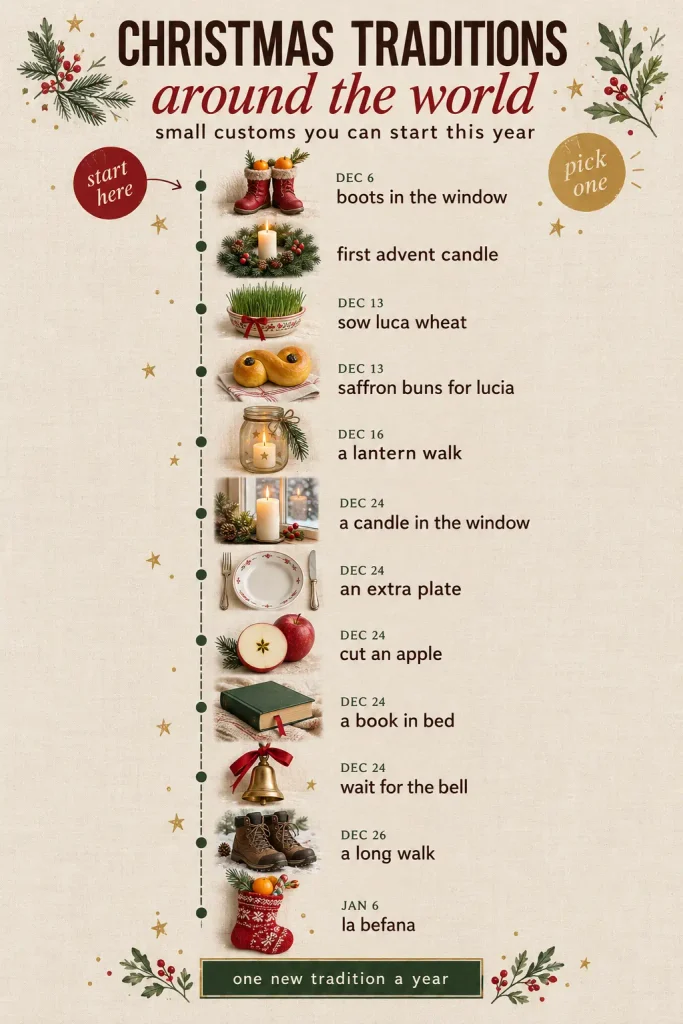
Save this pin for later on your Pinterest board!
Christmas Traditions Around the World: Questions Readers Ask
What are some easy christmas traditions around the world to start with kids?
Easy christmas traditions around the world to start with kids include Hungarian Mikulás boots on December 6, Luca wheat sown on December 13, Czech apple cutting and walnut shell boats on Christmas Eve, and the Ukrainian spider web ornament. They take only a few minutes, cost very little and give children something to look forward to.
Which christmas traditions from other countries work best for adults?
The christmas traditions from other countries that work best for adults are the Icelandic book night on Christmas Eve, Dutch gift poems, the Swedish Lucia breakfast and the Irish candle in the window. They’re calm, they don’t need small children to make sense, and they work well for couples, friends and adult children who don’t need more presents.
How do I start a new family christmas tradition that actually lasts?
A new family christmas tradition lasts when it’s small, tied to a fixed date and easy to repeat without extra shopping. Start only one per year, write the date in your calendar and give everyone a small role in it. If you still enjoy it in the second and third year, it has become yours.
What is the Icelandic Christmas book flood?
The Icelandic Christmas book flood, called Jólabókaflóð, is the custom of giving books as presents on Christmas Eve and spending the night reading them. It started during the Second World War, when many imports were limited but paper was not. Today most new books in Iceland come out in the months before Christmas.
Why do Polish families leave an empty seat at Christmas Eve dinner?
Polish families leave an empty seat at Christmas Eve dinner, called Wigilia, for an unexpected guest or a traveler who might knock on the door. For some families the place also remembers loved ones who have died. The custom is a sign of hospitality, and it’s easy to borrow at any table.
What are some family christmas traditions instead of gifts?
Family christmas traditions instead of gifts include a lantern walk with neighbors, a Boxing Day walk, a book night, an Advent candle dinner every Sunday and writing funny poems for each other. They create shared memories instead of more things. Many families keep one small present per person and put the rest of the energy into one of these customs.
When should I sow Luca wheat so it’s green by Christmas?
Luca wheat should be sown on December 13, St. Lucy’s Day, so it’s about 10 to 15 centimeters tall and bright green by Christmas Eve. Soak the grains overnight first, spread them on wet paper towels or a little soil, and keep them moist in a light, not too warm place.
Are European christmas traditions very different from American ones?
European christmas traditions are often spread over a longer period than American ones, from St. Nicholas Day on December 6 to Epiphany on January 6. In many countries the main celebration and the presents come on Christmas Eve, not on Christmas morning, and the gift bringer can be St. Nicholas, the Christ Child, the 3 kings or La Befana.
How many christmas traditions should a family have?
A family usually needs only 3 to 5 christmas traditions that everyone really looks forward to. More than that often turns December into a schedule to manage. It’s better to keep a few small ones every year than to try 10 new ideas once and drop them all by January.
Recommended Reading
Christmas Tree Ideas 2026: 20 Beautiful Trees You Can Reuse for Years
20 DIY Christmas Ornaments You’ll Still Love in 10 Years
What a Minimalist Birthday Party Really Teaches Kids About Enough
The Green Dish on Our Windowsill
Every year on December 13, I sit at the kitchen table with a bowl of wheat grains, exactly like my grandmother did in her village by the Tisza.
It’s not a big moment. 10 minutes, a dish, some water. Nobody takes photos.
But for 11 days, everyone who walks past the window checks how much it has grown. And on Christmas Eve, it’s on the table next to the candles, green and a little messy.
For me, that’s what makes a tradition truly precious: it’s small enough to keep, and it connects us to the people who did it before us.
Somewhere in the world tonight, people are lighting candles, cutting apples and waiting for the first star. You only need to borrow one of these to feel part of it.
Which Christmas moment from your childhood do you still remember clearly? For me it’s not a present. It’s the sound of a small bell on Christmas Eve, and my sister and I running into the room where the tree suddenly appeared.
You Might Also Like
-
Sweater Outfits: 11 Fresh Ways to Wear One Burgundy Sweater All Winter
In this post I’ll show you how to wear one burgundy sweater 11 different ways, from a Monday at the office to Christmas Eve dinner. You’ll also find color pairs, the mistakes that make a knit look tired, and simple care tips that keep it soft for years.
-
Christmas Savings Challenge: A Printable Tracker for Weekly and Biweekly Paydays
This christmas savings challenge turns the cost of December into small, planned amounts you set aside from now until the holidays. You’ll find 8 simple challenges with the real math for weekly and biweekly paydays, plus a free printable tracker to color in.
-
Christmas Mantle Ideas: 13 Calm Looks With Zero Clutter
These christmas mantle ideas help you build an elegant fireplace display that looks calm instead of crowded. You’ll find 13 looks, from a lush garland with burgundy velvet to a mantel with a TV above it, plus color pairs and the mistakes worth skipping.