10 Questions to Ask Before Buying Clothes You’ll Actually Wear
What are the right questions to ask before buying clothes when the closet is full and there’s still nothing to wear?
It’s one of the most common closet problems, and it rarely starts in the closet. It starts in the shop.
Most of us love new clothes. That small happy feeling at the checkout is real, and it’s hard to say no to it in October, when every shop window turns camel and cream.
And then the bag comes home. Some pieces become favorites. Others hang there for months, a little stiff, waiting for a day that never comes.
The real problem isn’t the money we spend. It’s the clothes we buy and never wear.
Will this go with anything I own? Is it a good price, or just a low one? And why does everything look so different in the bedroom mirror?
It’s a puzzle we face every season, too.
If you’re looking for questions to ask before buying clothes that actually change what you bring home, the trick is to test each piece against your real week and your real washing machine, before you test it against the mirror.
In this post I show you the 10 questions to use in the shop and at the checkout, each with a small test that takes less than a minute.
Disclosure: This post contains affiliate links. If you make a purchase through these links, I may earn a small commission at no extra cost to you. Thank you for supporting my blog!
What Is Mindful Clothes Shopping?
Mindful clothes shopping means stopping before the checkout to test a piece against your real life, meaning the clothes you already own and the week you actually live.
In practice, it’s a short list of questions you ask every time, in the shop or with an online cart open, plus a habit of waiting a little before you pay.
The way I see it, the goal is simple: a closet where almost everything gets worn.
Why do we keep buying clothes we don’t wear? I think we shop for the woman in the mirror, and then we get dressed as the woman with a school run at 7:40 and a meeting at 9.
Most of us have a piece like that in the closet. A silky blouse for dinners that never happen. White trousers for a summer that turns out to be mostly playgrounds and sticky little hands.
Each one is a nice piece. None of them fits the life we actually live.
The clothes don’t fail. Our questions do. We ask ourselves whether we like it, and we stop there.
10 Questions to Ask Before Buying Clothes, in 3 Moments
These questions are sorted by the moment you need them. Some belong at home, before you even leave. Some belong in the fitting room or the online cart, and the last ones are for the checkout, when the card is already in your hand.
You don’t need all 10 every time. The first 3 catch most mistakes.
Part 1: Before You Leave the House
The best shopping decisions happen at home, in front of your own closet, where nobody is playing nice music and nobody is telling you it’s the last one in your size.
Open your closet and find the pieces you haven’t worn since last fall. How many of them were bought on sale, or still have the tag on? For most of us, those 2 piles are almost the same pile. That pile is exactly what these questions are for.
1. What will I wear it with this week?
Try this:
- name 3 pieces you already own,
- picture one real day this week,
- if you’re shopping online, open your closet photos next to the product page.
This is the most important of all the questions to ask before buying clothes, and it’s also the simplest. Before you buy a new top, name 3 things you already own that it goes with.
Not things you’d still have to buy. Things that are in your closet right now.
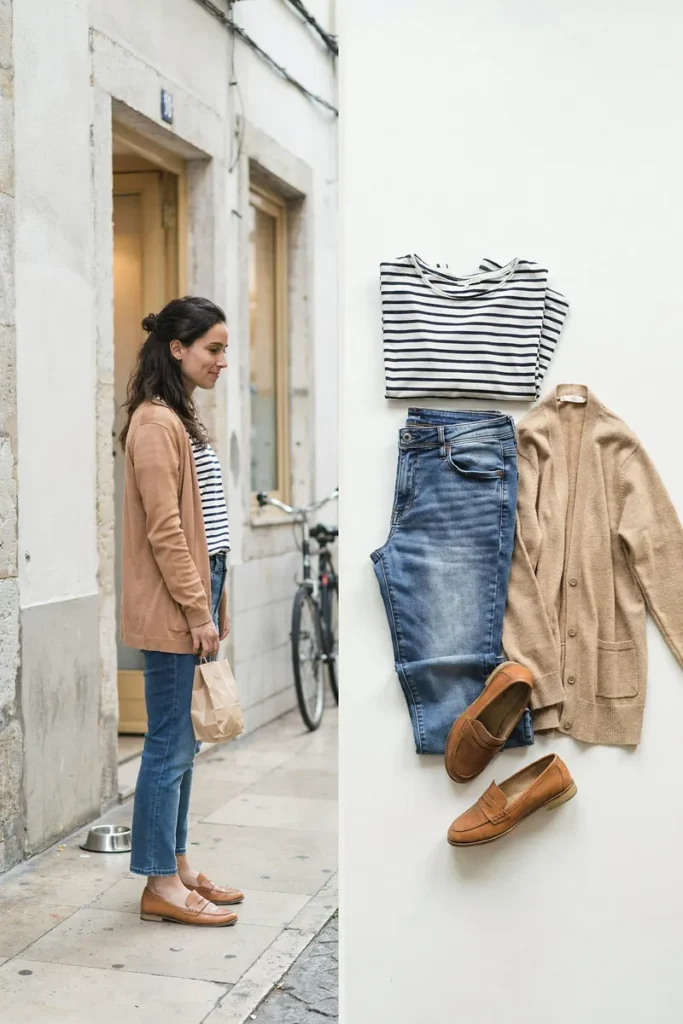
A piece that needs a new partner isn’t one purchase. It’s 2 or 3.
Stylists call these pieces orphans. A rust colored skirt with no top that goes with it. A pair of loafers in a brown that fights every other brown you own.
Then picture an actual day. Tuesday, for example. Rain at 8, a meeting at 10, pickup at 4.
Would you reach for this piece on that Tuesday? If the honest answer is only on a good day, it’ll mostly stay on the hanger.
If you’d like a closet where most pieces work together, my guide to a simple capsule wardrobe for every season shows how a small, connected wardrobe works all year.
Next time you shop, say the 3 pieces out loud before you walk into the fitting room.
2. Do I already own something that does the same job?
Try this:
- take one photo of each shelf and rail in your closet,
- check the photos before you buy anything in the same category,
- count how many of that thing you actually wear in a normal week.
Most of us don’t buy new things. We buy the same thing again, in a slightly different shade.
The 4th black cardigan. The 3rd pair of straight jeans. Another white shirt, because the other 2 are somewhere in the laundry.
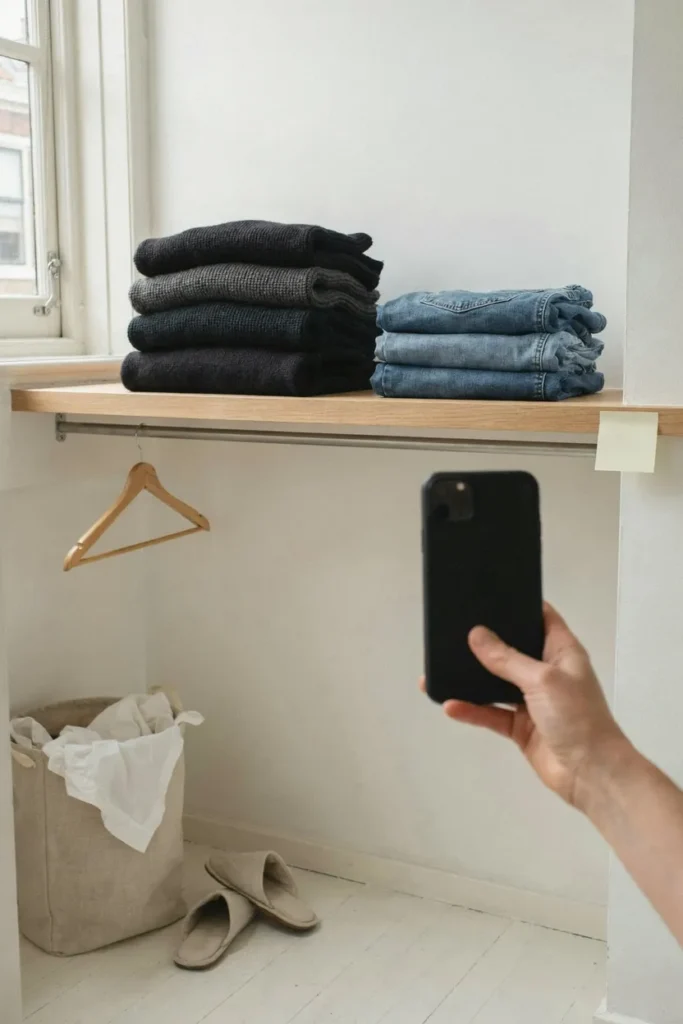
Duplicates feel safe in the shop, and they’re the first things to sit unworn at home.
Some duplicates are smart. If you wear a black T-shirt 4 days a week, a second one makes sense. The question is whether you’d really rotate them, or whether one would always win.
A small photo album on your phone, called closet, takes about 10 minutes to set up. It’s the easiest way to stop buying the same striped top twice.
Make a closet album on your phone this weekend, one photo per shelf.
Related post: If your closet already holds more doubles than you’d like, start with my post on how to declutter your closet this fall before back to school. It makes this question much easier to answer.
3. Would I buy it at full price?
Try this:
- cover the sale tag with your thumb,
- ask yourself if you’d pay the original price,
- if the answer is no, the discount is the only thing you like.
Sales are tricky. A big red 50 percent sign makes a top feel like a decision we’ve already made.
In Hungary we call a sale leárazás (it simply means marking prices down), and the word alone makes some of us walk faster.
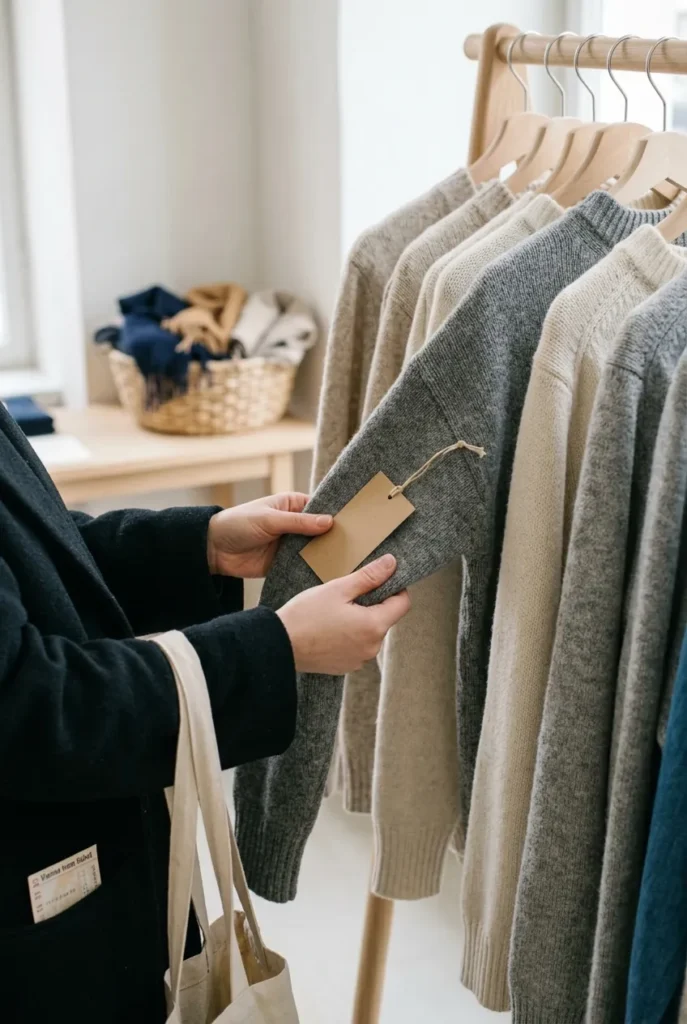
But a $25 top you never wear still costs $25. A $60 top you wear every week costs much less per wear, as you’ll see in question 10.
If it’s only good at the sale price, it isn’t good.
Online, a screenshot works the same way. Look at it again the next day, after the countdown timer has run out. Most of the time the excitement has run out too.
Before your next sale, write down the 1 or 2 things you really need, and only look at those racks.
Part 2: In the Fitting Room or With the Cart Open
This is where most of us decide with our eyes only. These 4 questions bring your body and your laundry basket into the decision.
4. Can I sit down and lift my arms in it?
Try this:
- sit down on the fitting room stool,
- reach up as if you were taking a box off a high shelf,
- bend down as if you were tying a child’s shoe,
- turn around and check the back in the mirror.
Fitting rooms are made for standing still. Real life isn’t.
A blazer can look sharp until you reach for the steering wheel. Trousers can fit beautifully until you sit down at your desk and the waistband starts to pinch.
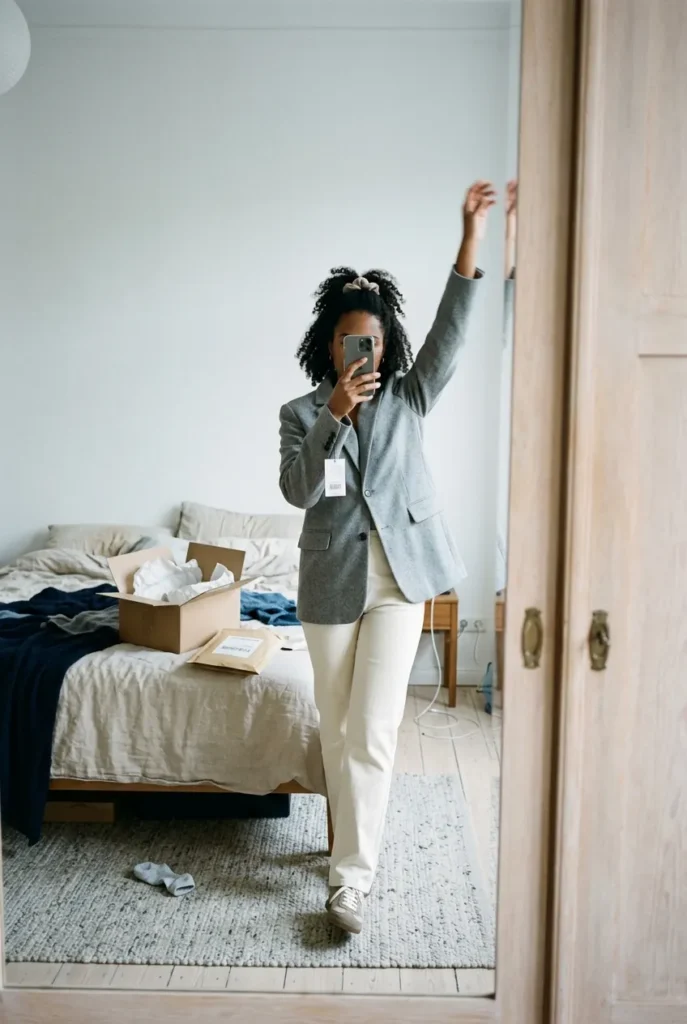
Give every piece 30 seconds of real movement before you decide. It feels a bit silly. Do it anyway.
When you shop online, do the same at home the day the parcel arrives, with the tags still on. Then decide within a few days, while you’re still inside the return window.
A soft measuring tape in your bag helps too. Compare your own measurements with the size chart before you order, instead of guessing between 2 sizes.
Measuring once at home is much easier than sending back a second parcel. If you already have a tape in the sewing drawer, use that one.
Do the 30-second movement test with the next piece you try on, even if it already feels right.
5. How will it look at 5 pm?
Try this:
- crumple a corner of the fabric in your fist for 10 seconds,
- hold it up to the light,
- look at the inside seams and under the arms.
Every piece looks good fresh off the hanger. The real question is how it looks after a full day of sitting and carrying bags.
The crumple test is my favorite. Squeeze a corner of the fabric in your fist for 10 seconds and let go. If it stays creased, it’ll look creased by lunchtime.
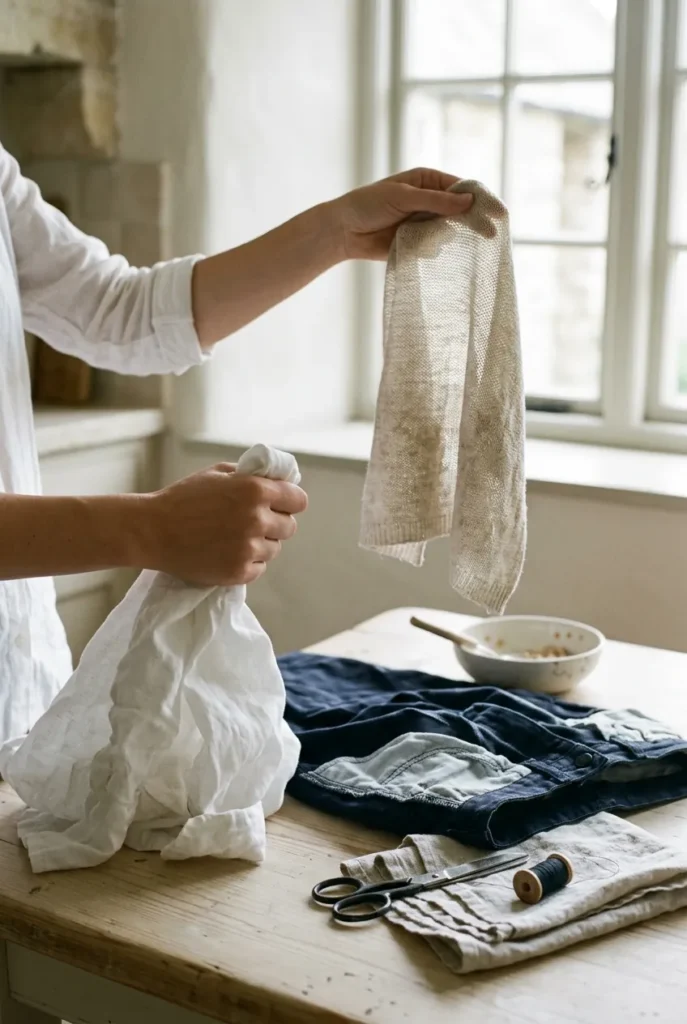
Hold a knit up to the light. If you can clearly see your hand through it, it’ll probably stretch and pill fast.
Look inside too. Seams should be straight and even, with no loose threads hanging. Stripes and checks should meet at the side seams.
There’s a full 2-minute quality check in the practical part below, so you can save it for your next shopping trip.
Try the crumple test on something you already own and love, so you know what a good fabric feels like in your hand.
6. Does it need something new to work?
Try this:
- check what you’d wear under it,
- check which shoes and which bag go with it,
- ask yourself if it needs a tailor.
This is the hidden cost nobody talks about. A dress that needs a special bra. Wide trousers that drag on the floor unless you wear heels. A coat that only looks right with a scarf in a color you don’t own.
Each of those is a second purchase waiting to happen.
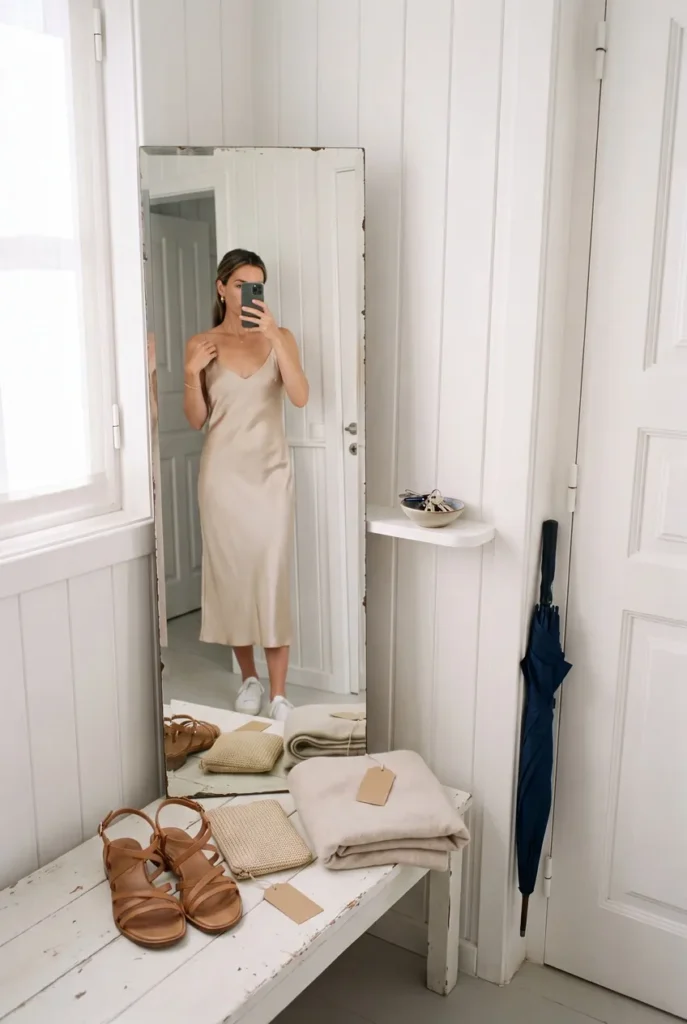
If a piece only works with things you don’t have yet, count them into the price.
Tailoring is the one extra I don’t mind. Taking up a hem or moving a button costs little, and it can turn a good piece into a great one.
Just be honest with yourself about whether you’ll really take it to the tailor. A bag of things waiting for the tailor is still a bag of clothes you don’t wear.
Next time, add up the price of everything the piece needs before you take it to the checkout. See if you still want it.
7. Can I wash it the way I actually wash?
Try this:
- find the care label before you try the piece on,
- look for dry clean only or hand wash,
- be honest about your real laundry routine.
Dry clean only pieces tend to get worn less, and it’s easy to see why. Cleaning them is a whole errand, with a drive and a ticket and a second trip to pick them up.
In the US, the FTC’s Care Labeling Rule requires most clothes to carry a label that tells you how to wash, dry, iron and bleach them, with a warning if a normal method would harm the piece. So the answer is always right there, in the side seam.
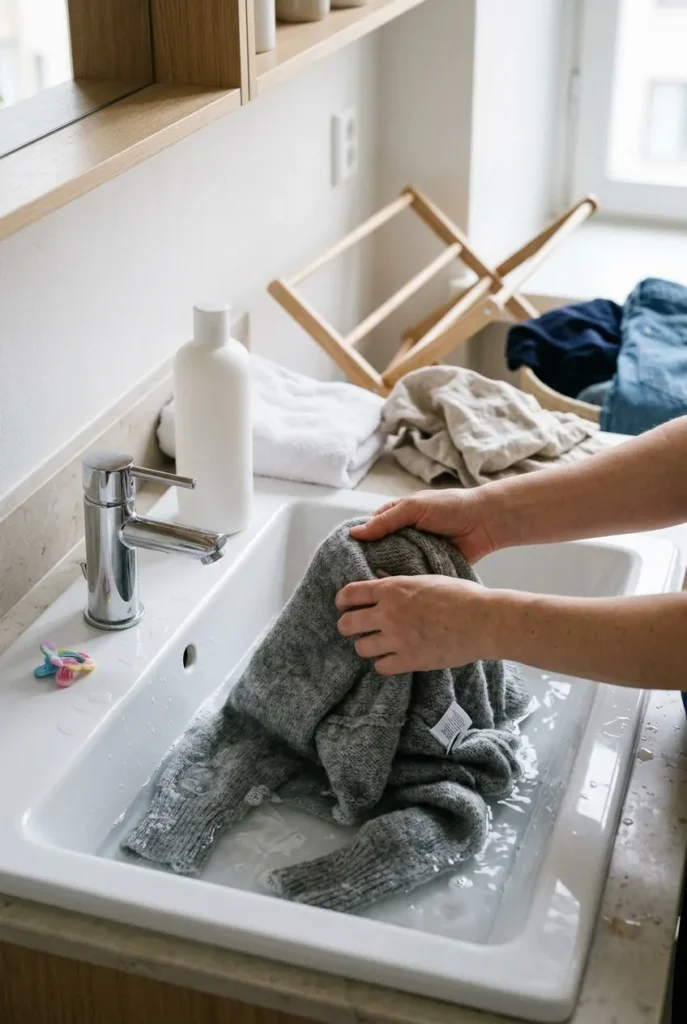
If the label asks for more care than you’ll really give, the piece will either sit unworn or get ruined in the wash.
Hand wash is fine if you truly hand wash. A little wool and cashmere wash in the bathroom sink, a towel for drying flat, and it takes about 10 minutes.
I’ve washed things by hand since I was a little girl, and I still do it for my finer pieces. I’ll be honest, I don’t love it. It dries out my hands every single time.
If a label says hand wash, count those 10 minutes into the price.
One small bottle lasts for months, so it’s worth having only if you own pieces that need it.
Turn your next favorite piece inside out in the shop and read the label before you look at the price.
We wear our clothes far less than we used to. According to the Ellen MacArthur Foundation, clothing use has dropped by almost 40% over the last 15 years, while production has roughly doubled. Some garments are thrown away after just 7 to 10 wears.
Related: If you’re building a smaller closet and want to skip the usual traps, I wrote about 15 common minimalist capsule wardrobe mistakes and what to do instead.
Part 3: Right Before You Pay
The card is in your hand. These last 3 questions are the quiet ones, and they’re the ones we skip most often.
8. Am I buying it for my real life or for a life I imagine?
Try this:
- write down what you did last week, day by day,
- count the days that needed this kind of piece,
- look at your calendar for the next 4 weeks.
This is the question that stings a little. Many of us buy clothes for a version of ourselves who goes to dinner parties every weekend and hikes on Sunday mornings.
Buy for the life you have now. The life you imagine can shop for itself when it arrives.
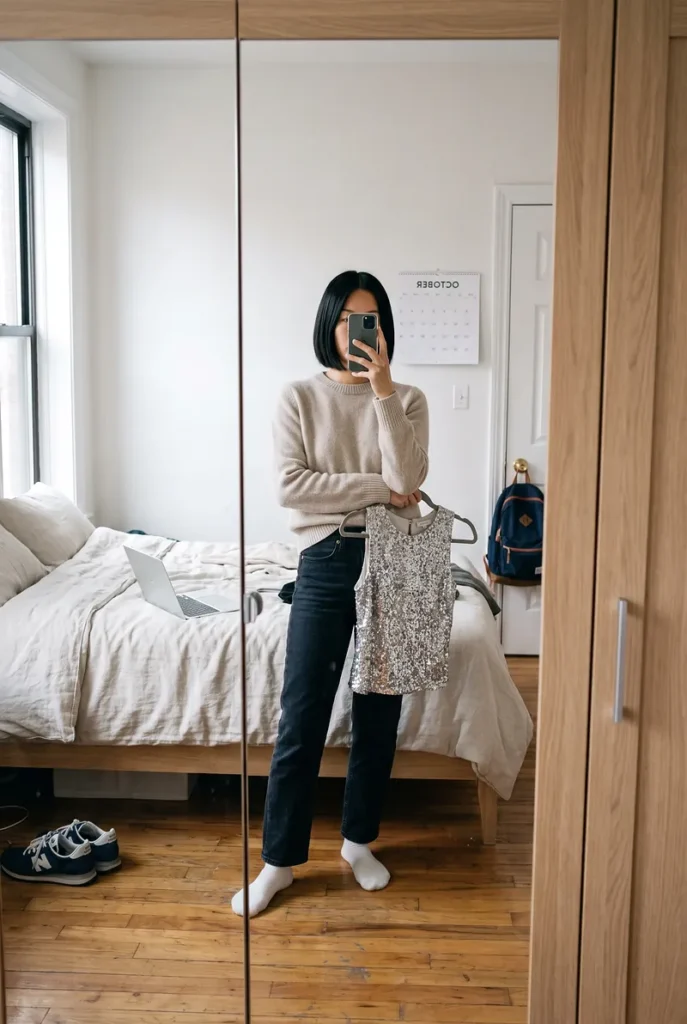
Look at your last week. If it was school runs, a desk, the supermarket and a quiet Sunday, then soft trousers and a good knit will get far more wear than any sequin top.
This doesn’t mean you can’t have one special dress. It means one, not 5.
For a calmer way of thinking about everything we already have, my post on how to stop wanting new things and start living a simple life is a good next read.
Open your calendar and look at the next 4 weeks before you buy anything for a special occasion.
9. How do I feel right now?
Try this:
- notice if you’re tired or bored,
- ask yourself if you came in for this or just walked in,
- put the piece on hold for 24 hours if you’re not sure.
A lot of shopping happens on bad days. A hard morning, a long week, a rainy afternoon with an hour to kill in town.
And here’s the honest part. Shopping to feel better isn’t always a mistake.
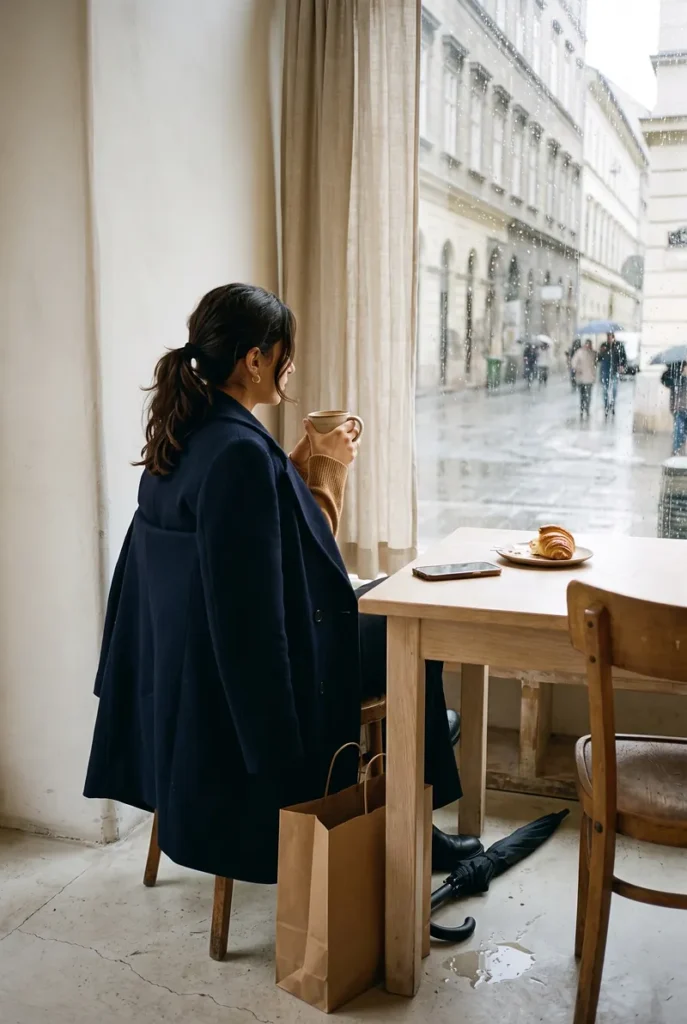
In a study published in Psychology and Marketing, Selin Atalay and Margaret Meloy found that small self-treats bought in a bad mood lifted people’s mood, and the buyers didn’t feel regret or guilt about them afterward. They also found that people could hold back when they wanted to.
So a small treat on a hard day isn’t the problem. The problem is the big, expensive piece bought to fix a feeling that has nothing to do with clothes.
So here’s a simple rule: if it costs more than a nice lunch, it waits until tomorrow.
Online, the cart is your waiting room. Leave things in it overnight. If you’ve forgotten about them by morning, you have your answer.
The next time you shop on a hard day, buy a coffee first and decide after you’ve finished it.
10. How much will it cost per wear?
Try this:
- guess honestly how often you’ll wear it in a year,
- multiply that by the years it should last,
- divide the price by that number.
Cost per wear is the simplest math in fashion. You take the price and divide it by the number of times you wear the piece.
A $40 top worn 4 times costs $10 per wear. A $90 wool sweater worn 60 times over 3 winters costs $1.50 per wear.
The cheap piece is often the expensive one.
There’s a well-known 30 wears challenge, made popular by Livia Firth: before you buy anything, ask if you’ll wear it at least 30 times. For a winter coat, that’s one season. For a sparkly party dress, it might be never.
I like it because it’s easy to remember in a busy shop. You don’t need a calculator, just a little honesty.
Write the cost per wear on the back of the receipt for your next 3 purchases, then check it again next fall.
Every Amazon Find From This List in One Place
These are the only things from this post that might be worth buying, and only if you don’t already have them. Check your drawers first, then click.
| Find | Best for you if | Shop on Amazon |
|---|---|---|
| Soft tape measure | you often guess between 2 sizes online | Soft tape measures |
| Wool and cashmere wash | you own knits that say hand wash | Wool and cashmere wash |
| Mesh laundry bags | you wash lace or delicate knits at home | Mesh laundry bags |
| Fabric shaver | your sweaters pill after a few washes | Fabric shavers |
| Handheld garment steamer | you own viscose or fine knits that crease | Handheld garment steamers |
Second-Hand Isn’t a Free Pass
Second-hand clothes are kind to the planet, and a lot of women love hunting for them. In Hungary we have turkáló (it’s our word for a second-hand clothes shop, from the verb to rummage), and almost every small town has one.
My mother loves them. I honestly don’t, mostly because of the smell. At least here in Hungary, turkálós have a very particular smell, and once you know it, you’d recognize it anywhere.
But I’ll say it clearly. A low price doesn’t make a piece the right one.
A $4 blouse from a turkáló that never leaves the closet is still a blouse that never leaves the closet. It was cheaper and kinder to the planet, yes. It’s still clutter.
There’s research on this too. In a study of more than 53,000 garments from 5 countries, researchers at OsloMet found that second-hand pieces were worn about 30 percent less by their new owners than pieces bought new. The newest clothes in a closet got the most wear, around 30 times a year.
I think the low price is the trap. It’s so easy to say yes to something that costs less than a sandwich.
So the same 10 questions belong in a turkáló as in any other shop. Especially the first one.
When I was a child in the village, simple living was just how everyone lived. Nobody called it sustainable fashion.
And one thing I still do today: I mend everything I think can be worn again. A small tear is never a reason for me to throw something out.
Pick the last 3 clothes you bought and ask each of them question 1 today. If one of them can’t find 3 partners in your closet, plan one outfit for it this week, or start the return while you still can.
The Small Receipt Audit Worth Doing Once
Receipts are honest. We can tell ourselves a lot of things about our closet, but the paper shows what really happened.
So here’s a small audit worth trying on a day when you feel you have nothing to wear.
Collect the receipts or the order emails from the last 6 months. Next to each piece, write roughly how many times you’ve worn it. Be honest, nobody is checking.
Then look for 2 patterns. First, which questions from this list would have stopped the pieces with a 0 or a 1 next to them? Second, what do your most worn pieces have in common?
The audit isn’t there to make you feel guilty. It simply shows you which questions you tend to skip.
For most of us it’s 1 or 2 questions, always the same ones. Those are the ones worth writing on a sticky note inside your wallet.
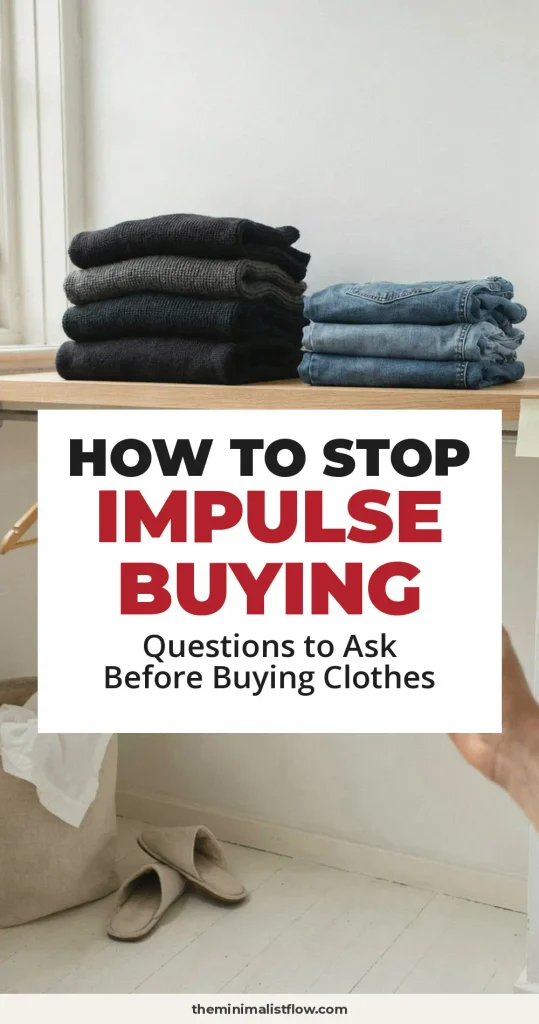
Before the Tag Comes Off: Quality Checks and Everyday Care
This is the practical part. How to check a piece in the shop, how to read the label, how to wash it so it lasts, and which colors help a new piece fit what you already own.
How to check quality in 2 minutes
Seams: pull gently on both sides of a seam. If you see gaps or the thread stretches, it won’t last long.
Fabric: read the composition label. Wool, cotton, linen and good blends usually wear well, while a soft sweater with a lot of acrylic in it often pills within a few washes.
Stripes and checks: they should line up at the side seams and at the pockets. It’s a small detail that shows how carefully the piece was made.
Buttons and zippers: buttons should be sewn on tightly, ideally with a spare one inside. Zippers should run smoothly without catching.
Hems: a deeper hem on trousers and skirts means you can let it down later, which is useful for anyone who changes heel heights a lot.
The crumple test: 10 seconds in your fist, as in question 5. If it stays creased in the shop, it’ll stay creased in real life.
A quick look inside a garment tells you more than the price tag does.
Read the care label before you fall in love
| Label says | What it means in real life |
|---|---|
| Dry clean only | A trip to the cleaner every few wears, so add that to the price |
| Hand wash | 10 minutes in the sink, then drying flat on a towel |
| Machine wash cold | The easiest piece you’ll ever own |
| Lay flat to dry | You need space on a rack or a towel, never the radiator |
| Do not tumble dry | Air drying only, so plan a full day for it |
| Wash with like colors | It may bleed, keep it away from your whites |
How to wash new clothes so they last
Wash less: jeans and knits don’t need a wash after every wear. Air them on a hanger overnight, and spot clean small marks.
Inside out and cold: turning clothes inside out and washing them cold keeps colors and prints fresh for much longer.
Mesh bags: mesh laundry bags protect anything with lace, thin straps or delicate knits from the rest of the load.
Air dry: the dryer is hard on elastic and on knits. A simple rack in the bathroom works for almost everything.
Pilling: a fabric shaver takes the pills off a sweater in a few minutes and makes it look almost new.
Small tears and loose buttons: mend them before the piece goes back in the closet. A few stitches take 5 minutes, and they keep a piece you like in your week.
Creases: a small handheld garment steamer is gentler than an iron on viscose and fine knits.
If you love light colored knits, my post on how to keep a white sweater outfit white has 14 care habits that work for every pale piece in your closet.
Cheap or worth it? Cost per wear compared
| Piece | Price | Wears | Cost per wear |
|---|---|---|---|
| Trend top on sale | $25 | 3 | $8.33 |
| Basic cotton T-shirt | $20 | 40 | $0.50 |
| Wool sweater | $90 | 60 | $1.50 |
| Party dress | $120 | 2 | $60.00 |
| Leather ankle boots | $180 | 150 | $1.20 |
| Winter coat | $250 | 200 | $1.25 |
The numbers are only examples, but the pattern holds: the pieces we wear most are almost never the most expensive per wear.
Mistakes to skip
| Buying a size down for later | Buy the size that fits you today |
| Buying because of the discount | Cover the sale tag and decide again |
| Buying the 4th of the same thing | Check your closet album first |
| Buying for a trip or a party months away | Wait until the date is close |
| Keeping something past the return window | Decide within a few days, with the tags on |
| Ignoring the care label | Read it before you read the price |
| Shopping when tired or bored | Leave it in the cart and sleep on it |
Recommended: If you like the idea of fewer, better pieces, I wrote about the 11 rules of Japanese minimalist fashion I follow, and they show how calm colors and good fabrics make a small closet feel full.
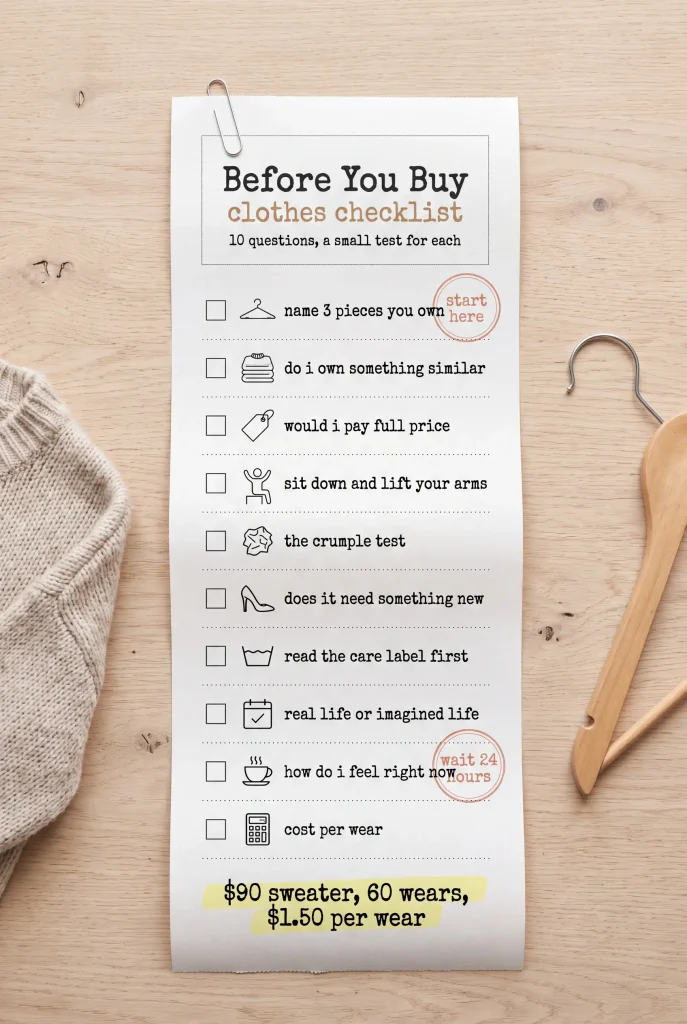
Your Before You Buy Clothes Checklist
Save this pin for later on your Pinterest board!
Questions to Ask Before Buying Clothes: What Readers Ask Me Most
What are the best questions to ask yourself before buying clothes?
The best questions to ask yourself before buying clothes are what you’ll wear it with this week and whether you already own something similar. Asking if you’d buy it at full price catches most of the rest. Add a quick movement test in the fitting room and a look at the care label, and you’ll skip almost every piece that would sit unworn.
How do I stop impulse buying clothes?
The easiest way to stop impulse buying clothes is to put a short wait between wanting and paying. Leave online carts overnight, and put pieces on hold in shops for 24 hours. Notice your mood too, because tired or bored shopping is when most impulse buys happen. A short list of what you really need keeps you away from random racks.
How do I stop buying clothes I never wear?
To stop buying clothes you never wear, check every new piece against your real week and your current closet before you pay. Name 3 things you’d wear it with and picture a normal Tuesday in it. Pieces that pass those tests usually get worn, while sale finds and pieces for an imagined life tend to stay on the hanger.
What is cost per wear and how do I calculate it?
Cost per wear is the price of a piece divided by the number of times you wear it. A $90 sweater worn 60 times costs $1.50 per wear, while a $40 top worn 4 times costs $10 per wear. Guess honestly how often you’ll wear something in a year, multiply by the years it should last, then divide.
How can I tell if clothes are good quality in the store?
You can tell if clothes are good quality in the store by checking the seams and the fabric. Pull gently on a seam to look for gaps, read the composition label, and hold knits up to the light. Matching stripes, tight buttons and a deeper hem are good signs, and the crumple test shows how it’ll look after a day.
Should I buy clothes on sale?
Buying clothes on sale is a good idea when the piece is already on your list and you’d happily pay the full price for it. Cover the sale tag with your thumb and ask yourself that question honestly. If the discount is the only thing you like, leave it, because a cheap piece you never wear still costs money.
Is it OK to buy clothes when I’m sad?
Buying a small treat when you’re sad is usually fine, and research on retail therapy suggests it can lift your mood without much regret. The risk is the big, expensive purchase made to fix a feeling. A simple rule helps: anything that costs more than a nice lunch waits until the next day.
How many clothes does a woman really need?
How many clothes a woman really needs depends on her life, but many people do well with far fewer than they own. The popular Project 333 challenge asks you to dress with 33 items, including shoes and accessories, for 3 months. Most women who try a smaller closet find they wear the same favorites anyway.
What should be on a fall capsule wardrobe shopping list?
A fall capsule wardrobe shopping list should only hold the gaps you found in your own closet, not a ready-made list from the internet. Start by checking what you already own: a coat, knits, trousers, boots and a few tops. Then write down the 1 or 2 missing pieces, and test each one with these 10 questions before you buy.
Recommended Reading
The Minimalist Capsule Wardrobe: A Complete Guide to Simplifying Your Style
9 Closet Organization Mistakes You Should Definitely Avoid
How to Stop Wanting New Things and Start Living a Simple Life
The Question I’d Keep If I Could Keep Only One
If I could keep only one of these 10 questions, I’d keep the first one.
What will I wear it with this week?
It’s short enough to remember in a busy shop. It works for a $4 blouse in a turkáló and for a winter coat, too.
The other 9 make it sharper. The 9th one is usually the hardest to ask, on a long, rainy afternoon with an hour to kill in town.
These questions won’t make you stop loving clothes, and they shouldn’t. They just make room for the pieces you’ll wear until the elbows go thin.
For me, that’s what makes a closet truly calm: every piece in it gets its turn.
Which of these 10 questions do you think you skip most often?