How to Keep a White Sweater Outfit White: 14 Care Habits
Disclosure: This post contains affiliate links. If you make a purchase through these links, I may earn a small commission at no extra cost to you. Thank you for supporting my blog!
While I was writing this post, I kept wondering why a favorite white sweater ends up banished to the back of the closet. What decides whether it keeps its shape, its color, and whether it starts looking cheap just from being worn?
I had a sweater I carefully tucked away at the back of the closet, saving it for holidays and special occasions. I hid it so well that I forgot about it.
And when I finally pulled it out, it was nowhere near as lovely as I remembered. Yellowed here and there, not nearly as fresh as the day I bought it, and I had hardly even worn it.
I did not really understand what was going on, so I read up on it a little. It turns out a white knit sweater is rarely ruined by being worn. It is ruined by washing it too often, washing it too warm, drying it the wrong way, or putting it away slightly damp.
I am not the kind of person who simply accepts it when something is not right, so I started looking into how we can protect a white sweater‘s quality, its color, and the way it looks.
So in this post I’m writing about how to make sure you can wear your favorite white sweater for a long time. I’m sharing 14 tips that can help you buy a beautiful sweater for more than a single season.

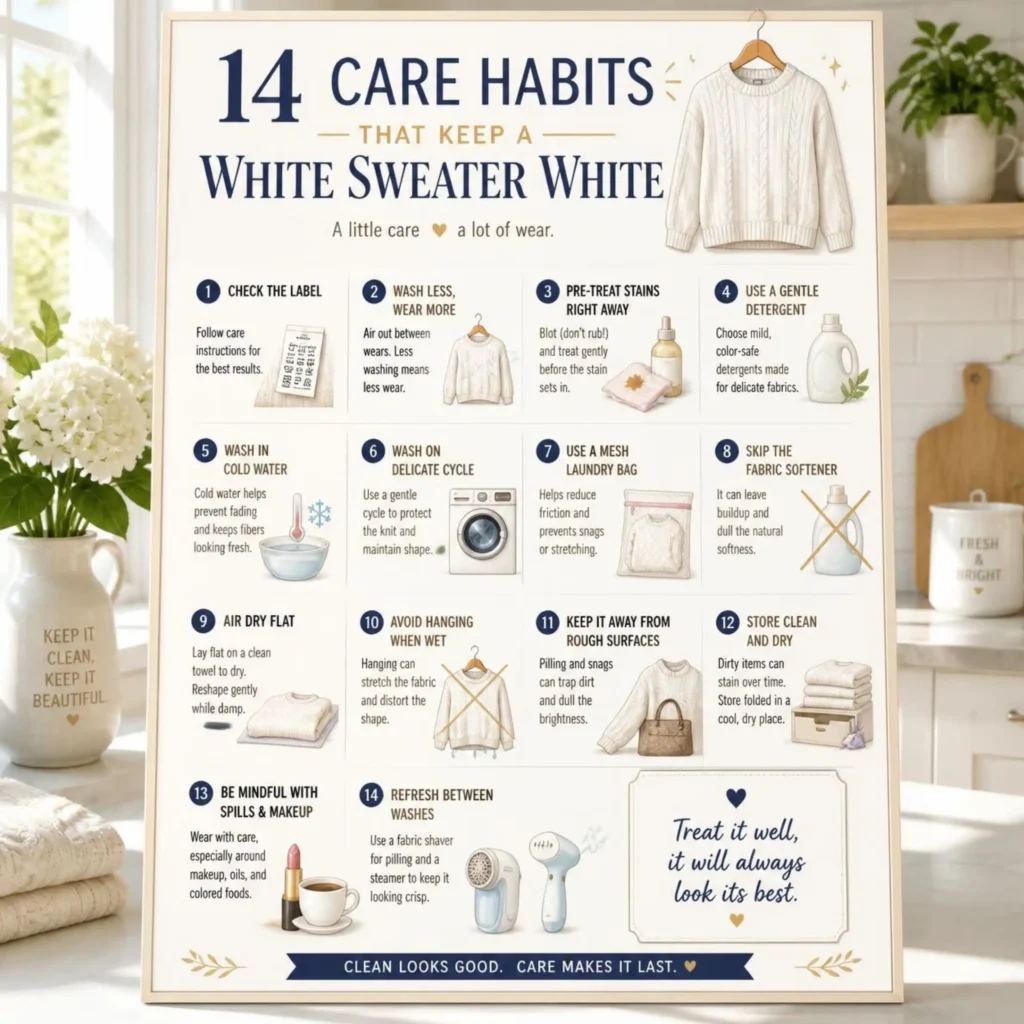
14 Care Habits That Keep a White Sweater White
These run roughly in the order you would meet them, from the evening after you wear it to the day you finally let it go. None of them takes real time. Together they are the difference between a knit that lasts two winters and one that lasts ten.
1. Air It Overnight Instead of Washing It
Hang your sweater on the back of a chair or over an open door for a night before it goes back on the shelf.
Why it works: wool is naturally odor resistant, so most of what a wash cycle does for a lightly worn knit, fresh air does on its own. The same study in the International Journal of Life Cycle Assessment that looked at merino sweaters found washing after fourteen wears instead of every wear cut environmental impact by up to 20 percent.
Every wash cycle you skip is also one less round of agitation, detergent, and heat on the fibers.
2. Wear a Thin Cotton Layer Underneath
Wear a plain cotton t-shirt, tank top, or collared shirt under your sweater. I do this almost every day in the fall without thinking because I’m cold and want to protect my sweater.
Why it works: nearly all sweater grime starts at the neck, the underarms, and the wrists, because that is where skin meets knit. A layer underneath means the sweater never touches any of it.
This one habit can easily double the number of wears between washes, which makes every other habit on this list easier.
A collared shirt underneath does the same job, so it works for the office too.
3. Spot Clean the Cuffs and Neckline First
Before you decide a sweater needs washing, take a damp cloth, one drop of wool wash, and press it gently into the dirty spot. Do not rub in circles.
Why it works: a white knit is usually not dirty, it is dirty in three small places. Washing the entire sweater to clean two cuffs is like repainting a room because of a scuff by the light switch.
Let the damp patch dry flat before you fold it away, so you are not storing moisture.
4. Turn It Inside Out Before Every Wash
Do it every time, it only takes a few seconds.
Why it works: Woolmark’s own washing guide recommends this specifically to reduce pilling on the outer surface. The friction inside a washing machine still happens, it just happens on the side nobody sees.
The same logic applies to a white sweatshirt, where the outer face is the part that goes fuzzy first.
Turn it inside out as you take it off, not later.
5. Use Half the Detergent You Think You Need
Look at the line on the cap, then use less than that. Most of us pour rather than measure, and for a small load of knits you need very little.
Why it works: this is the actual cause of that dull yellow cast on white clothes. Detergent that the rinse cycle cannot fully remove stays trapped in the fibers and slowly goes gray or yellow. Whirlpool’s guide to whitening yellowed clothes is refreshingly blunt about it.
More detergent does not mean cleaner but it means residue.
Measure one load properly this week and notice how low the line really is, then keep using that amount.
6. Wash Cool and Keep the Cycle Short
Use cold water and short program.
Why it works: researchers at the University of Leeds compared a 30 minute wash at 25 degrees Celsius with an 85 minute wash at 40 degrees and found the shorter, cooler cycle released up to 52 percent fewer microfibers and up to 74 percent less dye.
Less loose dye in the drum means fewer gray shadows on anything white.
Washing at 20 degrees instead of 40 also uses roughly two thirds less energy per load, which shows up on a real utility bill.
7. Choose a Wool Wash Instead of Regular Detergent
A small bottle of proper wool wash lasts a very long time, because you use a teaspoon at a time.
Why it works: many everyday detergents contain enzymes designed to break down protein stains, and wool is a protein fiber.
A no rinse wool wash such as Eucalan also lets you skip a whole rinse, which means less water and less agitation.
Check your current detergent bottle for the word enzymes and move it.
8. Press the Water Out, Never Wring It
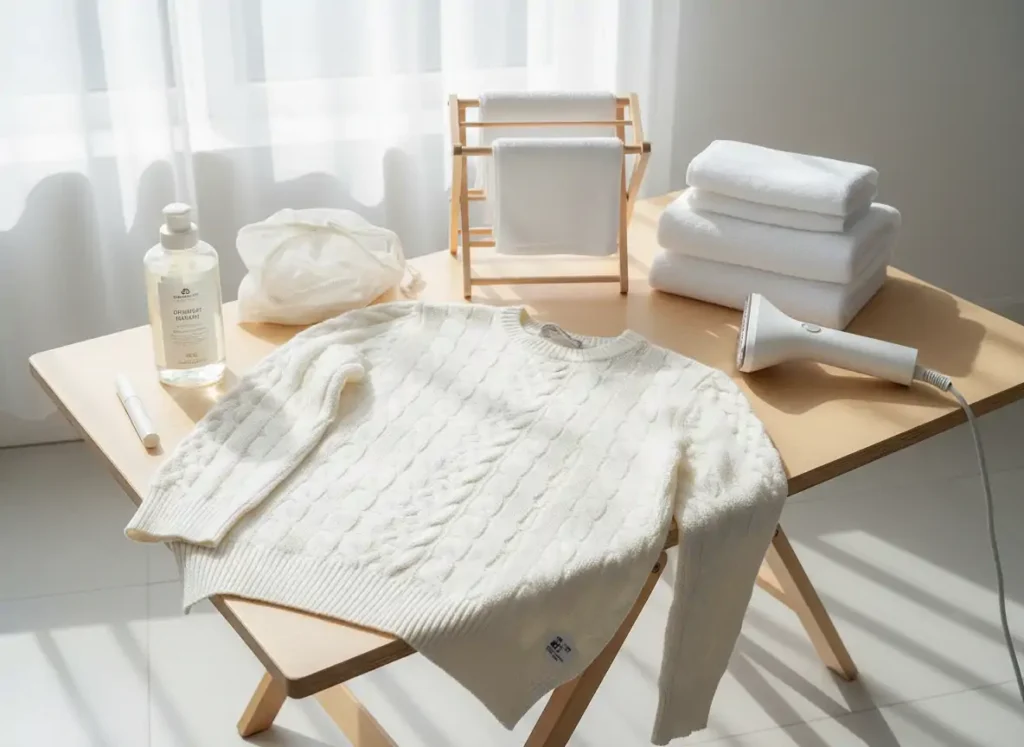
Lay the wet sweater flat on a towel, roll the towel up like a sleeping bag, and press. Then unroll it.
Why it works: wet wool has almost no structural strength, so twisting it stretches the fibers permanently.
The towel roll takes about a minute and removes more water than you would expect, which cuts drying time significantly.
Use an old bath towel you no longer put out for guests, and keep it with your laundry things.
9. Dry It Flat and Out of Direct Sunlight
On a drying rack, a mesh sweater dryer, or a towel on a flat surface. Reshape it gently with your hands while it is still damp.
Why it works: a wet knit hung on a hanger stretches under its own weight, and that is where those little peaks at the shoulders come from. They do not come back out.
Direct sun is the other trap. Strong sunlight can yellow wool and weaken the fibers.
Turn the sweater over halfway through drying so the underside does not stay damp against the towel.
10. Never Put It Away Damp
Wait until it is completely dry, then wait a bit longer. If you are not sure, it is not dry.
Why it works: slightly damp wool in a closed drawer is where mildew, that stale cupboard smell, and yellow patches all begin. This is exactly what happened to my sweater.
The center of a folded knit and the ribbed cuffs are the last parts to dry, so check those.
11. Fold It on a Shelf, Never on a Hanger
Fold in the sleeves, fold once across, stack it. Two knits per pile at most, so you can still see what you own.
Why it works: wool has no memory for its own weight. A hanger pulls at the shoulders and the neckline every day it sits there, and within a few weeks the shape is different.
If shelf space is the problem, this is the moment to be honest about how many sweaters are actually in rotation. Decluttering your closet this fall covers that side of it properly.
Move your favorite white knit to the front of the shelf at eye level, because we wear what we can see.
12. Shave the Pills While They Are Still Small
Once a month, run a sweater comb over the hip, the underarms, and the inside of the sleeves. Short, gentle strokes in one direction.
Why it works: pills form where fabric rubs fabric, not where a sweater is old. Caught early they come off in one pass and the knit looks two years younger. Left alone they mat together and take the surface with them.
A battery free comb like the Gleener is gentler on fine knits than an electric shaver, and you can feel how much pressure you are using.
Do it on the sofa in the evening rather than treating it as a laundry task, and it stops feeling like work.
13. Rescue a Yellowed Knit
A cool soak in a basin with a little oxygen based cleaner, thirty minutes, then a very thorough rinse. Rinse twice if in doubt.
Why it works: yellowing is almost always residue or storage damage rather than the fiber itself aging, which means it is reversible far more often than people assume. The rinse matters more than the soak, because leftover product is what caused the problem.
Skip chlorine bleach on wool entirely. It attacks protein fibers and can turn white wool a permanent dull yellow, which is the opposite of what you wanted.
14. Store It Clean
At the end of the season, wash or air it, dry it fully, fold it into a breathable cotton bag or a lidded basket, and tuck in a cedar block.
Why it works: moths are not really interested in wool, they are interested in the sweat, skin, and food traces on it.
Cedar blocks do the job without filling your closet with a chemical smell, and a light sanding once a year brings the scent back. Plastic bins trap moisture, and trapped moisture on white wool turns yellow.
Sand your cedar blocks on the same day you put the summer clothes away, so it becomes one seasonal job instead of two.

What to Do When a White Knit Is Genuinely Finished
Some sweaters really are done, and there is a better ending than the trash.
Repair first, because the group of repairable knits is much bigger than most of us assume. A moth hole the size of a lentil takes about ten minutes to darn with matching yarn, and a stretched cuff can be tightened by hand in an evening.
Pass on what is wearable but not by you. A friend, a clothing swap, or a donation point all work, and the honest move is to book the drop off before you fill the bag, because a bag by the door for eleven weeks is just relocation.
Recycle what nobody can wear.
According to the US Environmental Protection Agency, Americans generated 17 million tons of textile waste in a single year and only 14.7 percent of it was recycled. Textile collection bins take stained and torn items that donation centers cannot use.
Keep two for the house. Cut finished cotton knits into cleaning cloths for under the kitchen sink. That is where mine end up, and I have not bought dusters in years.
The Care Habits That Are Also the Greener Ones
This is the part I find genuinely motivating. Almost nothing on this list asks you to choose between the sweater, your wallet, and the planet.
Washing less often means fewer loads, less detergent, water, and a knit that keeps its shape. Cold and short means less energy per wash. Folding instead of hanging costs nothing at all.
If your knit is a synthetic blend, a Guppyfriend washing bag catches shed fibers before they reach the drain. Shedding varies enormously depending on how a fabric is constructed, as a study published in PLOS One found, which is a quiet argument for buying fewer and better made knits.
And when a white knit really does need replacing, two shapes cover almost everything: a soft lightweight crewneck for layering and work, and an oversized cable knit pullover for weekends. Two knits you care for properly will outlast six you do not.
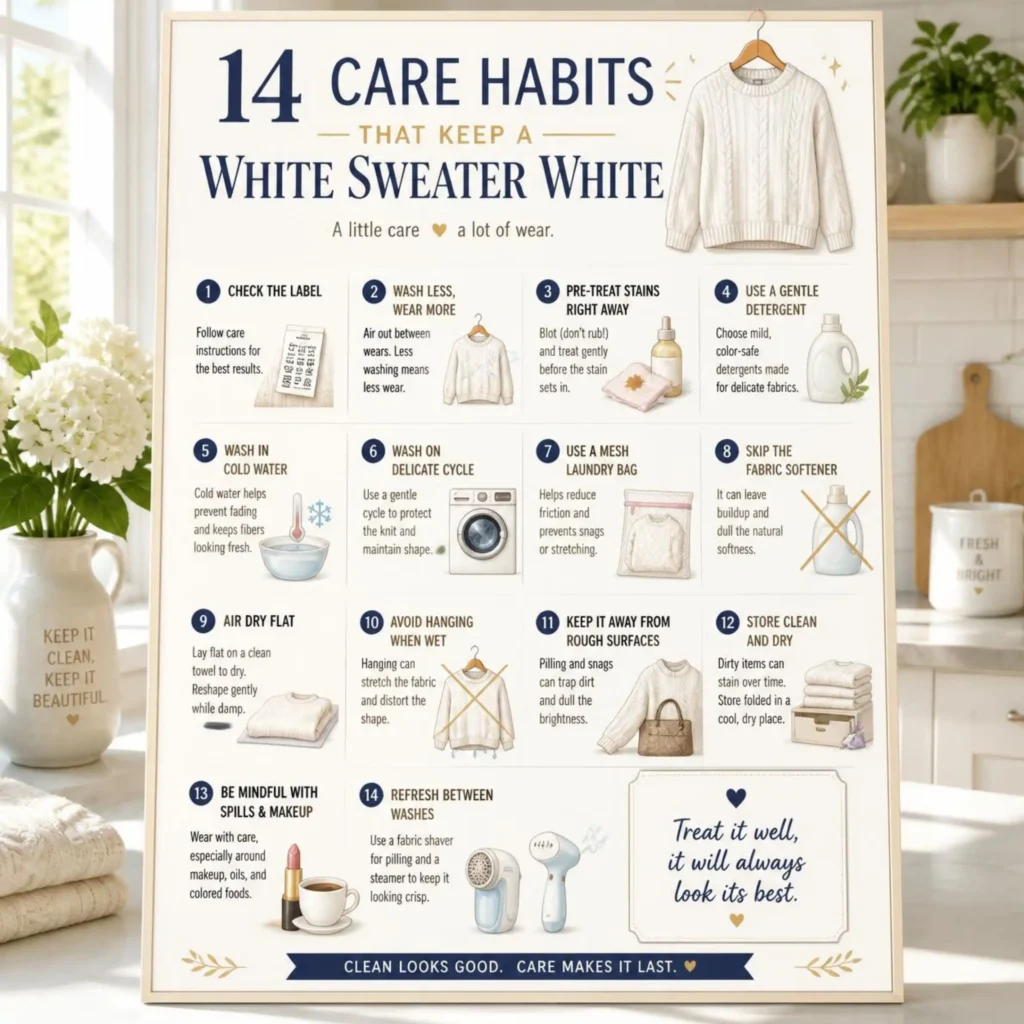
White Sweater Care Checklist
Pin this so you can come back to it the next time you are standing in front of the washing machine wondering.
- Air it overnight instead of washing after one wear
- Wear a thin cotton layer underneath every time
- Spot clean the cuffs and neckline before washing the whole thing
- Turn it inside out for every single wash
- Use half the detergent and a cold, short cycle
- Choose wool wash over enzyme detergent
- Press the water out in a towel, never wring
- Dry flat, reshaped, out of direct sun
- Fold on a shelf, never on a hanger
- Store completely dry, with cedar, never in plastic
FAQ – Common Questions About White Sweater Care
Far less often than most of us do. Air it after each wear, spot clean the cuffs and neckline as needed, and give it a full wash when it genuinely needs one. For a wool or wool blend knit, once or twice a season is realistic.
Usually not. Yellowing almost always comes from detergent residue or from storing something before it was fully dry, not from the fiber aging. A cool soak with a little oxygen based cleaner and a very thorough rinse fixes most cases.
Not on wool or a wool blend. Bleach attacks protein fibers and often leaves white wool a permanent dull yellow. Oxygen based cleaners are the safe route, and even those want a cool soak rather than hot water.
I would not. Heat and tumbling together are what felt wool and shrink cotton knits, and the damage is not reversible. Flat drying takes a day and costs nothing.
Shave it early and shave it often, in the places where fabric rubs fabric. The hip, the underarms, and the inside of the sleeves are where you will find it first. A comb in one gentle pass makes a knit look almost new.
Yes, and one bottle lasts a very long time because you use so little. Regular detergents often contain protein digesting enzymes, and wool is a protein fiber, so ordinary detergent slowly damages what you are washing.
Store them clean and completely dry, in breathable cotton bags or a lidded basket rather than plastic, with a cedar block tucked in. Moths are drawn to the traces on the fabric, not the wool itself.
Saving it. A knit kept for special occasions gets worn a handful of times a year, yellows in storage anyway, and never becomes the piece you reach for without thinking. Wear it on a Tuesday.

Recommended Reading
If you want the structure behind a wardrobe where this kind of care is realistic, start with the complete minimalist capsule wardrobe guide, then read the 15 common capsule wardrobe mistakes that quietly cost the most money.
For fewer, better pieces you will actually keep, a simple capsule wardrobe for every season assumes you are keeping most of what you already own, and these Italian fall outfits that look expensive show what a well kept white knit can do.
Why Is It Worth Following These Rules?
Cleaning a white sweater is not a complicated process, you just need to know the little tricks that will keep it looking good for a long time.
It is therefore worth trying the simple ideas in this article, they really don’t cost anything, but they still help.
If you have a favorite white sweater and you want to wear it for a long time, then follow these steps.
This way you don’t have to buy another one every new season, which will save your wallet and the environment.