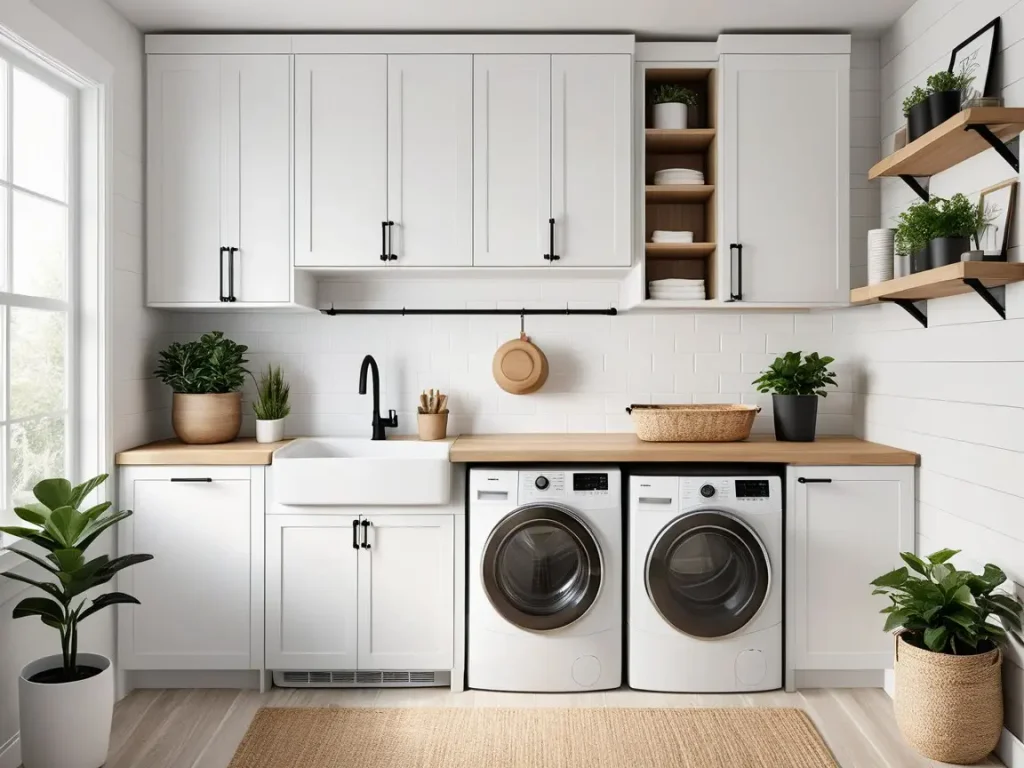
$1,000 Laundry Room Makeover: 16 DIY Ideas for Small Spaces
Disclosure: This post contains affiliate links. If you make a purchase through these links, I may earn a small commission at no extra cost to you. Thank you for supporting my blog!
If you think about your laundry room and you think you should just close the door, then these are some helpful tips for you.
You probably know that the solution is not a bigger room, but one or more work surfaces and space for baskets, cleaning supplies, and other things.
A quick win on the list: clear out the tops of your washer and dryer and take a look at what that empty space looks like. You’ll immediately see what’s missing from the room, and you’ll usually have an idea of what you can do to fix it.
If not, that’s okay, that’s why I wrote this article for you. Plus, you can save money with these tips, because we’re keeping the makover under $1,000.
What Is A Laundry Room Makeover?
A laundry room makeover means updating the surfaces, storage and light in the room you already have, without moving the machines or touching the plumbing.
Paint, a folding counter over the washer and dryer, open shelves and one better light fixture do almost all of the visible work. Done yourself, it usually lands between $400 and $1,000 and takes one to two weekends.
The point is not a prettier room. It is a room where the laundry actually finishes, instead of migrating to the couch.
3 Micro Actions for Today
1.) Clear the top of the washer and dryer and leave it empty overnight.
2.) Measure the gap between your machines at its narrowest point and save the number in your phone.
3.) Clean the lint trap and the dryer vent opening, then set a monthly reminder.

16 DIY Laundry Room Makeover Ideas That Hold Up in Real Life
These are simple laundry room ideas, running roughly from cheapest to most involved. You do not need all sixteen. Pick the four that fix your actual problem and stop there.
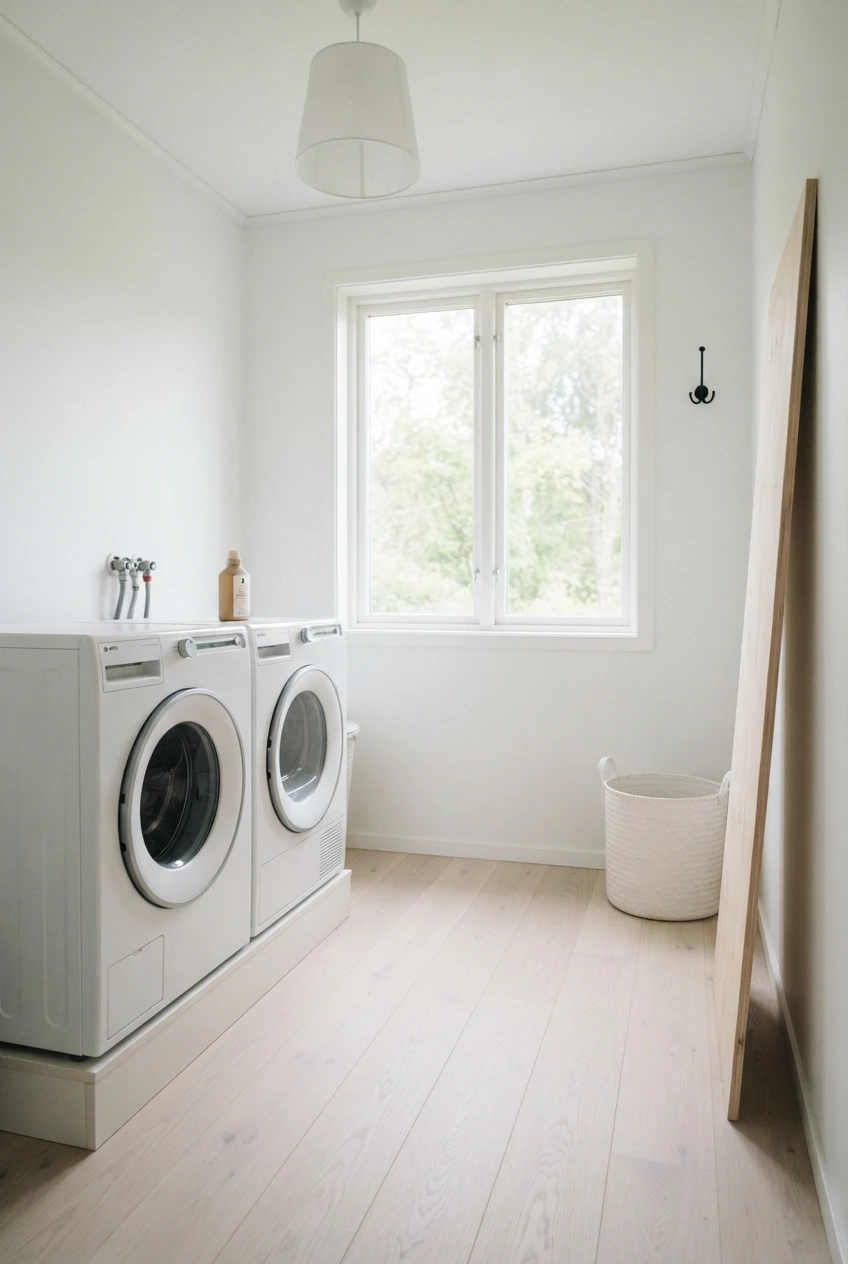
1. Empty the whole room before you buy a single basket
Take everything out. The floor, the shelf, the top of the dryer, the mystery bag behind the door.
Why it is useful for you: half the storage you were about to buy exists to hold things you will throw away in twenty minutes.
Real laundry room organization starts here. Sort what comes back by how often you use it, and put anything you cannot name a use for in a donation box.
More on why that box beats any bin in this post about storage bins.
Set a timer for thirty minutes and only empty the room today. Buying before this step is how small laundry rooms get expensive.
2. Paint the room one light color
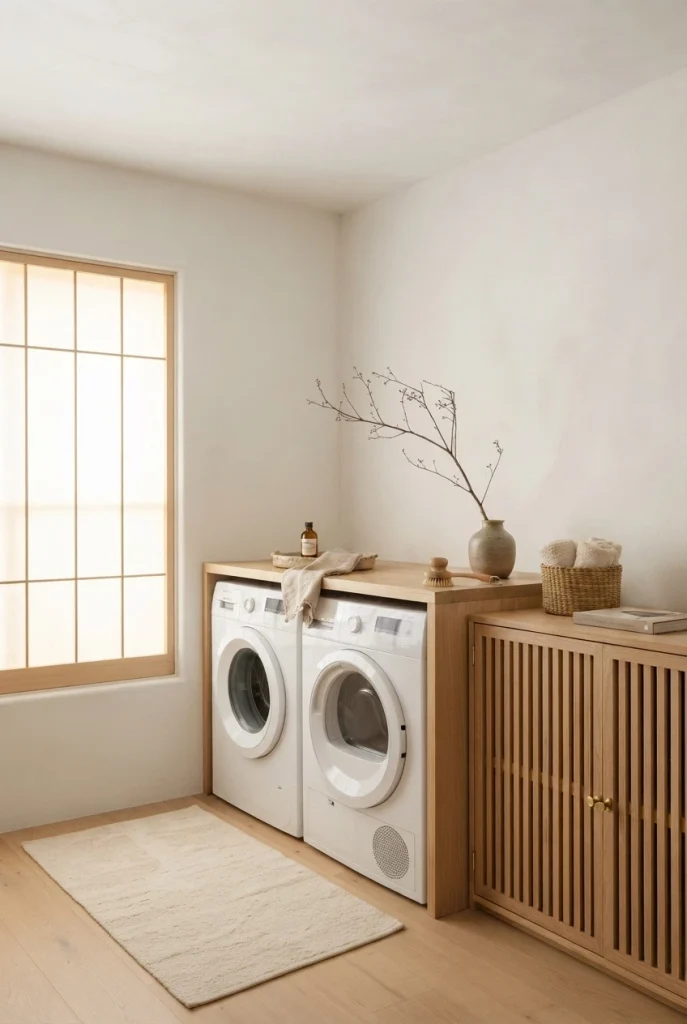
One color, walls and ceiling, in a soft white or warm off white. Satin or semi gloss, because laundry rooms get humid and you want to wipe the walls.
Why it works: a small room in one continuous color reads as bigger, since your eye has nothing to stop on. Feature walls chop the space into sections, which is the wrong direction here.
Skip the wallpaper. It is the most photographed part of every laundry room makeover online, and the part people regret first.
Buy a sample pot and paint a piece of cardboard. Move it around at different times of day, because laundry rooms usually have terrible natural light.
3. Build a folding counter across the top of your machines
If your washer and dryer sit side by side, you need one surface across both. Butcher block cut to length works, so does a solid pine panel.
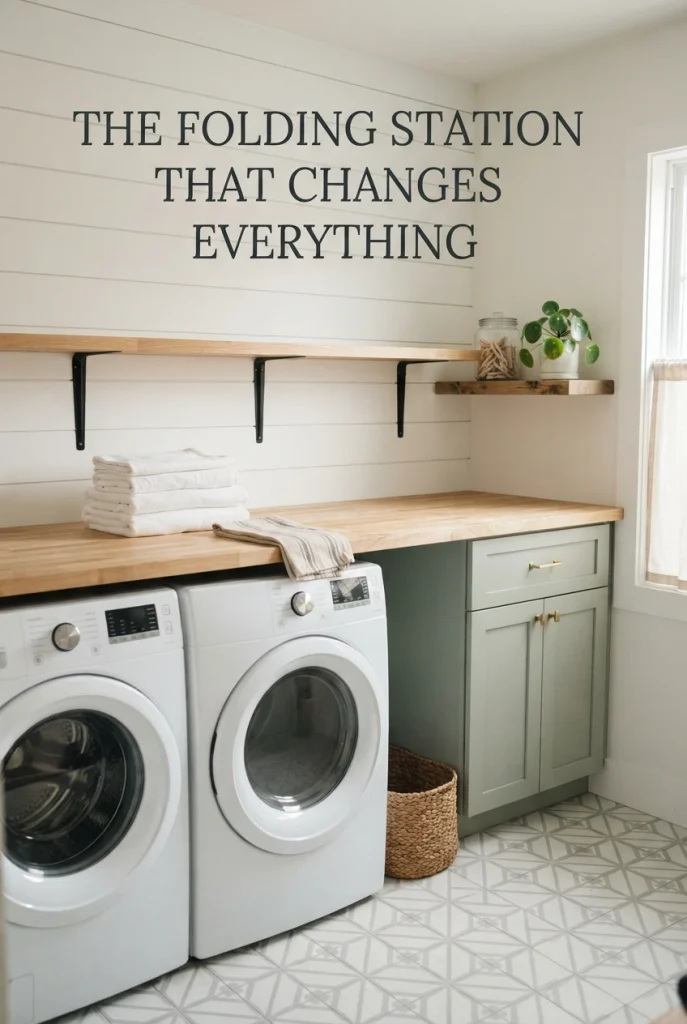
How it works: a counter turns your machines into a work surface, which is why laundry room folding station ideas dominate every small laundry room search.
Two details matter more than the material. It has to sit on brackets rather than balance on the machines, because front loaders vibrate. And leave a finger gap at the back.
Measure your machine height with the lid open before you cut anything. This is the mistake that turns a folding counter into an expensive shelf.
4. Hang open shelves instead of buying laundry room cabinets
Laundry room cabinets look tidy in photos and cost several hundred dollars. Two open laundry room shelves over the washer and dryer cost around eighty and hold the same amount.
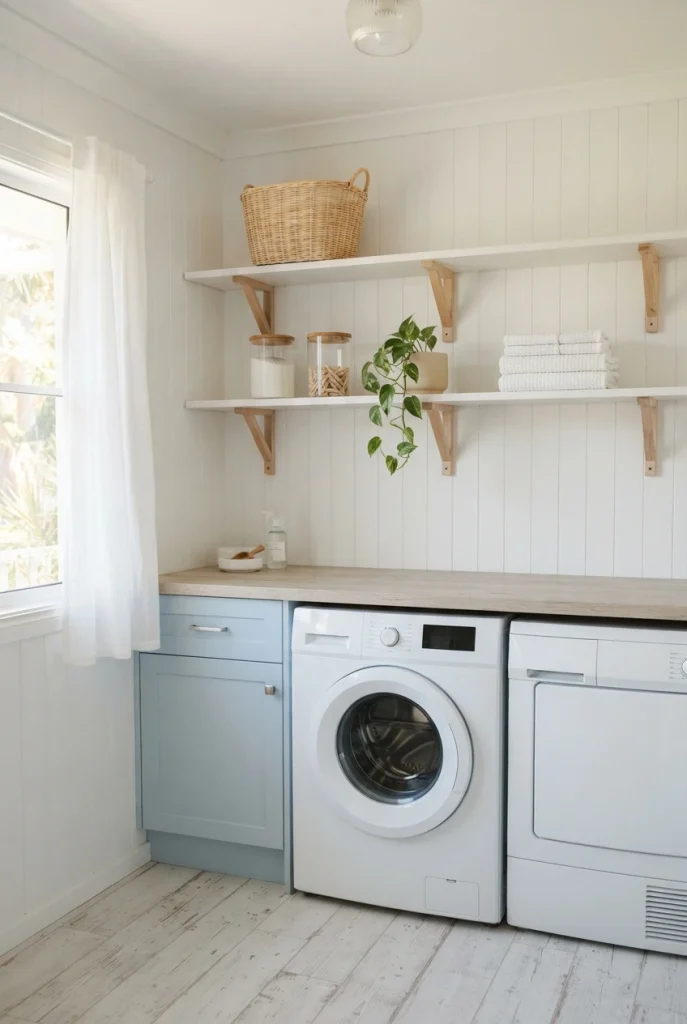
Why it is useful for you: in a very small laundry room, cabinets steal depth. An upper cabinet is twelve inches deep with a door that swings into the room, and a shelf is nine inches deep with no door.
That matters when you are squeezing past a machine with a full basket on your hip.
Mount them sixteen inches above the counter and use real anchors.
Hang the first shelf, live with it for a week, then decide if you need the second one. Most small rooms do not.
5. Add a wall mounted drying rack that folds flat
An accordion style rack screwed to the wall costs about twenty five dollars and folds to under two inches deep.
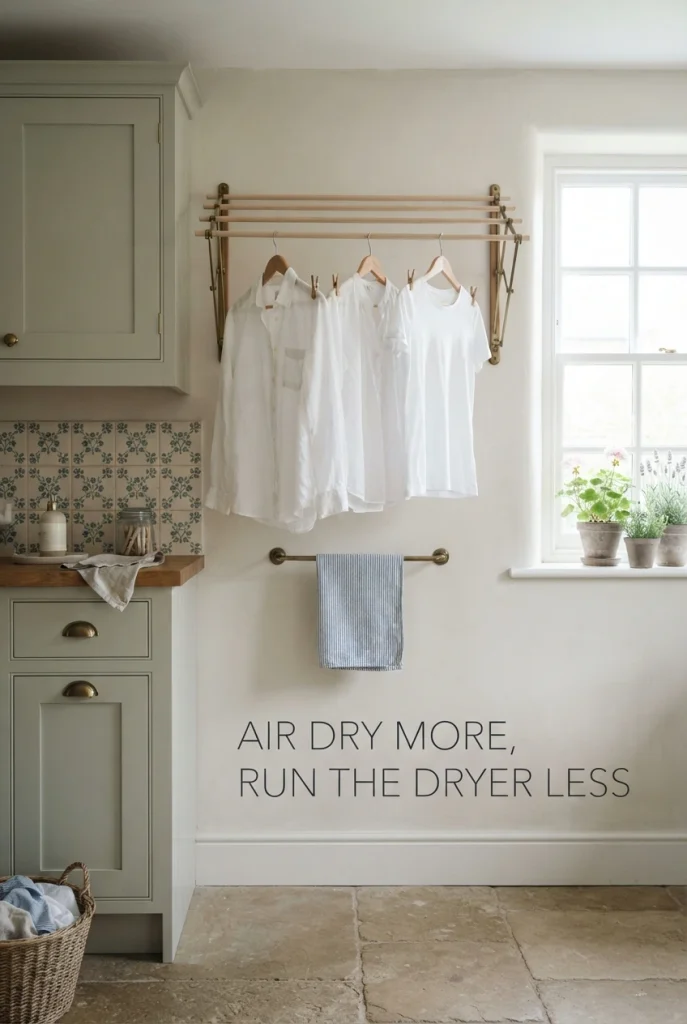
Why it is useful for you: air drying uses no electricity and is gentler on knits and anything with elastic. It also cuts the shedding of tiny plastic fibers from synthetic clothes.
Research on microfiber release from different fabrics during washing found that fabric type and wash conditions change how much comes off in a single load.
Hang a small towel bar directly under the rack for the drips. Cheaper than repainting the baseboard in two years.
Let’s do the math together
We never really add up what the dryer costs us, because one load feels like pocket change. Move the slider below and see what a year of hanging things up instead would put back in your pocket.
How much air drying could save you
Move the slider to the number of loads you could hang up instead of putting in the dryer.
That covers the drying rack, the brackets and the paint for this whole makeover, and it keeps coming back every year.
Start with the loads that hate the dryer anyway, the knits and anything with elastic. Those are the ones air drying keeps in shape the longest.
Based on a typical electric dryer using about 3 kWh per load at the US average rate of 18 cents per kWh, so roughly 55 cents a load.
6. Roll a slim cart into the gap between the machines
Almost every side by side setup has a gap that collects lint and lost socks. A slim rolling cart fills it exactly.
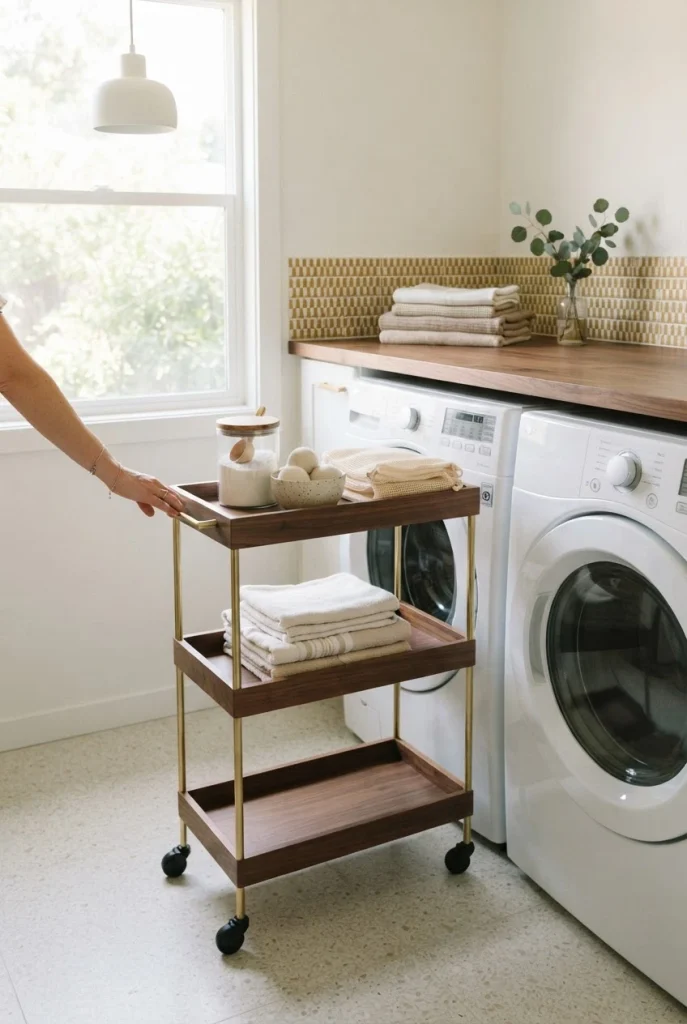
How it works: three or four narrow tiers on casters, around thirty to fifty dollars. Detergent, dryer balls, and mesh bags live there. You pull it out, use it, push it back, and the room looks empty again.
Measure the narrowest point of the gap, not the widest. Machines are rarely as parallel as they look.
7. Decant detergent into glass jars and bin the boxes
Powder into a jar with a scoop, pods into a jar with a lid, dryer balls into an open bowl.
Why it is useful for you: cardboard swells and splits in a humid room, which is why the shelf always feels sticky, and glass wipes clean. You can also see how much is left, so you stop buying a fourth bottle of something you already have.
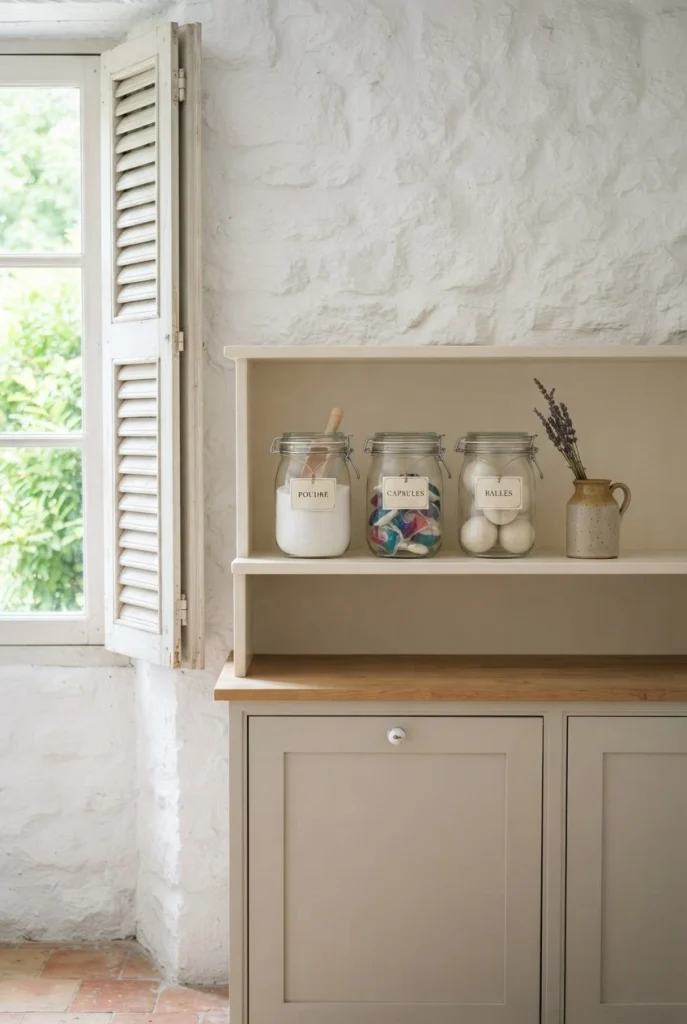
If you make your own cleaners, this is where they belong. I keep a few going and wrote them up in this post on natural cleaning solutions.
Keep the original box until the jar has been emptied once, so you still have the dosing and safety information.
8. Set up a laundry basket where you can store laundry separately
The best laundry basket storage does the sorting for you, before the clothes reach the room.
How it works: three narrow baskets in a row, labeled by what your family actually generates. Not lights, darks, and delicates, because nobody in a real house sorts that way at eleven at night.
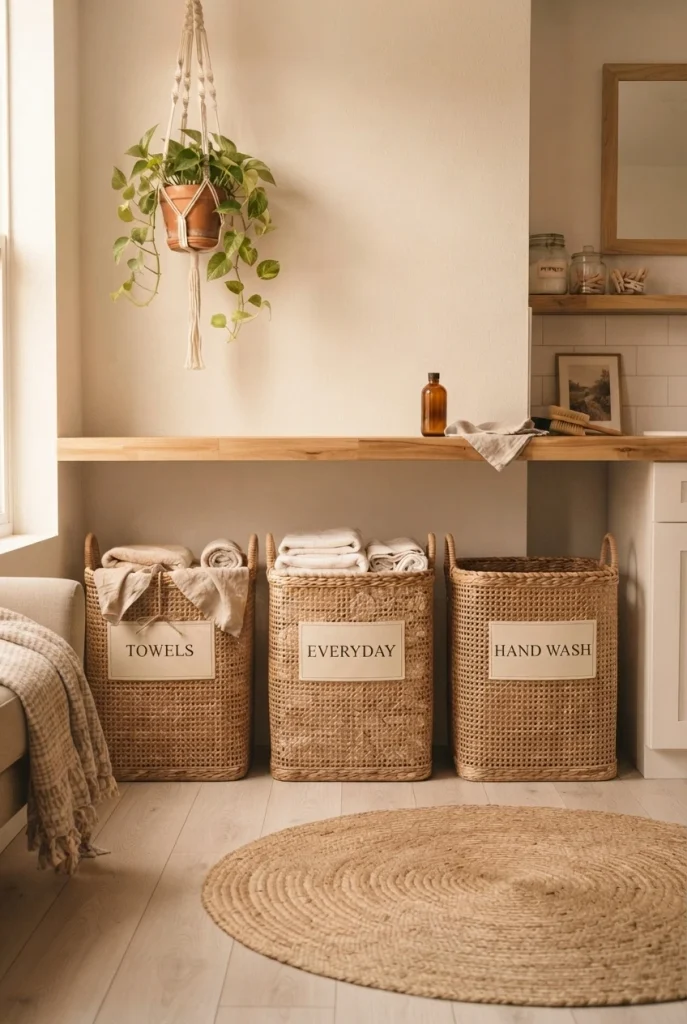
Keep them off the floor, ideally under the folding counter.
Give each person one labeled basket for clean laundry that has not been put away. The pile stops being your problem and starts being theirs.
9. Lay peel and stick flooring
Old vinyl or bare concrete drags the whole room down and no amount of styling fixes it.
How it works: peel and stick planks cost roughly two to four dollars per square foot, and a small laundry room is often under forty square feet.
Clean the subfloor, let it dry, and start from a center line rather than a wall, because walls in older houses are never straight.
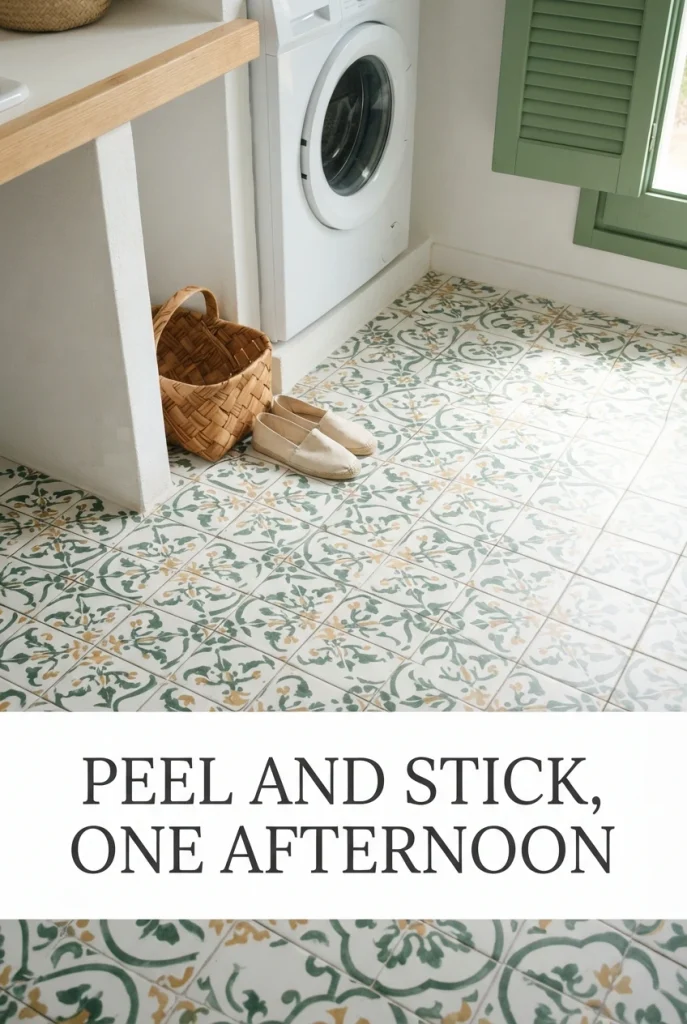
Go lighter than you think, because a dark floor in a windowless room turns it into a cave, and this is where a lot of otherwise good laundry design goes wrong.
Buy ten percent more than your measurement. Cuts, mistakes, and one plank dropped glue side down are all normal.
10. Fix the lighting
Most laundry rooms have one sad bulb in the middle of the ceiling, which means you fold in your own shadow.
Why it is useful for you: good light makes a small room feel larger, and it is the cheapest change on this list. Swap the fixture for a flush mount with a wider spread and a bulb around 3000K to 4000K, because warmer than that and you cannot tell whether the stain came out.
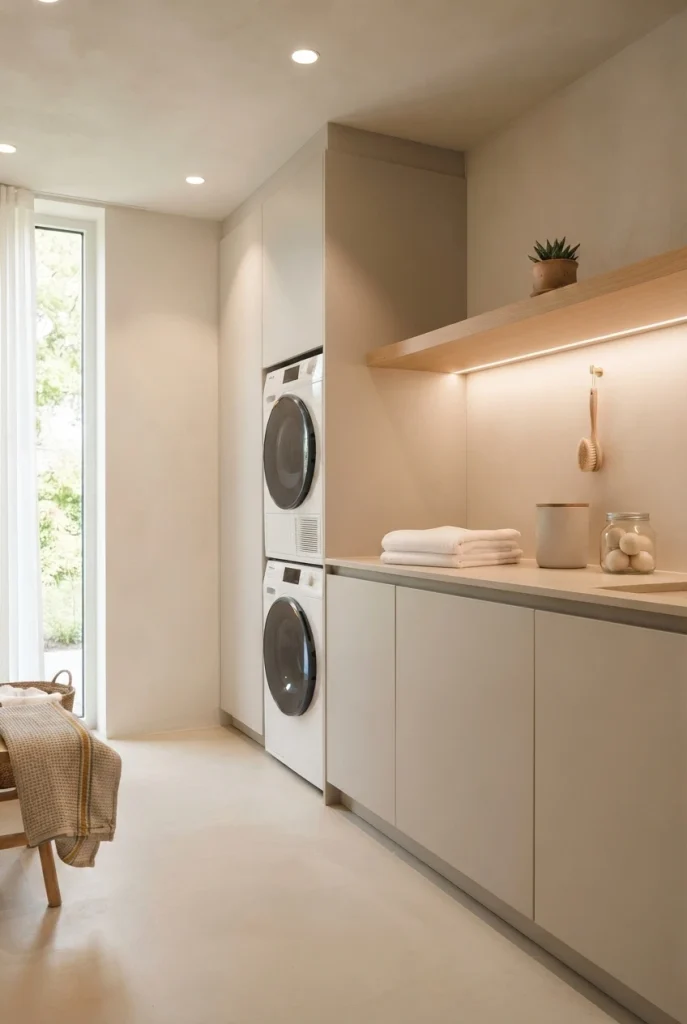
Then add a battery operated LED bar under the shelf. Fifteen dollars, four minutes.
Stick the under shelf light toward the front edge of the shelf. The light falls forward onto the counter instead of onto the wall.
11. Hide the machines behind a curtain
If your laundry lives in a hallway, a closet, or the corner of a bathroom, a curtain is the fastest visual fix in this whole article.
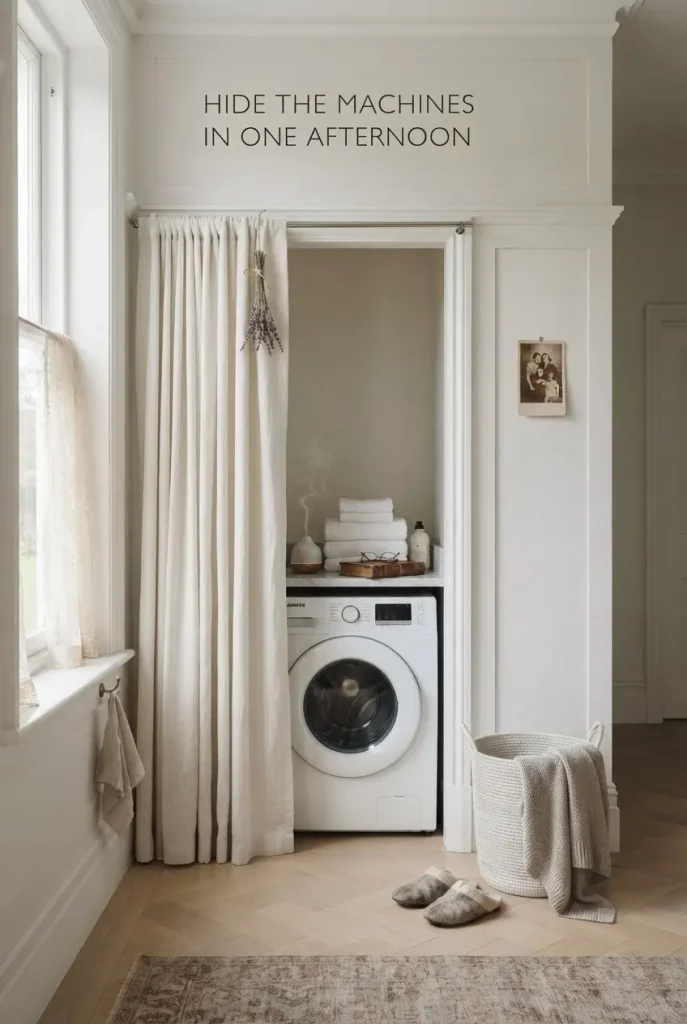
How it works: a tension rod and a linen or cotton panel in the same tone as your walls. Not a bold pattern, since the point is for the machines to stop shouting. Floor length reads as intentional. Half length reads as a temporary solution, which it will then become.
Wash the curtain with the towels every couple of months. It sits in a humid room and it does absorb the smell.
12. Put a Hanging Rod Above the Machines
One short rod, mounted between the shelf brackets or above the counter, holds the shirts that must not go in the dryer.
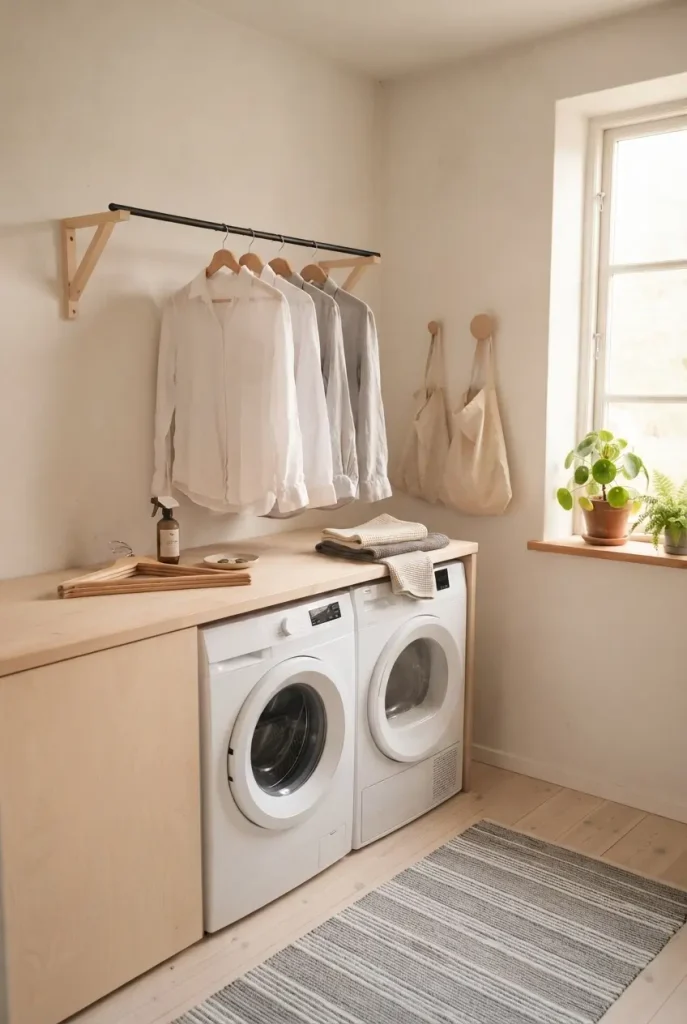
Why it is useful for you: hanging them wet means they dry into shape, so there is no ironing later. This works especially well for anything with a collar and anything you paid too much for.
Keep good hangers right there. If you have to go and find one, the shirt goes in the dryer.
Use the same hanger type everywhere. It costs nothing extra when you replace them gradually and it makes a chaotic corner look calm.
13. Make a separate space for lost socks and other small items
Mesh zip bags for socks, one per person, and everyone puts their own socks in their own bag. Wash the bag, dry the bag, hand back the bag.
How it works: it takes about a week to become automatic, and then the sock problem is over. Small items are also the ones that get caught in the drum seal, so this saves you crawling around behind the machine with a flashlight.

Hang the empty mesh bags on a hook next to the sorting baskets, so filling them is not an extra trip.
14. Use the back of the door
An over the door organizer, a row of hooks, or a narrow rack turns dead space into the most used storage in a tiny laundry room.
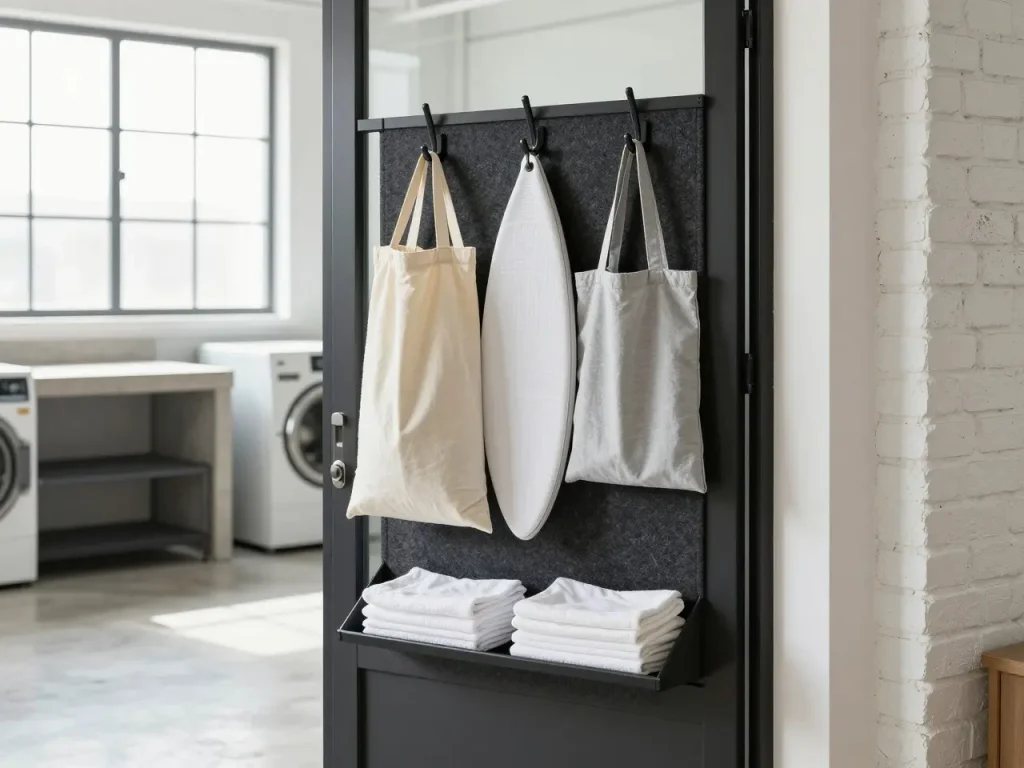
Why it is useful for you: hooks cost almost nothing and hold the awkward items. Two or three, spaced widely, for the laundry bag, the ironing board cover, and the tote you carry upstairs. Check the door clearance first, because over the door hangers add about an inch and a half.
Put the item you use most on the middle hook, at your own shoulder height. Top and bottom hooks quietly become storage for things you never touch.
15. Bring in a plant and a textile
This is where a functional room becomes a room you do not mind standing in.
How it works: one plant that tolerates low light and humidity, so a pothos on the shelf or a snake plant on the floor. Then one textile with actual texture, like a washed cotton runner or a linen towel on the rod.
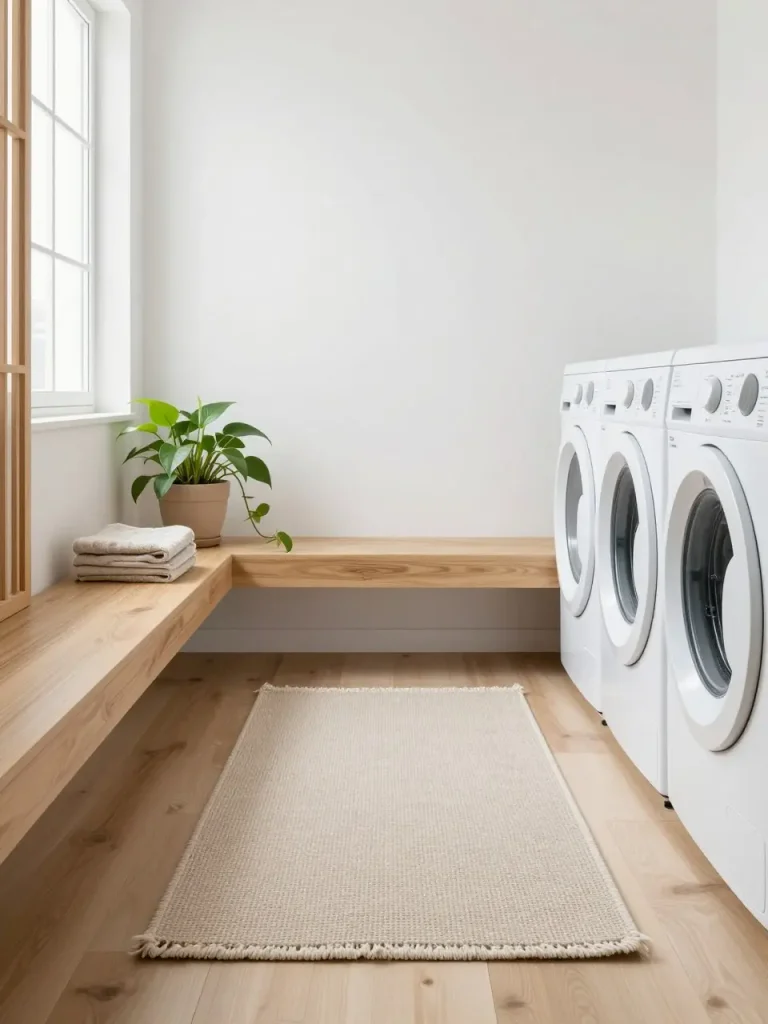
Two items, which is where cute laundry room ideas usually go too far.
If you kill plants reliably, use a glass jar with eucalyptus stems instead. It lasts weeks and the steam brings out the scent.
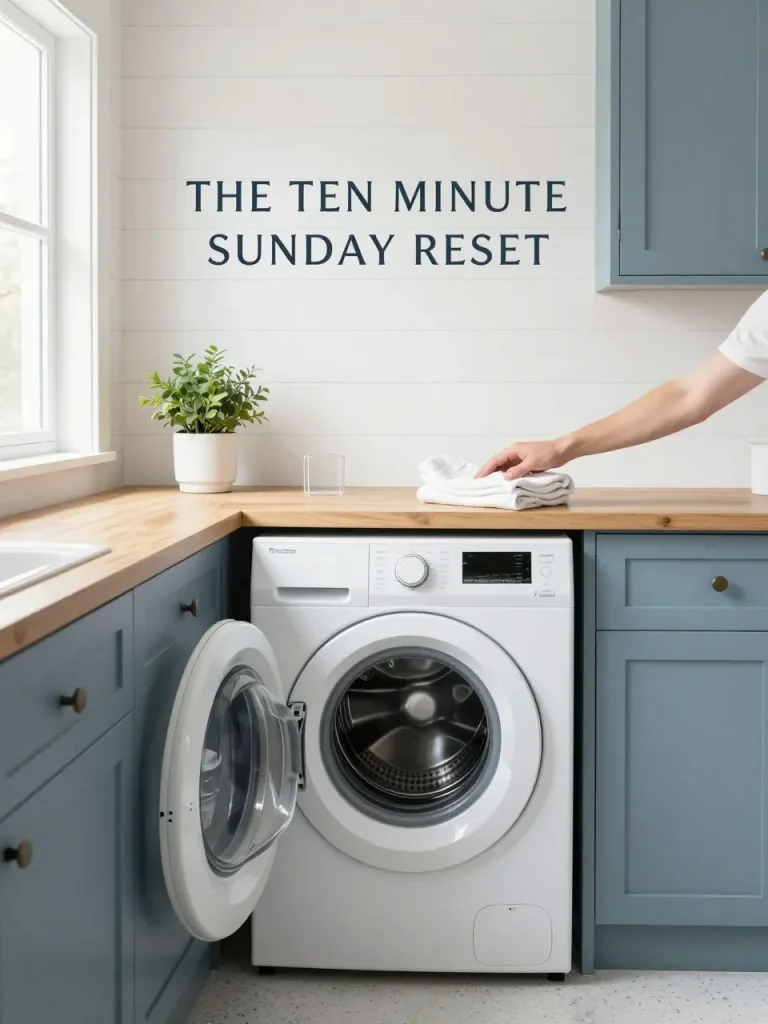
16. Schedule a ten-minute reset to stay organized
A laundry room makeover fails in about six weeks without one small habit attached to it.
How it works: mine runs on Sunday. Wipe the counter, empty the lint trap, put back anything on the wrong shelf, and leave the washer door open so the drum dries.
The lint trap is worth taking seriously. According to NFPA research on home fires involving clothes dryers and washing machines, failure to clean is the leading factor contributing to those fires.
Do the reset before you start the last load, not after. Nothing motivates you once the machine is already running.
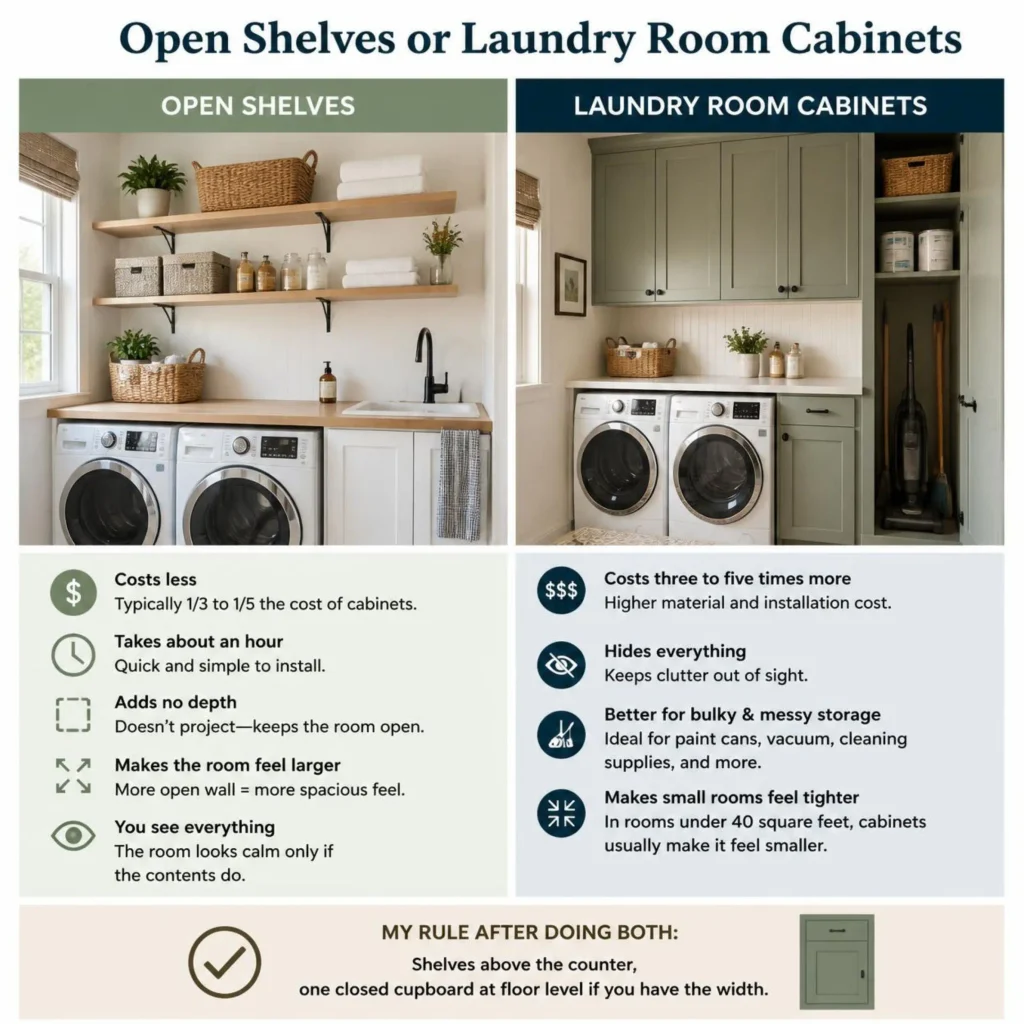
Comparison: Open Shelves or Laundry Room Cabinets
Open shelves cost less, take about an hour, add no depth, and make the room feel larger. They also mean you see everything, so the room only looks calm if the contents do.
Cabinets cost three to five times more, hide everything, and are the better choice if your laundry room also stores paint cans and the vacuum. In a room under forty square feet they usually make it feel tighter.
My rule after doing both: shelves above the counter, one closed cupboard at floor level if you have the width.
What a $1,000 Laundry Room Makeover Really Covers
Let us be honest about the number.
A laundry room makeover on a budget does not buy new machines or a new floor plan. It buys surfaces, storage, light, and paint, which is where nearly all of the visual change lives.
- Paint and supplies land around $60 to $120.
- A butcher block or laminate counter cut to size runs $80 to $250.
- Open shelving with brackets sits near $60 to $150.
- Peel and stick flooring for a small room is often under $150.
- Baskets, jars, hooks, a drying rack, and a rolling cart come to $150 to $300 together.

The Three Tasks of the Laundry Room
This room has to hold dirty clothes, give you somewhere to fold clean ones, and dry what cannot go in the dryer. If it does all three without you moving something first, it works.
Most laundry rooms fail at the middle one. There is nowhere to fold, so clean clothes go to the couch, the couch becomes the folding station, and the laundry never technically ends.
I know, because the same thing happened to us.
I learned this the slow way. For years I carried baskets to the living room, folded in the evening, then carried piles back. When I finally put a plain wooden board across the machines, the laundry started finishing in the laundry room.
My Honest Opinion About Laundry Rooms
I grew up in a small village in eastern Hungary, a few hundred meters from the Tisza river. We had no dryer. Nobody I knew had one.
Laundry went out on a line strung between the fruit trees, and in winter it hung on a wooden rack in the hallway, dripping quietly onto a folded towel.
That sounds charming now. It was just normal. But it left me with a habit I never lost, which is that I air dry most of our clothes.
So when I plan a laundry space, I plan the drying first and the storage second. Most makeover articles do it the other way around.
The Part Nobody Puts in a Laundry Room Makeover Post
Here is a European habit worth stealing.
In most homes I know in Hungary, Italy, and Austria there is no dryer at all. There is simply no room for a second machine and electricity is expensive.
So the space gets designed around drying rather than around a dryer. A rack that lives permanently in the hallway and a line on the balcony or on the patio.
When I walked around New York on my birthday a few years ago, the laundry rooms in the apartments we visited were bigger than my first Budapest kitchen. That was the moment I understood why American laundry articles talk about cabinetry and mine talk about racks.
There is also an another reason to care how this room looks.
A study by Saxbe and Repetti in Personality and Social Psychology Bulletin found that women who described their homes as cluttered showed a flatter daily cortisol pattern, which is linked with higher stress.
You can read the study on home tours, mood and cortisol here.
The laundry room is for us, not against us. It’s not a room where we have to throw everything in and it’s just there unnecessarily in our apartment. The laundry room can also be a room that is tidy and, even though we do work in it, it still feels good to enter it.
What I Would Actually Buy on Amazon
Everything here is something I use or would replace with the same thing.
A slim rolling storage cart for the gap between the machines, three tiers, on casters.
A wall mounted accordion drying rack that folds flat, ideally with wooden dowels.
Wool dryer balls to replace sheets, since they last for years.
Mesh laundry bags in a few sizes, for socks and anything with straps.
A battery operated LED light bar with adhesive backing for under the shelf.
If your machine is old, note that ENERGY STAR certified clothes washers use around twenty percent less energy and thirty percent less water than standard models.
Laundry Room Makeover Checklist
- Empty the entire room and sort before buying anything
- Paint walls and ceiling one light color in a wipeable finish
- Add a folding surface across or beside the machines
- Mount two open shelves at least sixteen inches above the counter
- Screw a fold flat drying rack to the wall you walk past
- Fill the machine gap with a slim rolling cart
- Decant detergent into wipeable jars with readable labels
- Set up sorting baskets under the counter, labeled for your real life
- Fix the lighting with a wider fixture and one task light
- Add one plant and one textile, then stop
Pin this so you can come back to it when you finally have a free Saturday.
Laundry Room Makeover: Questions Readers Ask
How much does a DIY laundry room makeover actually cost?
A DIY laundry room makeover usually runs between $400 and $1,000 when you do the labor yourself and leave the plumbing where it is. Paint, a counter, shelving, lighting, and storage make up most of it. Costs jump when you move a water line or add cabinetry.
What is the first thing I should do in a small laundry room?
The first step in any small laundry room makeover is emptying the room completely, before you buy storage. Most people buy baskets to hold things they would have thrown out anyway. An empty room also shows where the real problem sits.
What is the cheapest way to make a laundry room look better?
The cheapest laundry room upgrade is paint plus one light fixture change, which together cost under $150 and change the room more than any storage purchase. A properly lit room looks finished even before the shelving goes up.
How do I organize a laundry room with no cabinets?
A laundry room with no cabinets works fine with two open shelves, a rolling cart in the machine gap, and hooks on the back of the door. The trick is decanting anything ugly into jars and keeping the visible item count low.
Where should laundry baskets go in a tiny laundry room?
In a tiny laundry room, laundry baskets belong under the folding counter or stacked with front openings, never on the floor in the middle of the room. Keeping the floor clear is what makes a small room usable. Wall mounted canvas hampers take up almost no depth.
How do I stop my laundry room from smelling musty?
A musty laundry room is almost always the washer seal and trapped moisture, so leave the machine door and the detergent drawer open between loads. Wipe the gasket dry once a week and run a hot empty cycle monthly.
Can I do a laundry room makeover as a renter?
A renter can do most of a laundry room makeover with no drilling at all, using tension rods, adhesive hooks, freestanding shelving, and a curtain instead of doors. Peel and stick flooring is removable in many cases, though it is worth asking first.
How long does a DIY laundry room makeover take?
A DIY laundry room makeover takes one to two weekends for most small rooms, with painting on day one and shelving, counter, and storage on day two. Flooring adds a full day if you pull the machines out.
Recommended Reading
Stop Buying Storage Bins You Don’t Need
Minimalist Weekly Reset Routine
Final Thoughts
The laundry room is the least photographed room in the house, and the one we stand in most often on a Tuesday night with wet hands and a full basket.
Making it work has very little to do with the wallpaper. It comes down to whether you can put a basket down without moving something first, and whether clean clothes finish where they were washed.
Mine is small, the floor is peel and stick, and the counter is a pine board I sanded on the terrace while my daughter painted the offcuts. It is my favorite thing in the house that nobody ever sees.
What is the one thing in your laundry room that annoys you every single week?
You May Also Like
-
Sweater Outfits: 11 Fresh Ways to Wear One Burgundy Sweater All Winter
In this post I’ll show you how to wear one burgundy sweater 11 different ways, from a Monday at the office to Christmas Eve dinner. You’ll also find color pairs, the mistakes that make a knit look tired, and simple care tips that keep it soft for years.
-
Christmas Savings Challenge: A Printable Tracker for Weekly and Biweekly Paydays
This christmas savings challenge turns the cost of December into small, planned amounts you set aside from now until the holidays. You’ll find 8 simple challenges with the real math for weekly and biweekly paydays, plus a free printable tracker to color in.
-
Christmas Mantle Ideas: 13 Calm Looks With Zero Clutter
These christmas mantle ideas help you build an elegant fireplace display that looks calm instead of crowded. You’ll find 13 looks, from a lush garland with burgundy velvet to a mantel with a TV above it, plus color pairs and the mistakes worth skipping.