
10 Stylish Laundry Room Ideas for Storage and Function This Fall
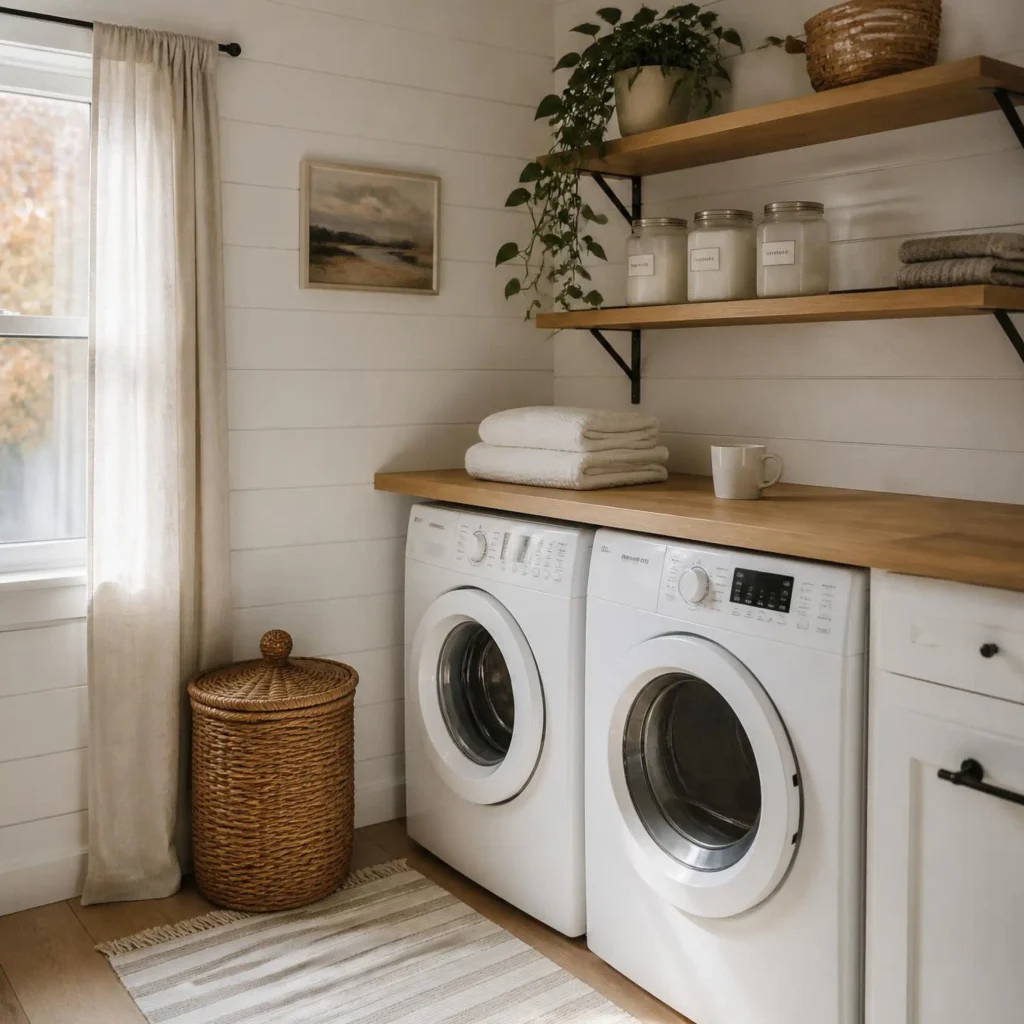
Disclosure: This post contains affiliate links. If you make a purchase through these links, I may earn a small commission at no extra cost to you. Thank you for supporting my blog!
In autumn, when the cold weather arrives, we usually have more laundry to do. There are more thick, knitted clothes, sweaters, pants or jackets, which were completely absent in the summer (that’s why I love summer).
We need to somehow solve the problem so that laundry is not a chaos, but rather some kind of system is introduced into it, as much as possible.
These ten ideas are designed to solve exactly this problem, and one of them is free.
I have washed clothes in a hallway, then in the corner of a bathroom, and now in a narrow space off the kitchen with a cat who sleeps on anything warm.
Fall breaks whatever system you built in July. The washing does not slow down but the drying does, and suddenly there are wet coats, muddy sneakers, and a school uniform that has to be clean by Tuesday. That is the exact problem these ten ideas were built around, and one of them is free.
Here is what you can do in the next five minutes. Take everything off the top of your machines, set it on the floor, and only put back what you have touched in the last two weeks. What stays on the floor is the real reason the room feels chaotic.
10 Laundry Room Ideas That Hold Up From October to March
These are in the order I would actually do them, starting with the one that costs nothing.
1. Start with a visual edit, not a shopping list
Before you buy a single bin, take a photo of your laundry area on your phone.
A photo shows what your eyes have learned to skip over, usually five plastic bottles, three shades of packaging, and a stack of things that live there because nobody decided where else they should go.
Most of what makes a small laundry space feel stressful is visual noise, not lack of storage.

Why this is useful for you: a visual edit is the only laundry room makeover step that costs nothing and works in every space. Rented or owned, tiny or generous.
I did this last September and pulled out four half empty bottles I had bought for one specific stain and never used again. Then I put back only what earns its spot: detergent, an oxygen booster, a stain stick, and a small brush.
Take the photo before you touch anything, then take another one when you’re done and see how different the entire room looks with this inexpensive change.
2. Use the wall above the machines
The square footage in most laundry areas is not on the floor. It is the eighteen to thirty inches of blank wall sitting above the washer and dryer, doing absolutely nothing.
A few shelves change the room.
If you rent and cannot drill, a floor standing unit that frames the appliances does the same job without a single hole, and this over the washer and dryer storage shelf fits a standard pair. For a taller version with a wire basket built in, the Ulif over washer and dryer shelving rack holds more without eating floor space.
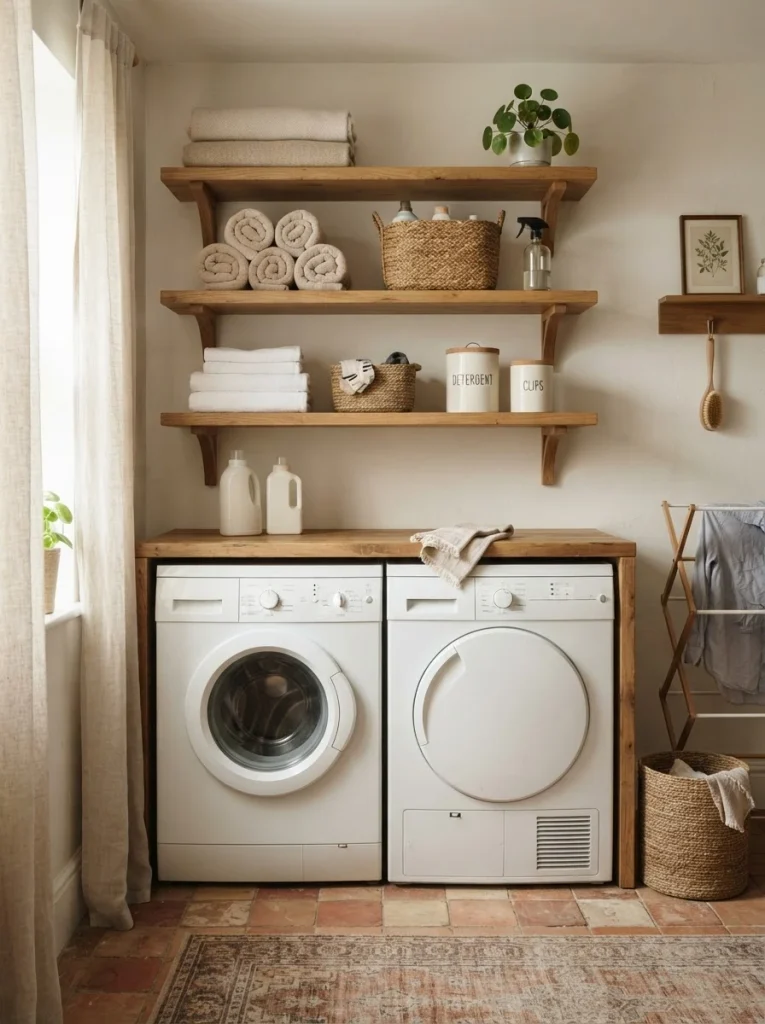
How it works: laundry room shelves keep the tops of your machines clear, and a clear machine top becomes a folding surface later in this list.
Closed laundry room cabinets are calmer to look at, open laundry room shelves are faster to use, and in a room you are in for six minutes at a time I take fast over calm. Keep the bottom shelf for daily items and the top for seasonal ones.
Measure the height of your detergent bottle before you set the shelf height.
3. Build a folding station that fits the room you actually have
A folding station is not a piece of furniture. It is a clear, flat surface at roughly hip height that stays clear, which means most of us already own one.
If you have front loaders, the top of the machines is your station. A cut piece of butcher block or a laminate board laid across both machines gives you a seamless counter, hides the gap, and costs less than almost anything sold as a laundry room folding station.
If you have a top loader, look at the wall instead. A wall mounted drop leaf table that folds flat when you are done gives you a station in a room where a permanent counter would never fit.
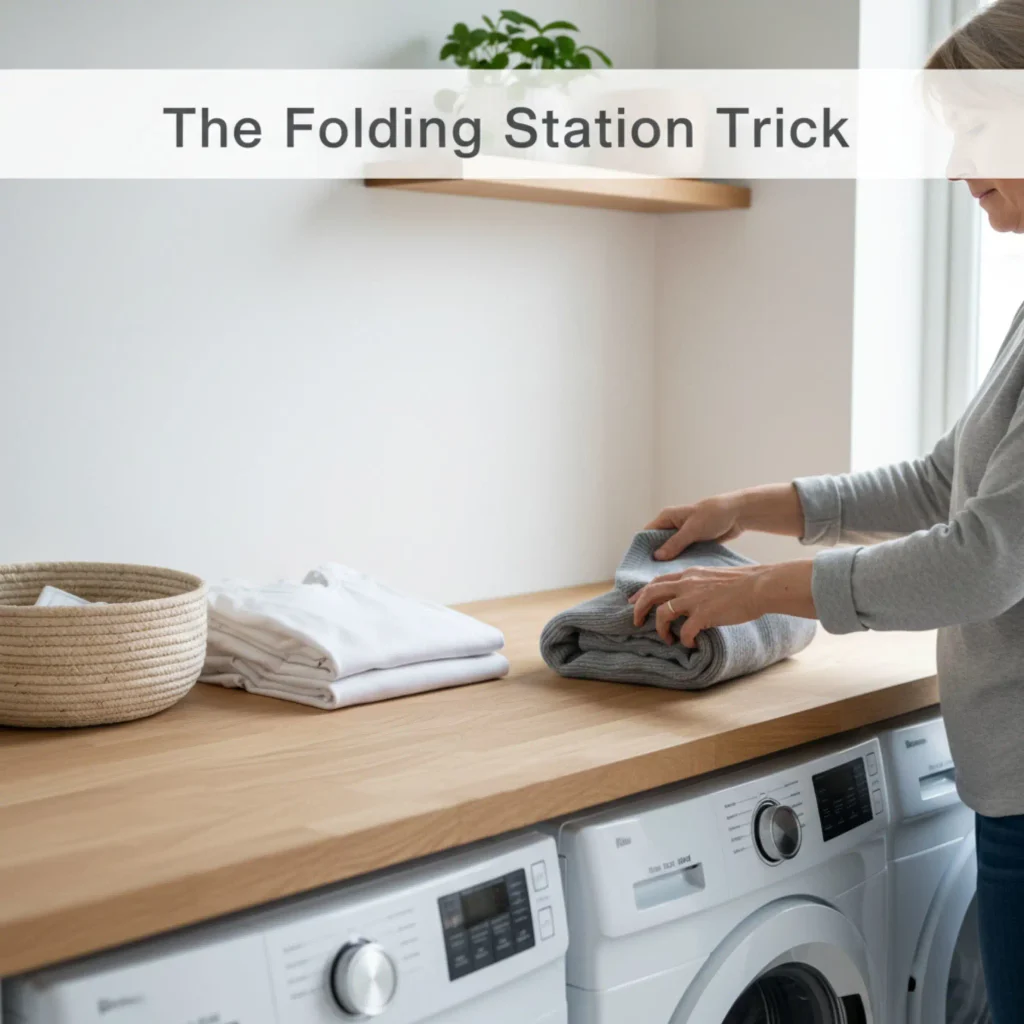
Why this is useful for you: clothes folded within a few minutes of the dryer stopping do not need ironing, and in fall that saves real time when everything is thicker and creases harder. (I really hate ironing our clothes, I don’t have time for it.)
Clear your folding surface completely tonight, then treat it the way you treat a kitchen counter.
4. Give every laundry basket one job
Most homes do not have too few baskets. They have too many baskets doing vague jobs, which is why clean and dirty laundry end up in the same room looking identical.
Give each one a single, named purpose. Darks, lights and towels, clean laundry waiting to go upstairs, and one small basket for anything that needs attention, like a missing button or a stain that needs a soak.
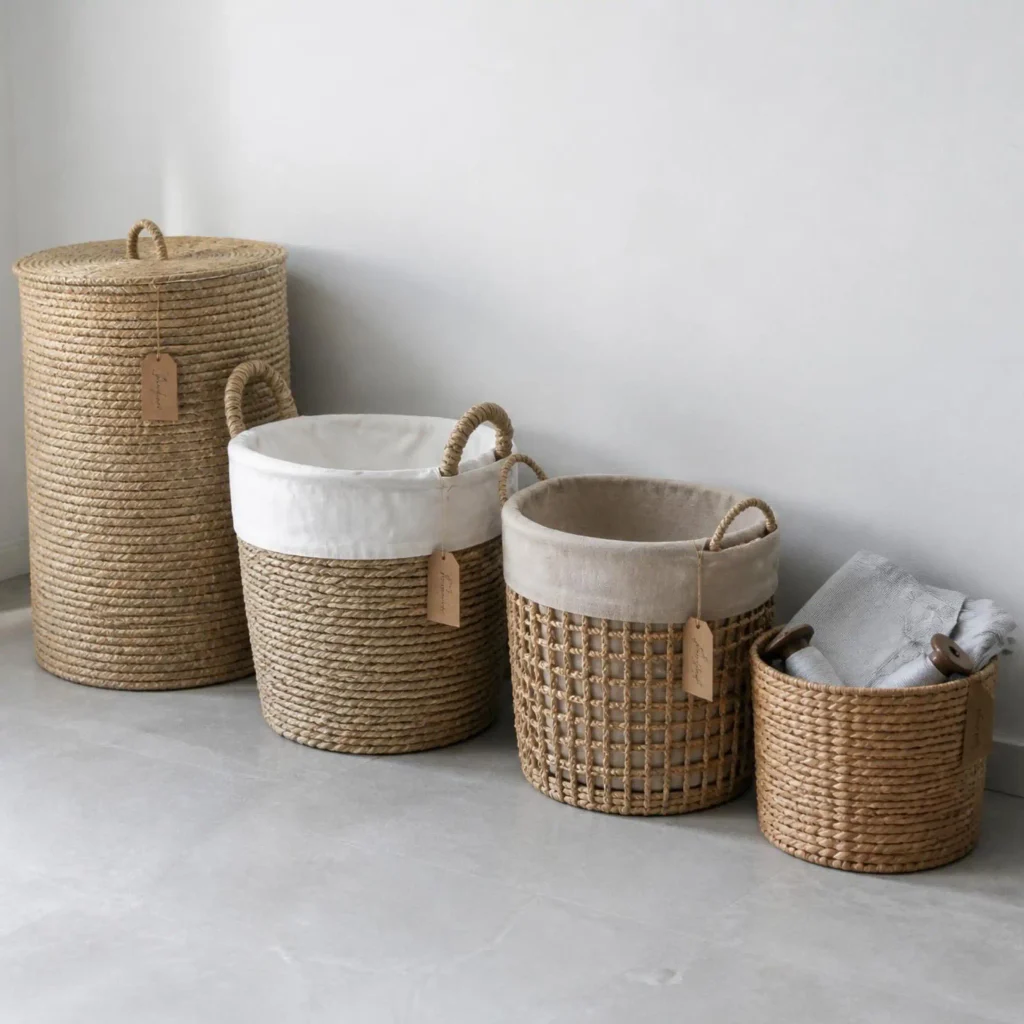
How it works: if you sort your clothes when you get undressed, you actually save time because you don’t have to worry about it when washing.
The American Cleaning Institute’s guide to sorting laundry is worth two minutes, because sorting by color and fabric weight is what keeps dark fall clothes from going gray.
For laundry basket storage that does not look like storage, a seagrass hamper with a lid and a removable liner hides the contents.
5. Put a drying rack on the wall
From October to March, I can’t really use the yard for hanging out, so everything dries inside. The drying rack in the middle of the room serves its purpose, but it’s not the prettiest sight for my minimalist soul.
So we had to find a normal solution, and a wall-mounted dryer is the best solution. It folds down a few inches and can hold a full load of shirts.

A foldable wall mounted drying rack with six rods is enough for one load.
Why it’s good for you: Knitwear, leggings, and anything with elastic will last for years if you air dry it. In a sustainable wardrobe, the dryer is usually the way to go, and while it’s convenient, it can quickly ruin your clothes.
Hang heavy items nearest the wall and light ones on the outer rods, since the outer edge gets more air movement. Give sweaters a flat surface instead, because hanging a wet wool sweater is how you end up with sleeves that reach your knees.
Mount it into studs, not just drywall anchors.
6. Manage the moisture
A single load drying indoors puts a surprising amount of water into your air, which researchers have measured in full scale studies of indoor laundry drying and water emission rates.
That water has to go somewhere. In a closed room in November it goes into the walls, the window frames, and eventually into that faint damp smell you cannot trace.

How it works: the EPA recommends keeping indoor humidity below 60 percent, ideally between 30 and 50 percent, because mold needs moisture to grow at all. A cheap hygrometer tells you where you stand in about ten seconds.
Three things fix most of it. Crack the window for ten minutes after you hang a load, run the extractor fan if you have one, and keep the door open so the moist air is not trapped.
If your space has no window at all, a small quiet dehumidifier under the drying rack does the work for you, and it cuts drying time as a side effect.
7. Make a wet weather drop zone right where people come in
Half of what clogs a laundry room in fall never belonged there. It is wet coats, muddy boots, one glove, and a backpack that got rained on, and it lands there because there is nowhere else obvious.
So build the obvious place. Three hooks at adult height, two low enough for a six year old, a boot tray that catches the melt, and a lidded basket for hats and gloves.
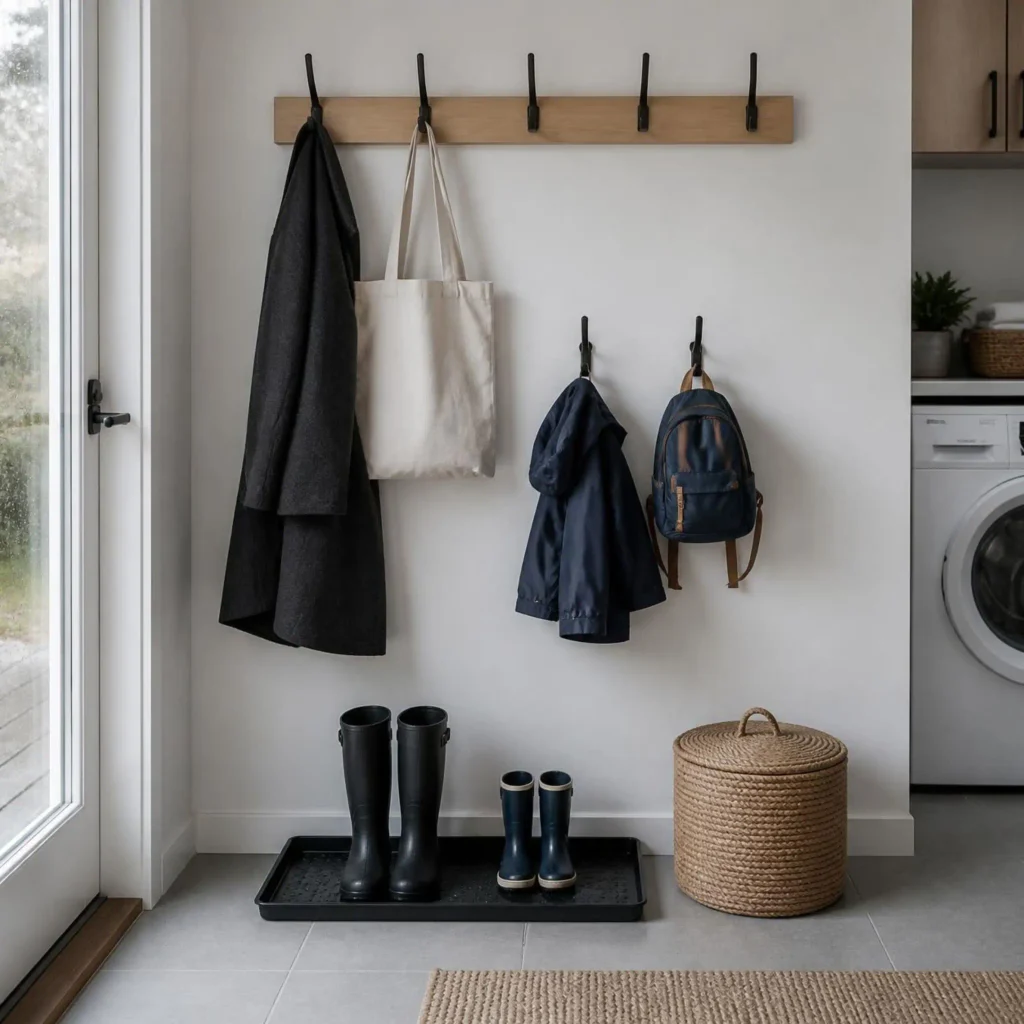
Why this is useful for you: a drop zone keeps outdoor water in one contained square.
My daughter started school this year, so her coat and backpack come home wet in the wet and cold weather. Her hangers are at her own height, so she can reach them without help.
Once a week, take everything off the hooks and dry the hooks themselves, since damp metal and damp wool sitting together for four months is how a mildew smell starts.
Hang one extra hook that stays empty.
8. Use the narrow gaps
There is almost always a gap, for example between the washer and the wall, between the two machines, or in that useless six inches beside the door, and in tiny laundry room setups that strip of space is valuable.
A slim rolling cart slides into a gap as narrow as seven inches and pulls out like a drawer.
This slim rolling storage cart made for the space between a washer and dryer is the type that fits.

How it works: narrow storage on wheels turns dead space into a full column of shelves. Very small laundry room ideas are mostly about direction. When you cannot go wider, you go up, and when you cannot go up, you go narrow.
The other overlooked gap is the back of the door. A slim over the door organizer holds mesh wash bags, a spare lightbulb, and the delicates you always mean to wash separately and never do.
Measure first, including the door frame depth, because I once bought an organizer that made the door impossible to close.
Measure the narrowest gap in your laundry space today and write the number in your phone notes, so you have it when you shop.
9. Fix the light
Laundry rooms are almost always lit by one cold ceiling bulb. You cannot see a stain properly, and the room feels like a utility closet at four in the afternoon.
Change the bulb to something around 3000K, which reads as warm white without going yellow, and add a puck light inside a dark cabinet.
Then add exactly one soft thing. A washable runner, a linen curtain instead of a cabinet door, or a stack of folded towels in a color you like looking at.
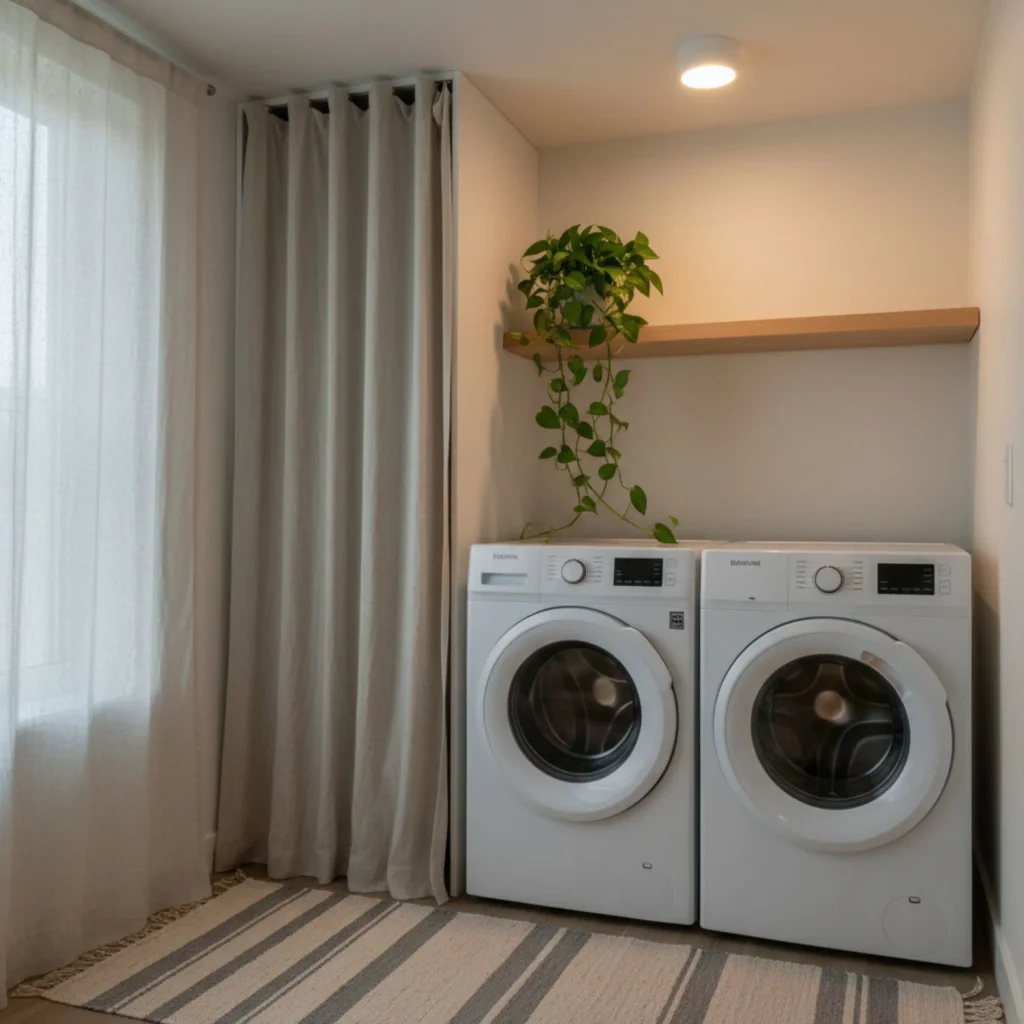
Why this is useful for you: your surroundings act on your body and soul more than we like to admit.
In a study in Personality and Social Psychology Bulletin, women who described their homes as cluttered and unfinished showed flatter daily cortisol patterns than women who described their homes as restorative.
Cute laundry room ideas do not require a renovation. One warm bulb, one textile, and one plant that tolerates low light will change how the room feels far more than new cabinet fronts. I keep a small pothos on the shelf above my machines.
Swap the bulb this weekend, before you buy anything else for the room.
10. Put the lint and vent routine on the calendar
This is the least charming idea on the list and the one I would not skip. Dryers run hardest in fall and winter, and lint is not just fluff, it is fuel.
The National Fire Protection Association’s research on home fires involving clothes dryers shows failure to clean is the leading cause of these fires.
Clean the lint screen after every single load. Once a season, pull the machine out and clean the vent duct itself, where the buildup you cannot see collects.
A long flexible dryer vent cleaning brush reaches the whole run in about fifteen minutes.

How it works: a clear vent means shorter drying cycles, lower bills, and a machine that lasts longer. A blocked vent makes your dryer work twice as hard for the same result.
While you are at it, look at what goes in the drum. Wool dryer balls separate the load so air moves through it, cut drying time, and replace dryer sheets completely.
If you ever replace the machine itself, look at heat pump models. According to ENERGY STAR, heat pump dryers use around 70 percent less energy than conventional dryers, which adds up over a winter when the dryer runs almost daily.
The Laundry Room I Grew Up With Had No Dryer At All
I grew up in a small village in eastern Hungary, a few hundred meters from the Tisza river, in a house where nothing was ever thrown away.
There was no laundry room. There was a line in the garden, a bar of soap, and my grandmother who could get a stain out of anything.
In winter the washing froze solid on the line. My mother would carry in shirts that stood up on their own like cardboard, lean them against the kitchen wall, and let them thaw by the stove. It sounds miserable and it was, a little, but the clothes lasted for years.
Here is the part that surprises most American readers. Across much of Europe a dryer is still not standard equipment, and people dry indoors on racks all winter with an open window and a bit of patience.
I am not suggesting you give up your dryer. I am saying the assumptions built into most laundry room ideas, the double machines and the deep counters and the dedicated room, are one way of doing this and not the only way.
The Prettiest Laundry Rooms Are Often the Slowest
This is where I disagree with the internet. The laundry rooms that go viral, with matching glass jars and wallpaper and brass hardware, are often slower to use than a plain room with two shelves.
Decanting detergent into a beautiful jar means you now do a task you did not do before. Powder in a jar with a scoop makes sense. Liquid poured from a heavy glass vessel over a machine is a spill waiting to happen, though a set with a pump and a drip tray solves most of that if you love the look.
Ask one question about every pretty thing you are tempted to add. Does this remove a step, or add one? A basket that hides clutter removes a step. A label maker session that requires you to keep labels accurate forever adds one, for the rest of your life.
The best small laundry room organization I have seen was in a rented Budapest apartment. Two open shelves, one rolling cart, a wall rack, a lidded basket. That’s it.
A Laundry Room Checklist Worth Keeping
Save this list for later, because it is the one to run through at the start of every season.
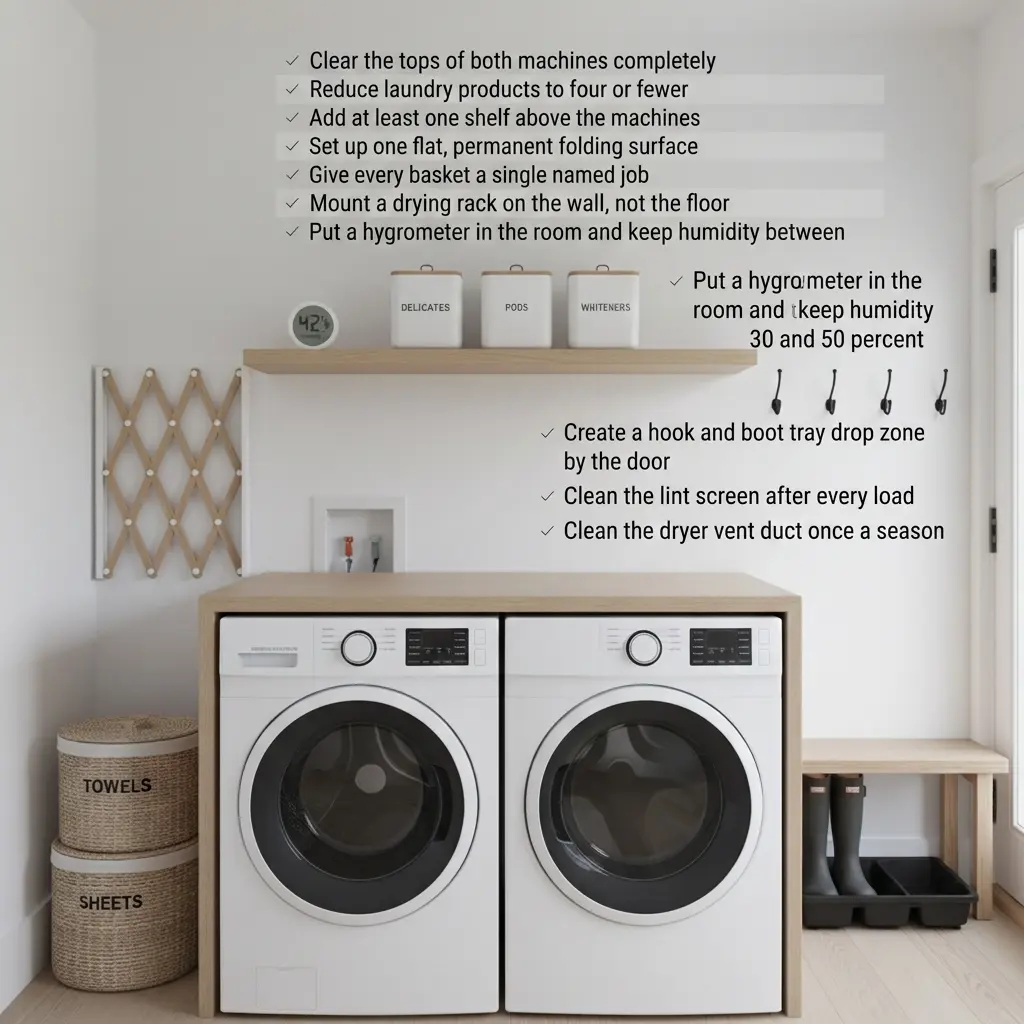
3 Small Things You Can Do Today
- Everything off the machine tops, only what you use weekly back on.
- Measure your narrowest gap and the wall above your machines, and save both numbers in your phone.
- Take out the cold ceiling bulb, put in a warm white one, and look at the room again in the evening.
Related post: If your whole house needs this kind of small reset rather than just one room, my minimalist habits for a calm home post works the same way, one small change at a time.
Laundry Room Ideas: Questions Readers Ask
How do I make a laundry room work when it is really just a closet?
A laundry closet works when you use height instead of floor space. Put one shelf above the machines for products, mount a folding rack on the back wall or the inside of the door, and keep one lidded basket on the floor instead of three open ones. Nothing else belongs on that floor.
Is it bad to dry clothes indoors during winter?
Drying clothes indoors in winter is fine as long as you deal with the moisture it releases. A drying load puts real water into the air, so ventilate for ten minutes afterward, keep the door open, and check that humidity stays under 60 percent. Problems start in closed rooms with no airflow.
What is the cheapest laundry room makeover that actually looks different?
The cheapest laundry room makeover is a warm bulb, a decluttered shelf, and one textile. Swap the cold ceiling light for a 3000K bulb, cut your products down to four, and add a washable runner. That is usually under forty dollars and it changes the room more than new cabinets would.
How many laundry baskets does a family of four really need?
A family of four works well with four baskets, each with one job. Darks, lights and towels, clean laundry waiting to be put away, and a small repair basket for anything with a missing button or a stain that needs soaking. More than that and they stop having clear purposes.
Where do I put a folding station if there is no counter space?
A folding station without counter space goes on the wall or on top of the machines. A wall mounted drop leaf table folds flat when you are done, and a board laid across two front loaders gives you a full counter for almost nothing. Both beat folding on a bed.
How often should a dryer vent be cleaned?
A dryer vent should be cleaned at least once a year, and once a season if you run the dryer most days. Lint builds up in the duct where you cannot see it, restricting airflow and creating a fire risk. The lint screen itself needs clearing after every single load.
My laundry room always smells damp. What am I missing?
A persistent damp smell usually comes from the washer door seal and the humidity in the room, not from the laundry itself. Leave the door and detergent drawer open between loads, wipe the rubber gasket dry weekly, and run a hot empty cycle monthly. Then check the room humidity.
Can I do any of this if I rent and cannot drill holes?
Renting rules out drilling but not storage. A freestanding over the machine unit, a slim rolling cart, an over the door organizer, and a floor drying rack cover almost everything here without a single hole. Removable adhesive hooks handle the drop zone if you stay under their weight limit.
Recommended Reading
If your laundry pile is really a wardrobe problem, start with decluttering your closet this fall, because fewer clothes means fewer loads.
For what goes into the machine, my post on natural cleaning solutions covers what works and what you can stop buying.
And for a rhythm rather than a one time reset, the Sunday reset checklist is where laundry stopped ambushing me on Monday mornings.
Laundry is one of the few tasks in a house that is never finished. There is no version of this where you get to the bottom of the basket and stay there, and I made my peace with that years ago.
So the goal was never a beautiful room. It was six minutes instead of twenty, a floor you can walk across in the dark, and clothes that come out of winter looking like they did in September.
That is what these ten ideas are for. Not a laundry room that photographs well, but one that quietly stops costing you time on the days you have the least of it.
Which one are you going to start with this week?
Recommended Articles
-
Sweater Outfits: 11 Fresh Ways to Wear One Burgundy Sweater All Winter
In this post I’ll show you how to wear one burgundy sweater 11 different ways, from a Monday at the office to Christmas Eve dinner. You’ll also find color pairs, the mistakes that make a knit look tired, and simple care tips that keep it soft for years.
-
Christmas Savings Challenge: A Printable Tracker for Weekly and Biweekly Paydays
This christmas savings challenge turns the cost of December into small, planned amounts you set aside from now until the holidays. You’ll find 8 simple challenges with the real math for weekly and biweekly paydays, plus a free printable tracker to color in.
-
Christmas Mantle Ideas: 13 Calm Looks With Zero Clutter
These christmas mantle ideas help you build an elegant fireplace display that looks calm instead of crowded. You’ll find 13 looks, from a lush garland with burgundy velvet to a mantel with a TV above it, plus color pairs and the mistakes worth skipping.