21-Item Sunday Reset Checklist for Overthinker Women
If your Sunday resets usually involve twenty minutes of deciding how to start, followed by ten minutes of feeling bad about this situation, this list was made for you.

I know this because my Sunday resets look exactly like that. I will make a coffee, sit down with my planner, and then spend a good chunk of time thinking about the optimal order to do things in.
Should I clean first so the environment is clear? Journal first so my head is clear? Or start with the laundry because it runs itself and I can do other things in parallel?
By the time I have finished thinking about it, the coffee is cold and I have used up the best energy of the morning on a logistics problem that did not need solving.
The order barely matters. The doing is what matters.
This checklist is for the women who get it done anyway. Who carry the weight of the week in their shoulders until Sunday, then spend the day quietly setting things back to order so Monday does not feel like an ambush.
Who feel everything a bit more than average, process it a bit more slowly, and are completely exhausted by it while also somehow managing to be the most reliable person in every room they walk into.
Twenty-one items. Do them in whatever order your overthinking brain settles on. All of them count.
What You Will Find in This Sunday Reset Checklist
- 21 Sunday reset ideas organized by category: mind, space, body, week ahead
- The actual reason overthinkers struggle with reset routines, and why it is not what you think
- A saveable quick-start version for Sundays when even 21 items feels like a lot
- Real talk on why doing five things well beats doing twelve things halfway
- Q&A for the specific overthinking traps that derail a Sunday reset before it starts
What You Actually Need for a Sunday Reset Routine
Not a four-hour block. Not a perfect, empty house. Not the motivation that Instagram suggests arrives fully formed on Sunday mornings in cream-colored linen.
What you need is a list you trust and permission to start anywhere on it. The Sunday reset works for overthinkers specifically because it removes the decision-making from the process. The decisions are already made. The list tells you what to do. Your only job is to pick one thing and begin.
A notebook helps. A timer helps more. And a cup of something warm that you make before you look at your phone is the single best investment you can make in the quality of your Sunday.
Overthinkers Are Not Bad at Reset Routines – They Are Too Good at Them.
Here is the thing nobody says: overthinkers are not avoiding the reset. They are pre-doing it. Mentally. At significant detail.
By the time a sensitive, analytical woman sits down on Sunday morning, she has already walked through the week ahead seventeen times in her head.
She knows which tasks are going to be hard, which conversations she is dreading, where the gaps are in the schedule, and which of her kids’ needs she has not fully addressed yet.
That is not procrastination. That is thorough, involuntary preparation.
The problem is it happens before coffee, often at 3am on Saturday, and it costs the same energy as actually doing the things.
The Sunday reset works best for this personality type when it includes items that address the mental load directly: writing things down, making decisions, clearing tabs both literal and mental. Not just cleaning the kitchen. Processing the week.
I spent years with this exact Sunday pattern: excellent mental preparation, mediocre execution, lingering guilt. What changed was realizing that my reset needed to start with the things inside my head before I could make progress on the things outside it.
Clear the mind first. The surfaces follow.
For a more structured approach to the mental side of weekly resets, Therapy in a Nutshell’s breakdown of overthinking and why it happens is one of the most practical resources I have found. It explains why the thinking loop runs without stopping and what actually interrupts it.

Try this
Before you start the checklist: open a blank page and write down everything that is currently running in your head.
Not a to-do list, just everything: the worry about that email, the thing you forgot to say, the plan you have not made yet, the feeling you have not named. Write until it is empty.
This is your pre-reset reset. It takes eight minutes and it changes what the next two hours feel like entirely.
Why the Sunday Reset Matters More for Sensitive Women
Sensitive women carry more sensory and emotional data across the week than most people realize. More noticed, more processed and more stored. Research on sensory processing sensitivity by Dr. Elaine Aron shows that HSPs process experiences more deeply and thoroughly, which means the accumulated weight of a week is genuinely heavier for them than for someone with a less sensitive nervous system.
A Sunday reset is not optional maintenance for this type of woman. It is how the week gets closed. Without it, Monday arrives and the previous week is still partially open in the background, running processes, consuming attention.
The Highly Sensitive Refuge’s guide on weekly routines for HSPs makes the useful point that structure is not the opposite of sensitivity. For many sensitive women, a predictable weekly rhythm is what creates enough safety to actually feel things rather than just manage them.
And for the overthinking piece specifically, Psychology Today’s overview of rumination and how to stop it covers why writing things down works better than thinking them through, and why that distinction matters especially on Sundays when the upcoming week is already generating mental noise.

21-Item Sunday Reset Checklist for Overthinkers
Part 1: Clear Your Mind
1. Write Down Everything That Is Circling in Your Head
Every unfinished thought, every item you keep forgetting, every low-grade worry. Get it out of your head and onto paper. You cannot reset a brain that is still running background processes. This is the step that makes all the other steps easier.
Why it works: writing externalizes the mental loop. The brain keeps rehearsing incomplete tasks because it is trying not to lose them. Once they are written, it can stop rehearsing.
2. Review Last Week Without Judgment
What happened. What you handled. What you dropped. Not a performance review, a simple debrief. Two minutes. One page. What went well, what did not, what you want to do differently. Then close it.
Why it works: overthinkers replay the week continuously without resolution. A structured, time-limited review gives the replay a defined endpoint.
3. Write Down Three Things You Actually Did Well This Week
Not three things you should have done better. Three things that went right. This is harder than it sounds for overthinkers and sensitive women, which is exactly why it is on the list. The brain that notices every mistake needs an explicit prompt to notice the wins.
Why it works: negativity bias is stronger in highly sensitive people. An intentional gratitude or accomplishment prompt counterbalances it without bypassing the real experience.
4. Close Your Open Mental Tabs
For every unfinished thing on your mental list: either schedule it, delegate it, or consciously decide to let it go. A thing on the list with no action attached is not a plan. It is just weight.
Why it works: decision fatigue is real, and overthinkers carry more undecided items than most people. Making even small decisions on a Sunday reduces the cognitive load of the following week.
5. Send the Message You Have Been Putting Off
The check-in text. The reply you drafted three times but never sent. The thing you keep moving to next week. Send it now, while you are in reset mode and the resistance is slightly lower than it will be on Tuesday.
Why it works: deferred communications sit in working memory and consume attention continuously. One sent message removes that load entirely.
6. Write Tomorrow’s Top Three Priorities
Just Monday. Not the whole week. Three things that, if done, would make Monday feel like a success. Write them the night before and put them somewhere you will see them when you wake up.
Why it works: the Monday morning anxiety spiral is mostly about uncertainty. Three specific priorities replace the open-ended question of what do I do with what is already decided.
For a full approach to managing the morning that follows your Sunday reset, the slow morning routine guide how to start Monday from a genuinely settled place rather than a reactive one.

Part 2: Reset the Space
7. Do One Load of Laundry Start to Finish
Wash, dry, fold, put away. One complete loop. Not two loads started and sitting in the machine. One finished load is more satisfying than four loads in progress and nothing wearable on Monday.
Why it works: completion is disproportionately satisfying for overthinkers who are used to having many things partially done. A single finished task provides evidence that finishing is possible.
8. Clear One Surface Completely
Not the whole house. One surface. The kitchen counter, the desk, the dining table. Clear it, wipe it, leave it empty. One clear surface in the house does something to the nervous system that a generally tidied room does not quite replicate.
Why it works: visual clutter is a continuous low-level stressor for sensitive women. One deliberately empty surface functions as a reset point the eye returns to all week.
9. Tidy the Space You Spend the Most Time In
Your desk, your reading corner, your side of the bedroom. The space that is most yours. Not a deep clean. A tidy: things in their place, surfaces clear, nothing visually demanding.
Why it works: having your primary space in order creates a sense of control that extends outward. You feel more settled in your body when the environment around you is settled.
10. Check the Kitchen Before Bed Sunday Night
Empty the sink, wipe the counter, set the coffee maker for Monday. Three minutes on Sunday night is worth thirty minutes of Monday morning friction. This is not cleaning. This is setting the stage for the week.
Why it works: walking into a clean kitchen Monday morning is a small sensory win that sets a different tone than walking into yesterday’s dishes.
For the full kitchen routine that keeps this feeling consistent across the week, the kitchen cleaning hacks guide exactly how to maintain a clean kitchen without it consuming the whole evening.
11. Do a Quick Sweep of the Shared Spaces
Shoes by the door, pillows back on the sofa, cups back to the kitchen. Ten minutes, no judgment about how it got this way. The sweep is not for cleanliness. It is for the particular relief of walking through your own home and not being greeted by evidence of the previous week at every turn.
Why it works: a home that feels manageable on Sunday evening makes Monday feel like a fresh start rather than a continuation of the same tired week.
12. Put Fresh Flowers or a Plant Somewhere Visible
One thing that is alive and beautiful in a place you will see every day. It does not have to be expensive. A single stem. A propagated cutting. The plant you have been meaning to repot sitting in a better spot now that the surface is clear.
Why it works: sensitive women respond strongly to their visual environment. One intentional, beautiful element signals that the space is cared for, which is a signal about the self as much as the room.

Part 3: Reset the Body
13. Move Your Body in a Way That Feels Good
A walk. Stretching on the floor while listening to something you love. A slow yoga session with no goal. Not exercise as obligation. Movement as maintenance. Your body carried the week too. It deserves something gentle before the next one starts.
Why it works: physical movement processes stored stress in a way that thinking about the stress does not. For overthinkers who have spent the week largely in their heads, moving the body is a necessary counterweight.
14. Eat Something You Actually Made
One meal on Sunday that you prepared with attention. Not fast, not grabbed. Something that required you to chop something, stir something, stand in the kitchen for fifteen minutes. The act of making food slowly is its own kind of reset.
Why it works: the sensory experience of cooking something from scratch, the smell, the warmth, the physical attention it requires, pulls you out of your head and into your body in a way that is genuinely regulating.
15. Take a Bath or a Slow Shower
Not functional. Warm water, no rush, no phone on the edge of the tub. The specific temperature that tells your nervous system the day is winding down. This is not a luxury. For sensitive women, it is maintenance.
Why it works: warm water lowers cortisol, relaxes muscle tension that has been accumulating all week, and provides a clear sensory transition that the brain registers as a change of mode.
16. Go to Bed at a Time That Makes Monday Possible
Not the time you want to go to bed because you are finally alone and the house is quiet. The time that gives you enough sleep to be a functioning version of yourself when the alarm goes off. Sunday nights are when overthinkers most reliably stay up too late, and Monday mornings are when they most regret it.
Why it works: sleep is the most powerful reset available and also the most skipped by women who finally have quiet time after everyone else has gone to bed. The reset only works if the body gets to finish it.

Part 4: Set Up the Week
17. Check the Calendar for the Week Ahead
All of it. What is scheduled, what needs to be scheduled, what needs preparation before it arrives. Do this once, completely, on Sunday, so your brain does not have to keep checking throughout the week to make sure it has not missed anything.
Why it works: the anxiety of possibly having forgotten something is often worse than the actual forgotten thing. A complete calendar review on Sunday closes that loop.
18. Prep One Meal or Snack for the Week
Not a full meal prep. One thing. A batch of hard-boiled eggs. A container of cut vegetables. A pot of grains. One item that makes three meals slightly easier this week is worth fifteen minutes of Sunday.
Why it works: decision fatigue peaks at mealtimes during busy weeks. Having one prepared element removes at least one decision per day, which is more valuable than it sounds.
19. Lay Out What You Need for Monday Morning
Clothes. Bag. Keys. Anything that needs to go with you. The version of you on Monday morning is less resourced than the version of you on Sunday afternoon. Help her out.
Why it works: the energy required to make decisions and locate items under time pressure is exactly the energy that sensitive women do not have in surplus on Monday morning. Removing those tasks from Monday removes the friction that turns a hard morning into a genuinely bad one.
20. Set One Intention for the Week
Not a resolution. Not a goal. One word or one sentence for how you want to feel or who you want to be this week. Patient. Present. Focused. Honest. Something to come back to on Wednesday when the week has gotten complicated.
Why it works: overthinkers operate in great detail all the time. A single broad intention provides a north star that can orient the detail without overwhelming it.
21. Give Yourself Credit for Doing the Reset at All
This sounds soft. It is not. Sensitive women who carry a lot, process deeply, and hold high standards for themselves are consistently the last ones to acknowledge that maintaining themselves is an achievement. You did the reset. That matters. It is what makes next week different from this one.
Why it works: self-acknowledgment is not vanity. It is the neurological signal that tells the brain the effort was worth making. Without it, the motivation to do the reset again next Sunday quietly erodes.
For the broader evening practice that supports a good reset, the night routine guide the hours between the reset and sleep, which are often where sensitive women undo the work they just did.
The Sunday Reset Is Not About Productivity. It Is About Dignity
In Hungary, Sunday still has a different quality than the rest of the week. Not spiritual necessarily, just slower. The shops are mostly closed. The streets are quieter. There is a cultural permission to stop that does not exist on other days.
I did not fully appreciate that until I spent a few years in the constant-output mode that most productivity culture promotes. The mode where Sunday is just an extension of the productivity week with a slightly different task list.
What I know now is that the Sunday reset is not about doing more. It is about treating yourself with enough care to close one week properly before another one opens.
That is not luxury. That is the minimum standard for a life that does not slowly collapse under its own weight.
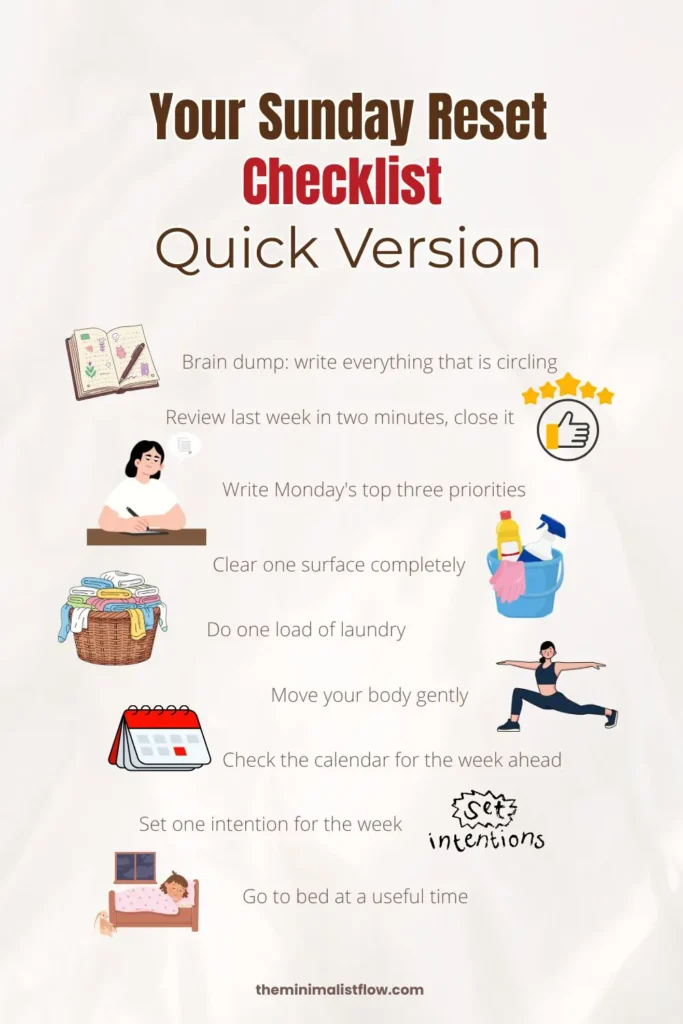
Your Sunday Reset Checklist: Quick Version
Save this for the Sundays when twenty-one items is too much.
- Brain dump: write everything that is circling
- Review last week in two minutes, close it
- Write Monday’s top three priorities
- Clear one surface completely
- Do one load of laundry
- Move your body gently
- Check the calendar for the week ahead
- Set one intention for the week
- Go to bed at a useful time
Pin this Sunday reset list so you have it when Sunday arrives and your brain is already running scenarios for next week.
Start Right Now
- Open a blank page and write for five minutes. Everything in your head. No structure, no editing. Just clear the buffer.
- Pick one item from the list above and do it next. Not the optimal one. Not the most important one. Just the one you will actually do right now.
- Set a timer for 45 minutes. Tell yourself you are doing a reset until the timer stops. When it stops, you are done for the day. Whatever you finished, finished. Whatever you did not, did not.
The 10-Minute Sunday Reset: When That Is All You Have
- Write down five things currently in your head
- Put away ten things that are out of place
- Write Monday’s three priorities
- Set the coffee maker
That is a Sunday reset routine in ten minutes and it’s absolutely enough.
Q&A: Sunday Reset for Overthinkers
1. I always start my Sunday reset and then get distracted by something that feels more urgent. How do I stop this?
Put the urgent thing on your written list and then return to the reset. The urgency feeling is usually your overthinking brain looking for a reason to do something it already knows how to do instead of sitting with the more ambiguous reset tasks. Write it down. Come back.
2. I do my Sunday reset and by Wednesday the week has fallen apart anyway. What is the point?
The reset is not a guarantee. It is a better starting position. A week that starts from a reset position falls apart from a higher baseline than one that starts from chaos. The Wednesday collapse is less bad, even if it does not feel that way.
3. My Sunday reset checklist is so long it stresses me out to look at it.
Use the nine-item quick version. A reset you actually do beats a perfect list you avoid. Reduce until it feels doable, then do that. Add items back one at a time as each one becomes automatic.
4. I live with other people and Sundays are never quiet enough to reset.
Find thirty minutes that are yours. Early morning before the house wakes up. Sunday evening after the kids are in bed. The reset does not require the whole day. It requires a window.
5. I feel guilty spending Sunday on myself when there is family stuff to do.
The reset is not for you in isolation. It is for the version of you that shows up for your family on Monday. A settled, prepared mother is more present than a depleted, disorganized one. The reset benefits everyone in the house.
6. What if I finish the whole checklist and still feel anxious about the week?
That is your nervous system doing its job, not a sign the reset failed. The reset does not eliminate the anxiety. It reduces the legitimate reasons for it. What remains after a full reset is usually the general uncertainty of being a sensitive person in an uncertain world. That is a different thing, and it needs a different tool.
7. Is it okay to do the Sunday reset on Saturday instead?
Yes. The name is a convention, not a rule. The reset works whenever you do it. Some people reset Friday evening. Others need Sunday night specifically. Do it when it serves your actual week, not the concept of a Sunday.
8. I skip the mental items and only do the physical ones. Is that okay?
It is better than skipping the whole thing. But for overthinkers specifically, the mental items are where the actual weight is. A clean house with a cluttered mind is only half a reset. Try starting with just the brain dump and see if the physical tasks feel different afterward.
9. How long should a Sunday reset actually take?
Somewhere between twenty minutes and three hours, depending on the week and your capacity. The ideal is probably ninety minutes: enough to cover the mind, one or two spaces, and the week ahead setup without turning it into a full workday.
10. I have done a Sunday reset for three weeks and I keep not finishing it. Should I give up?
No. Three weeks of partially done resets is three weeks of better weeks than you would have had otherwise. Lower the bar to whatever you actually finished. That is your current reset. Build from there.
Recommended Reading
- You Are Not Lazy. You Just Need a Different Kind of Morning Routine. for the Monday morning that follows your Sunday reset, written specifically for sensitive women who need more time to feel human
- 13 Night Routine Ideas That Make Your Next Morning Easier because the Sunday reset ends when you go to sleep, and how that sleep goes determines whether the reset actually held
- The 30-Day Declutter Challenge for Busy Moms for taking the space-clearing part of the reset further, one small step per day across the month
Last Thing
I want you to know something: the fact that you are here, looking for a Sunday reset checklist, is already evidence that you care about showing up well for your life. That is not a small thing.
Overthinkers get a bad reputation for the spinning and the second-guessing and the forty-five minutes spent deciding where to start. But underneath all of that is a person who is taking their life seriously. Who wants it to go well. Who is willing to put in the work even when the work is just sitting with a notebook on a Sunday morning trying to close the week that just ended.
That is not a flaw. That is how you’re built. The checklist just helps you use it.
What is the one thing on this list that you already know you need to do this Sunday, the one that has been sitting quietly in the back of your mind since you started reading?
You May Also Like
-
Sweater Outfits: 11 Fresh Ways to Wear One Burgundy Sweater All Winter
In this post I’ll show you how to wear one burgundy sweater 11 different ways, from a Monday at the office to Christmas Eve dinner. You’ll also find color pairs, the mistakes that make a knit look tired, and simple care tips that keep it soft for years.
-
Christmas Savings Challenge: A Printable Tracker for Weekly and Biweekly Paydays
This christmas savings challenge turns the cost of December into small, planned amounts you set aside from now until the holidays. You’ll find 8 simple challenges with the real math for weekly and biweekly paydays, plus a free printable tracker to color in.
-
Christmas Mantle Ideas: 13 Calm Looks With Zero Clutter
These christmas mantle ideas help you build an elegant fireplace display that looks calm instead of crowded. You’ll find 13 looks, from a lush garland with burgundy velvet to a mantel with a TV above it, plus color pairs and the mistakes worth skipping.









2 Comments