
You Are Not Lazy – You Just Need a Different Kind of Morning Routine
If you are a highly sensitive person, a slow riser, or someone who genuinely needs more transition time than the average productivity article accounts for, this list is for you.
In this post, I am sharing 12 slow morning routine ideas that actually work for women who need more time, more quiet, and a gentler start before the world comes in.

If your mornings feel harder than other people’s, you are probably not doing anything wrong. You might just be wired differently, and the morning routine you have been trying to copy was never designed for you.
There is a version of the perfect morning that gets passed around endlessly: wake up at five, cold shower, workout, journal, meditate, green smoothie, and arrive at your desk glowing and ready by seven-thirty.
I have tried pieces of that routine. I have tried all of it at once. What I found was that I arrived at my desk at seven-thirty feeling like I had already lived three days.
The problem was not my discipline. It was that the routine assumed a nervous system that processes the morning the same way everyone else does.
Mine does not. And maybe yours does not either.
What You Will Find in This Slow Morning Routine Guide
- 12 morning routine ideas for sensitive women, with real explanations
- The case against the 5am hustle routine and what to do instead
- A saveable checklist for your own slow morning ritual
- A quick-start mini routine for days when even slow feels like a lot
- Honest Q&A on the questions sensitive women actually ask about mornings
What You Actually Need for a Slow Morning Routine
Not a lot. The beauty of a slow morning is that it requires less, not more. No equipment, no supplements, no special setup. What it requires is time protected before the demands of the day reach you.
The one thing that makes a slow morning routine possible is a buffer: a gap between when you wake up and when you have to be anywhere or do anything. Even fifteen minutes. Even ten. That gap is not wasted time. It is the whole point.
If you want to understand why sensitive women need this buffer more than others, Highly Sensitive Refuge’s guide to morning routines for HSPs has a clear explanation of how sensory processing sensitivity affects the nervous system from the moment of waking, and why a rushed start creates a deficit that is genuinely hard to recover from later in the day.
The Contrary Opinion: Slow Mornings Are Not Self-Indulgent. Fast Ones Are Expensive.
Here is the view that most productivity culture will not tell you: rushing through your morning does not save time. It borrows it from later in the day, at interest.
When a sensitive woman starts her day without adequate transition time, her nervous system goes into mild overdrive before she has even sat down to work. She may not call it overwhelm.
She may just notice that she is slower to focus, quicker to snap, more easily pulled off task by small interruptions.
That state costs more time across the day than a slow morning ever would.
The hustle-morning myth assumes that the brain is equally productive from the moment it is activated.
It is not, and this is especially true for people with heightened sensory processing. A fifteen-minute slow start does not delay your day. It funds it.
Research on sensory processing sensitivity, including work built on Elaine Aron’s foundational research on HSPs, consistently shows that highly sensitive people process both positive and negative stimuli more deeply. That depth is an asset in many ways. But in the morning, before the nervous system has settled, it means every input lands harder. The neighbor’s door. The brightness of the kitchen light. A notification sound. All of it registers.
A slow morning is not about being precious. It is about being accurate about what you actually need.
Try It
Tomorrow morning: do not look at your phone for the first twenty minutes after you wake up. Not to check the time, not to silence an alarm, nothing.
Use a regular alarm clock or place your phone across the room. Notice what those twenty minutes feel like when the first input of the day is not a screen. That single change is the foundation of everything else on this list.

What the Research on Sensitive Women and Mornings Actually Says
About fifteen to twenty percent of the population has a nervous system that processes stimuli more deeply than average. This is not a disorder. It is a trait, described in detail by Dr. Elaine Aron at hsperson.com, and it has real implications for how mornings should be structured.
One of the clearest practical breakdowns of what this means in daily life comes from Of Iron and Velvet’s HSP morning routine guide. The key insight: highly sensitive people do not fail at standard morning routines because they lack discipline. They fail because the routines were designed for a different nervous system.
The HiSensitives blog on HSP morning habits makes a particularly useful point about treating the first hour of the morning as a protected appointment, not optional, not flexible, but a genuine commitment to nervous system regulation before the day begins.

12 Slow Morning Routine Ideas for Sensitive Women
1. Wake Up Without an Alarm When Possible
An alarm is a small shock to the system.
For sensitive women, it can set a tone of mild stress that lingers into the morning without a clear cause. On days when the schedule allows, try waking naturally or using a gradual light alarm that mimics sunrise rather than a sudden sound.
Why it works: your cortisol levels rise naturally in the hour before waking. Disrupting that process with a sharp alarm interrupts a transition your body was already making on its own. A gradual wake pulls you up with that natural curve rather than against it.
2. Stay Horizontal for Five Minutes After Waking
Not sleeping, not scrolling. Just lying still with your eyes open or closed, noticing that you are awake. Five minutes of stillness before the first movement of the day is not laziness. It is your nervous system orienting to the morning at its own pace.
Why it works: the transition from sleep to waking involves a neurological shift that benefits from a short pause. Sensitive people feel this transition more acutely. Giving it five uninterrupted minutes means you arrive at standing already partially settled.
3. Open One Window Before Anything Else
Fresh air before coffee. Before the phone. Before the light is fully on. Two minutes at an open window is one of the gentlest ways to signal to your body that the day has started without flooding it with input all at once.
Why it works: outdoor air in the morning contains higher levels of negative ions, especially after rain, and exposure to natural light even through a window starts the body’s circadian signal. It is a quiet, low-stimulation way to begin.
4. Make a Hot Drink Slowly and On Purpose
Not fast coffee grabbed on the way out. A drink you make with attention: the sound of the kettle, the warmth of the mug, the smell before the first sip. This is your slow morning ritual anchor, the one sensory experience that signals to your brain that the morning belongs to you.
Why it works: sensory rituals activate the parasympathetic nervous system, the one responsible for rest and regulation. A warm drink made slowly is a physical act of deceleration. It works even when nothing else about the morning is calm.
5. Keep the Lights Low for the First Hour
Bright overhead light in the morning is a stimulation spike for sensitive eyes and nervous systems. Use lamps instead of overhead lights for the first hour. Warm, low light keeps the morning feeling slow even when it is not.
Why it works: light is one of the most powerful regulators of the circadian rhythm and one of the most underestimated sensory inputs in the morning. Dim, warm light in the first hour keeps melatonin dropping gradually rather than crashing, which means a smoother, less disorienting transition into wakefulness.
6. Do Not Check Your Phone for the First 20 Minutes
Every notification, message, or headline is a demand on your attention. Sensitive people process those demands more thoroughly than others, which means the first twenty minutes of phone scrolling can feel like the first twenty minutes of a workday before breakfast has happened. Leave the phone face down until you are ready.
Why it works: your attention is at its most undirected and absorptive in the morning. What you put into that window shapes your nervous system’s baseline for the next several hours. Give it something quiet.
7. Write Three Sentences, Not a Full Journal
Full journaling is wonderful. It is also a lot when you are still in the first half-hour of consciousness. Three sentences is enough: one thing you are carrying from yesterday, one thing you want to feel today, one thing you are grateful for. Three sentences take four minutes and accomplish what most journaling practices aim for.
Why it works: externalizing thoughts onto paper quiets the part of the brain that keeps running loops. For sensitive women who wake up with a lot already in motion mentally, three sentences can be the difference between a settled morning and one that never quite stabilizes.
Read this article: For a broader approach to using a morning routine as genuine emotional regulation rather than productivity theater, the flexible morning routine guide how to build something that holds up even on the hard days.
8. Eat Breakfast Sitting Down With No Screen
Eating standing at the counter while checking email is a morning habit that feels neutral but is not. Sitting down to eat, even for ten minutes, even something simple, sends a signal to your nervous system that you are not in an emergency. Sensitive people need that signal more than most.
Why it works: eating while standing and distracted activates a mild stress response that affects digestion and cortisol. Sitting down with no input is a physiological choice, not just a pleasant one.
9. Move Gently Rather Than Intensely
A hard workout first thing in the morning is genuinely great for some people. For sensitive women, intense morning exercise can overstimulate a nervous system that is still warming up, leaving you feeling wired and flat rather than energized. Ten minutes of gentle stretching, a slow walk, or yoga does more for your actual day than a thirty-minute HIIT session that leaves you depleted by noon.
Why it works: gentle movement increases circulation and releases endorphins without spiking adrenaline. It wakes the body without alarming it. For a nervous system that is already doing a lot of processing, that distinction matters.
10. Build a Sensory Buffer Before Any Social Interaction
If you live with other people, this one takes honesty and a bit of negotiation.
Sensitive women often need twenty to thirty minutes of quiet before they are ready to be fully present in a conversation, even with people they love. That is not aloofness. It is the time the nervous system needs to finish settling before it can engage outward.
Why it works: social interaction, even friendly morning conversation, requires attentional resources that are still coming online in the first half-hour. Starting a conversation before those resources are available can feel like being asked questions in the middle of a sentence.
11. Set One Intention for the Day, Not a Full To-Do List
A long to-do list in the morning is a list of demands. One intention is a direction. What do I want to feel by the end of today? Focused. Patient. Present. Creative. That single word or phrase anchors the day without loading the morning with obligations before it has properly started.
Why it works: sensitive women tend to hold more in working memory than average. A full list activates all of it at once. One intention focuses that capacity rather than scattering it.
For the broader connection between intentional morning habits and a more organized daily life, the 30-Day Declutter Challenge for Busy Moms on The Minimalist Flow applies the same single-step logic to home life: one small, meaningful action at a time.
12. Give Yourself Permission to End the Slow Morning When You Are Ready
Not when the clock says so. Not when guilt arrives. When you actually feel ready.
The whole point of a slow morning routine for sensitive women is that it ends on your terms, not because the schedule closed in. Some days that is thirty minutes. Some days it is an hour. Both are correct.
Why it works: the feeling of readiness is a nervous system signal, not a personality trait. When you wait for it instead of overriding it, you start the rest of the day from a genuinely different baseline. And that baseline carries forward in ways that are hard to quantify but very easy to feel.

What European Slow Mornings Already Know
In Hungary, where I live, the morning is still treated as a transition zone rather than the first productive hour of the day.
Breakfast is eaten sitting down. Coffee is not grabbed on the way out. The walk to wherever you are going is part of the morning, not lost time.
This is not nostalgia. It is a structural understanding that the nervous system needs a runway before it can fly.
The most productive workers I have known are not the ones who started soonest. They are the ones who started in a state that made the starting worth something.
A slow morning is not a luxury for sensitive women. It is a maintenance requirement. The difference is worth knowing.
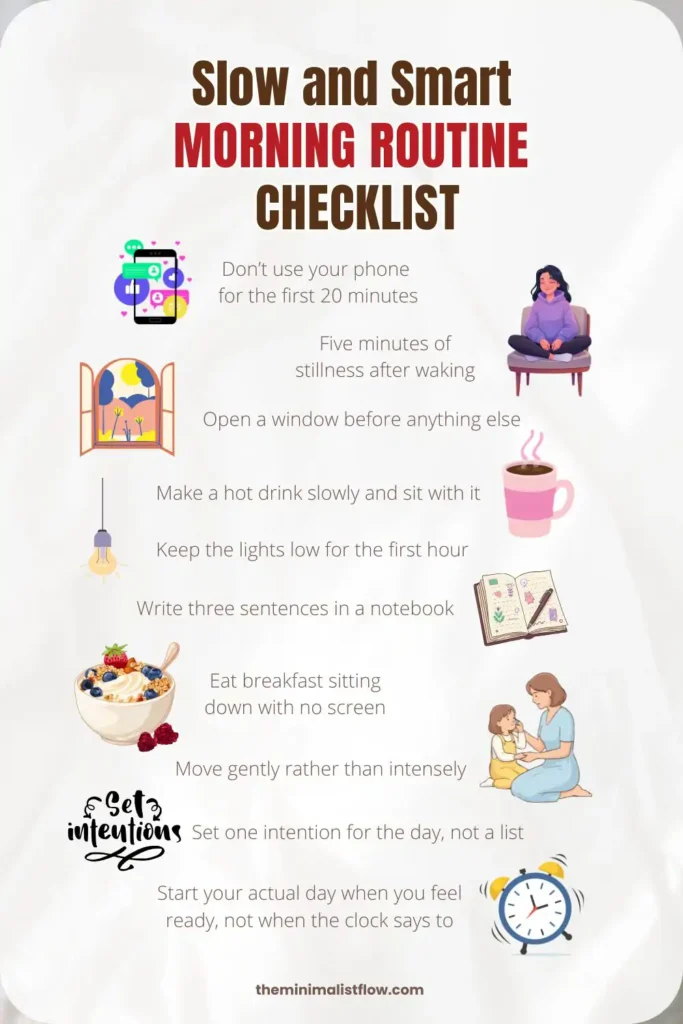
Slow and Smart Morning Routine Checklist
Save this and use whichever items fit your morning.
- No phone for the first 20 minutes
- Five minutes of stillness after waking
- Open a window before anything else
- Make a hot drink slowly and sit with it
- Keep the lights low for the first hour
- Write three sentences in a notebook
- Eat breakfast sitting down with no screen
- Move gently rather than intensely
- Set one intention for the day, not a list
- Start your actual day when you feel ready, not when the clock says to
Pin this list for the mornings when you need a reminder that slow is not wrong.
Start Tomorrow
- Move your phone out of the bedroom tonight. Use a regular alarm or a sunrise light. The phone is the single biggest obstacle to a slow morning for most sensitive women.
- Pick two items from the list above. Try those two for one week before adding anything else.
- Tell one person in your household that you need twenty minutes alone in the morning. You do not have to explain why. Just say it.
Mini Routine: When Even Slow Feels Like a Lot
On the hard days, use just these four:
- No phone for ten minutes.
- One hot drink, sitting down.
- One window opened.
- One intention for the day.
That is a slow morning ritual in twelve minutes.
Q&A: Slow Morning Routines for Sensitive Women
1. I have kids. A slow morning is not possible for me. What do I do?
Wake fifteen minutes before they do. Fifteen minutes of quiet before the household activates is enough to make a difference. You do not need a full hour. You need the first input of your day to be yours rather than someone else’s need.
2. I am not sure if I am actually highly sensitive or just tired. Does it matter?
Not for the purpose of this routine. If rushed mornings consistently leave you feeling worse rather than better, a slower start is worth trying regardless of what you call the reason.
3. Is it okay to skip the workout entirely on slow mornings?
Yes. Gentle movement is enough. A ten-minute walk counts. Stretching while the kettle boils counts. You do not need to earn your morning with exercise.
4. I tried journaling before and always abandoned it. What is different here?
Three sentences is different from journaling. It has a defined end. You are done when you have written three sentences, not when you have filled a page or processed everything in your head. That boundary is what makes it sustainable.
5. My partner is a fast-morning person and we wake up together. How do I handle the difference?
Have the conversation once, clearly. You need quiet in the morning. It is not about them. It is about your nervous system. Most partners, when they understand it is a genuine need rather than a preference, are more accommodating than you expect.
6. What if I wake up feeling anxious? Does a slow routine help or make it worse?
It usually helps, specifically because anxiety in the morning is often a nervous system response to being activated too quickly. The slow routine slows the activation. The writing helps externalize the loops. The gentle movement discharges some of the physical tension. It does not fix anxiety but it does not make it worse.
7. How long until I notice a difference?
Most people notice something within three to five days of consistent slow mornings. Not a transformation. A shift in baseline. The mornings feel a little less like something to survive.
8. Is it okay to vary which items I do each day?
Yes. The point is the quality of the morning, not the completion of a checklist. Some days you will do eight things. Some days you will do two. Both can be slow mornings.
9. What about the morning routine ideas for sensitive women that involve cold showers or intense exercise?
Those approaches work well for some people. For highly sensitive women, they often create a stimulation spike that leaves the nervous system overstimulated rather than regulated. Try gentle first. If you want to add intensity later, add it gradually and notice how it affects the rest of your day.
10. I feel guilty for needing more time than other people. How do I get over that?
You stop calling it needing more time and start calling it knowing what you need. Those are the same thing described from different angles. One makes you feel behind. The other makes you feel accurate.
Recommended Reading
- A Flexible Morning Routine That Holds Up When Life Gets Chaotic for a practical companion guide on building a morning structure that bends without breaking on hard days
- Realistic Summer Evening Routine Ideas for Highly Sensitive Women because a slow morning starts the night before, and this guide covers the evening side of the same system
- 13 Night Routine Ideas That Make Your Next Morning So Much Easier for the full picture of how a protected evening feeds directly into a protected morning
Last Thing
I spent years feeling like I was losing a race every morning. Other people seemed to snap into the day and I was still somewhere between asleep and awake, sitting with my coffee, not quite ready to be a person yet.
What I eventually understood is that that transition time is not a delay. It is how I work. It is how a lot of us work. The morning routine that actually fits is the one that starts before the demands do and moves slowly enough to let the nervous system catch up.
You are not lazy. You are not undisciplined. You are just someone who needs the morning to belong to you before it belongs to everything else.
What is the first thing you would protect if you had twenty minutes of genuinely uninterrupted quiet tomorrow morning?
You May Also Like
-
Sweater Outfits: 11 Fresh Ways to Wear One Burgundy Sweater All Winter
In this post I’ll show you how to wear one burgundy sweater 11 different ways, from a Monday at the office to Christmas Eve dinner. You’ll also find color pairs, the mistakes that make a knit look tired, and simple care tips that keep it soft for years.
-
Christmas Savings Challenge: A Printable Tracker for Weekly and Biweekly Paydays
This christmas savings challenge turns the cost of December into small, planned amounts you set aside from now until the holidays. You’ll find 8 simple challenges with the real math for weekly and biweekly paydays, plus a free printable tracker to color in.
-
Christmas Mantle Ideas: 13 Calm Looks With Zero Clutter
These christmas mantle ideas help you build an elegant fireplace display that looks calm instead of crowded. You’ll find 13 looks, from a lush garland with burgundy velvet to a mantel with a TV above it, plus color pairs and the mistakes worth skipping.









2 Comments