11+1 Better Sleep Habits for Sensitive Women Who Sleep Worse Every Summer
If summer turns you into a person who stares at the ceiling at midnight wondering why all your good sleep habits have stopped working, there is a real explanation for that.
In this post, I am sharing 12 sleep routine ideas that address what actually disrupts sleep for sensitive women in summer, not just the heat.
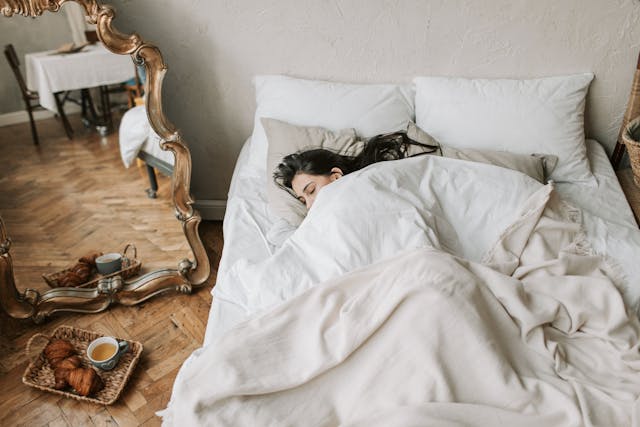
Every winter I congratulate myself on my sleep routine. I go to bed at a reasonable hour, the room is cool, I wake up feeling like a functional adult. Then June arrives and everything quietly falls apart.
The nights are too bright., too warm and too full of sound from open windows. My mind, which usually settles within twenty minutes of lying down, is suddenly running three conversations, replaying a look someone gave me at two in the afternoon, and also thinking about whether I left something in the car.
For years I thought this was a discipline problem. That I needed better sleep tips, a stricter routine, more consistency.
What I eventually understood is that the summer sleep problem for sensitive women is not a habits problem. It is a nervous system problem. And once you know that, the solutions become much more specific and much more effective.
Why Better Sleep Habits Are Not Enough in Summer
Here is the thing that most sleep advice misses: standard good sleep hygiene was designed for average nervous systems. And an average nervous system responds to summer the way most people expect. A little warmer, a little lighter outside, slightly harder to fall asleep. Manageable with a fan and some blackout curtains.
A sensitive nervous system responds differently. It picks up the extra light, the ambient noise, the temperature change, and the longer evenings with significantly more intensity. Each of these inputs is processed more deeply, which means each one does more work on the nervous system before sleep becomes possible.
Research from 2024 published on Sensitivity Research confirms this directly: highly sensitive people have heightened sleep reactivity, meaning their sleep is significantly more disrupted by stress and environmental factors than the average sleeper. Summer delivers both in one package.
This is not a personal failing. It is a neurological fact. And it means that the sleep routine ideas that work for everyone else might not be enough for you, not because you are doing anything wrong, but because you need a more tailored approach.
Summer Sleep Problems Are Not a Willpower Problem
The prevailing advice for summer sleep is: go to bed earlier, use blackout curtains, get a fan, stop looking at your phone. All fine. None of it addresses the actual mechanism that is keeping sensitive women awake.
The mechanism is accumulated sensory load. A summer day for a sensitive woman involves more input than a winter one: brighter light for longer, more social events, more disruption to schedule, more heat that the body works to regulate. By the time she gets to bed, her nervous system is still processing the day.
I grew up in Hungary, where summer means genuinely long days. The sun does not set until well past nine, sometimes closer to ten. The evenings are warm and full of sound. As a child I thought I just was not tired enough.
As an adult I understand that my nervous system was still actively metabolizing the day at eleven at night, and no amount of telling myself to fall asleep was going to help with that.

The fix is not more willpower at bedtime. The fix is reducing the load earlier in the day so there is less to process by the time you lie down. That reframe changes everything about how you approach a summer sleep routine.
For more on how a sensitive nervous system accumulates and processes sensory input across the day, the Highly Sensitive Refuge breakdown of HSP sleep and insomnia is the most accessible explanation I have found. It also covers why the tired-but-wired feeling is so specific to sensitive people.
Try it
Tonight: step outside for ten minutes before you start your sleep routine. Just standing. Feet on the ground if you can manage it, or a chair on a porch or balcony. This one step begins discharging the day’s sensory accumulation before you go through the door and try to sleep.
What the Research Actually Says About Sensitive Women and Summer Sleep
A 2024 study summarized by Sustainably Sensitive found that heightened sleep reactivity, defined as the tendency for sleep to be disrupted when the nervous system is stressed, explains the connection between sensitivity and insomnia symptoms. Importantly, the researchers noted this also holds potential for targeted solutions.
In practical terms: sensitive women do not just need better sleep tips. They need a sleep routine that begins several hours before bed, not twenty minutes before. The wind-down window for a sensitive nervous system is significantly longer than for the average person.
Dr. Elaine Aron, whose foundational research defines the HSP trait, notes in her work at hsperson.com that sensitive people often do better by promising themselves nine hours in bed with eyes closed, rather than fixating on actually sleeping. The rest itself, with eyes closed and external input removed, is restorative even when sleep is not immediate.
And for the environmental piece specifically, Neurolaunch’s guide to HSP-friendly bedding and sleep environments covers how material choice, temperature regulation, and sensory setup interact for sensitive sleepers. The short version: natural fibers, cool air movement, and minimal tactile irritation matter significantly more for sensitive women than for average sleepers.
12 Better Sleep Habits for Sensitive Women in Summer
1. Start Your Wind-Down Three Hours Before Bed, Not Thirty Minutes
The standard sleep hygiene advice says to start winding down an hour before bed. For sensitive women in summer, that is not enough time. Three hours is the realistic window between the last stimulating activity and genuine sleepiness. That means if you want to be asleep by eleven, your nervous system should be in deceleration mode by eight.
This might mean eating dinner earlier, stepping away from screens earlier, or simply choosing quieter activities after eight. The specific choices matter less than the commitment to a genuinely long transition period.
How it works: The sensitive nervous system does not switch off quickly. It processes and releases input slowly. Three hours of gradual deceleration produces a fundamentally different sleep onset than an abrupt switch from activity to bed.
2. Dim Every Light in the House After Sunset
Not just your phone. The kitchen lights, the overhead in the living room, the bright bathroom. Summer light is already pushing your melatonin later than winter. Adding bright indoor light on top of that compounds the delay. Lamps only after sunset. Warm, low, directed. The visual environment should feel like it is shifting toward night even when it is still warm outside.
How it works: Light is the primary regulator of melatonin production. Bright light tells the brain it is still daytime regardless of the clock. Switching to low, warm light after sunset gives the melatonin signal its best chance of arriving on time.
3. Eat a Lighter Dinner Earlier in the Evening
Digestion is physiologically activating. A large meal close to bedtime keeps the body in an active metabolic state that conflicts with the transition to sleep. For sensitive women, this effect is magnified because the body’s internal activity is processed as additional input. A lighter dinner, finished two to three hours before bed, removes one significant source of physical activation from the sleep equation.
How it works: The digestive system and the nervous system compete for resources. A body still actively digesting cannot fully shift into the parasympathetic state that good sleep requires.
4. Cool Your Wrists and Neck Before Bed
The body needs to drop its core temperature by about one degree to initiate sleep. In summer, that drop is harder to achieve. Running cool water over your wrists and neck for two minutes before bed helps that process along. It sounds too simple to work. It works.
This is more effective than a cold shower, which can briefly activate the nervous system before cooling it. Wrists and neck are pulse points where the blood is close to the surface. Cooling them cools the blood going to the brain.
How it works: Core temperature drop is a biological trigger for sleep onset, not just a comfort issue. Helping it happen faster means falling asleep more quickly, which is one of the most practical better sleep tips available.
5. Use a Sleep Playlist of Brown Noise, Not White Noise
Summer comes with noise. Open windows let in the sounds of neighbors, traffic, crickets, distant music. For sensitive ears, these sounds do not fade into the background the way they do for non-sensitive sleepers.
Brown noise, which is deeper and less sharp than white noise, masks the variable sounds of summer nights without adding the high-frequency brightness that white noise can produce.
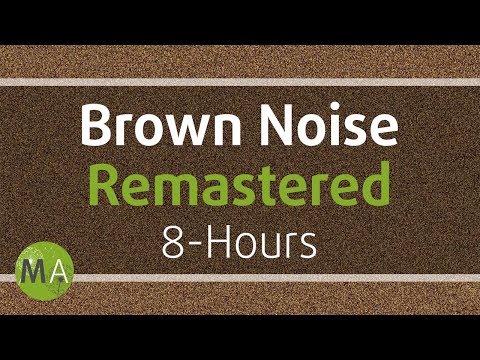
Play it through a speaker at a consistent volume, set before you lie down so you are not adjusting it in the dark when you should be falling asleep.
How it works: Sensitive hearing registers inconsistent sounds as potential signals requiring attention. A consistent low-frequency sound layer fills the acoustic space and reduces the brain’s tendency to process each individual noise as information.
6. Write Down the Day Before You Lie Down
Three to five minutes of writing what happened today: what you noticed, what bothered you, what you did not finish, what is still running. Then close the notebook.
This is the mental equivalent of cooling the wrists. The nervous system is still carrying the day. Writing it down gives it somewhere external to put it.
How it works: The brain keeps reviewing incomplete information loops as a way of not losing them. Writing them down closes the loop without requiring the brain to keep rehearsing. For sensitive women who process deeply and retain a lot, this step is not optional. It is the difference between lying there thinking and actually resting.
The night routine builds on exactly this idea: a structured evening debrief as part of a sleep routine that goes beyond the standard wind-down advice.
7. Stop Checking the Clock When You Wake at Night
This one is harder than it sounds and more important than most sleep tips acknowledge. Checking the clock at 3am tells the brain exactly how worried to be about the remaining sleep time. That worry activates the nervous system more thoroughly than the waking itself did. For sensitive women, that activation can last another hour.
Turn the clock away. If you use your phone as a clock, leave it on a different surface. Not knowing the time gives the nervous system less to calculate.
How it works: Time awareness in the night activates the prefrontal cortex, which is the part of the brain responsible for planning and problem-solving. That is not the part you want running at 3am. Not knowing the time keeps the brain in a lower activation state that is much closer to sleep.
8. Keep the Bed for Sleep Only, Without Exceptions in Summer
In winter, reading in bed or watching something from the couch-equivalent of your bedroom feels contained. In summer, when the heat makes every room feel like a different temperature, the bed becomes a refuge from the day.
This is a trap. The bed needs to be one thing to your nervous system: the place where sleep happens. The moment it becomes the place where you also do everything else, the cue is lost.
How it works: Sleep onset relies on conditioned cues. The bed as a consistent signal for sleep is one of the most robust findings in sleep research. A sensitive nervous system is particularly responsive to environmental conditioning, which means this rule matters more for highly sensitive people than for average sleepers.
9. Take a Slow Walk Outside in the Morning Light
This is a good sleep habits tip that works at the opposite end of the day from bedtime. Morning light exposure, especially within the first hour of waking, sets the circadian clock more precisely. For sensitive women whose circadian rhythm gets pulled later by summer evening light, a morning walk is the counterbalance.
Ten to twenty minutes outside in the morning light, without sunglasses if the light is not yet intense, is enough to produce the effect. It does not have to be a workout. A slow walk counts.
How it works: The circadian rhythm runs on a roughly 24-hour cycle anchored by light signals. Morning light tells the clock when the day started, which determines when it calculates that night should begin. Consistent morning light exposure is one of the most effective long-term tools for better sleep in summer.
10. Build a Wind-Down Sleep Routine and Do It in the Same Order Every Night
The sequence matters as much as the components. A sleep routine done in a consistent order becomes a learned signal: this sequence ends in sleep.
For sensitive women whose nervous systems respond strongly to pattern and prediction, the consistency of the order is itself part of the wind-down.
Dim the lights, do the wrist cooling, write the debrief, change into sleep clothes, lie down. Or your version of that. Whatever the sequence is, keep it the same. The predictability is the point.
How it works: Behavioral conditioning is one of the most reliable tools in sleep science. The nervous system learns through repetition. A consistent pre-sleep sequence becomes a trigger that begins the shift toward sleep before you even lie down.
11. Drop the Expectation of Eight Hours in Summer
Sleep researchers, including Elaine Aron herself, note that HSPs sometimes do better with a nine-hour window in bed rather than fixating on a specific hours-of-sleep target. In summer, the realistic expectation might be slightly different sleep than in winter.
Different does not mean broken. Lighter sleep, more dreaming, earlier waking with the sun are all common for sensitive people in summer and all fall within normal variation.
The anxiety about not sleeping enough is itself a significant driver of insomnia. Releasing the eight-hour expectation and replacing it with the practice of good sleep habits and a long, restful window produces better outcomes than the pressure of a specific number.
How it works: Sleep pressure builds through wakefulness and releases through sleep, but the architecture of that sleep changes with the seasons and with individual variation. For sensitive people especially, the quality and the felt sense of rest matter as much as the quantity.
+1 Extra Habit: The Cold Wet Sock Method
This is the extra item. It sounds completely wrong. It is completely right.
Wet a pair of thin cotton socks in cold water. Wring them out thoroughly. Put them on your feet. Put a pair of dry wool or thick socks over them. Get into bed.
The body, detecting cold at the extremities, redirects blood flow to the feet to warm them. This process draws heat away from the core and the head, accelerating the temperature drop that triggers sleep onset. Most people fall asleep within twenty minutes. Most people who try it are surprised enough to do it again.
This is a naturopathic remedy with roots in European folk medicine, used in Germany and parts of Central Europe for generations as a fever and sleep aid. It has physiological logic behind it: the reflexive vasodilation in the feet after cold exposure is real, measurable, and directly connected to the core temperature drop that the sleeping brain requires.
How it works: The body uses peripheral blood flow as a thermostat. Cold feet trigger warming via vasodilation, which moves blood to the extremities and away from the core. A cooler core is the physiological signal the brain needs to shift into sleep mode. For sensitive people who overheat easily in summer and struggle to fall asleep quickly, this addresses the precise mechanism responsible.

Better Sleep Habits Checklist for Summer
Save this and use it this week.
- Start winding down three hours before bed, not one
- Switch to lamps only after sunset
- Eat a lighter dinner at least two hours before bed
- Cool wrists and neck with cold water before lying down
- Use brown noise to mask summer night sounds
- Write a five-minute debrief before you lie down
- Turn the clock away so you cannot see it at night
- Keep the bed for sleep only, no exceptions
- Walk outside in morning light within the first hour of waking
- Do your sleep routine in the same order every night
Pin this sleep routine checklist so you have it when the next heatwave arrives and your good sleep habits start failing again.
Do This Tonight
- Turn your clock away from the bed right now. Before anything else. This is the fastest change with the most immediate effect for night waking.
- Wet the socks, put them on. Yes, tonight. You will not believe it until you try it.
- Set a reminder for three hours before your target bedtime. Label it Wind Down. When it goes off, close the laptop, lower the lights, and start the transition.
If You Only Have Ten Minutes Tonight
- Dim every light to lamp-only
- Cool water on your wrists for two minutes
- Write three things that are still running in your head
- Turn the clock away
- Sleep routine in the same order as last night
Q&A: Better Sleep Habits for Sensitive Women
1. I do everything right and still cannot fall asleep in summer. What am I missing?
Probably the timing. Good sleep habits that start thirty minutes before bed are often not enough for sensitive women. The three-hour wind-down window is the piece most people skip because it seems excessive. It is not. It is calibrated to a nervous system that needs significantly more transition time than the standard advice assumes.
2. Is summer insomnia actually more common in sensitive women or am I imagining it?
You are not imagining it. Research on HSPs consistently shows higher rates of sleep disruption, and summer compounds this through heat, extended light, and increased social and sensory load. The combination is real and documented.
3. I wake up at 3 or 4am every summer night and cannot get back to sleep. What helps?
Keep your eyes closed. Do not check the time. Do not pick up your phone. Lie still with eyes closed for as long as possible. The rest is restorative even without sleep, and the absence of time-checking keeps the nervous system from activating around the anxiety of being awake.
4. My room is too hot even with a fan. What actually helps with temperature?
The cold sock method addresses this from the inside rather than the outside. Additionally: cooling a buckwheat hull pillow in the freezer for twenty minutes before bed, placing a bowl of ice in front of a fan, and using a single cotton sheet rather than any kind of duvet are all more effective than most people expect.
5. How long does it take to notice a difference when I start these habits?
Most people notice a shift within three to five days. The circadian anchoring from morning light walks shows results fastest. The conditioned sleep routine effect builds over one to two weeks. The debrief habit often produces results the first night.
6. I feel guilty spending so much time on sleep prep. Is it really worth it?
Count the hours you are currently losing to poor sleep, the slow mornings, the fatigue, the reduced focus. Thirty extra minutes of wind-down usually recovers two or three hours of functional time the next day. It is not self-indulgence. It is arithmetic.
7. Can I still read before bed or does that interfere with sleep?
Reading is fine if the content is genuinely calm. Avoid anything emotionally activating, whether that is news, emotionally complex fiction, or work material. A sensitive nervous system will process emotionally engaging content for longer than you intend, which means the chapter you read at ten is still running at midnight.
8. Is it normal to sleep differently in summer than in winter?
Yes. Seasonal variation in sleep is normal across humans and more pronounced in sensitive people. Summer sleep tends to be lighter and shorter for many women, particularly in latitudes with long summer days. Accepting this as variation rather than failure removes a significant source of sleep anxiety.
9. Does the cold sock method really work or is it a placebo?
There is physiological logic behind it and enough anecdotal evidence to make it worth trying. For the specific mechanism of core temperature reduction, it addresses the exact biological process responsible for sleep onset. Whether it works for you specifically is something you can find out tonight for free.
10. What is the single most effective change I can make right now for better sleep in summer?
Turn the clock away from the bed and start your wind-down three hours before you want to be asleep. Those two changes together address the two most common reasons sensitive women stay awake: time anxiety during night waking and insufficient nervous system deceleration before bed.
Recommended Reading
- Realistic Summer Evening Routine Ideas for Highly Sensitive Women for the full evening structure that feeds into this sleep routine, covering the hours between dinner and bed in detail
- You Are Not Lazy. You Just Need a Different Kind of Morning Routine. because good sleep starts in the morning, and the slow morning routine for sensitive women is the other end of the same system
- 13 Night Routine Ideas That Make Your Next Morning Easier for a broader sleep routine list that works year-round, with the summer-specific additions from this guide layered on top
Final Thoughts
Summer is the season I love most and sleep through least. I have made peace with the fact that those two things are going to coexist for the foreseeable future.
What I have stopped doing is blaming myself for it. My nervous system is not failing at sleep. It is doing exactly what it is built to do: processing everything, thoroughly, including the long golden evening and the neighbor’s music and the conversation I had at three in the afternoon. It just needs more time to finish. The habits in this list give it that time.
Quick Question: Which of these are you trying first tonight?
You May Also Like
-
Sweater Outfits: 11 Fresh Ways to Wear One Burgundy Sweater All Winter
In this post I’ll show you how to wear one burgundy sweater 11 different ways, from a Monday at the office to Christmas Eve dinner. You’ll also find color pairs, the mistakes that make a knit look tired, and simple care tips that keep it soft for years.
-
Christmas Savings Challenge: A Printable Tracker for Weekly and Biweekly Paydays
This christmas savings challenge turns the cost of December into small, planned amounts you set aside from now until the holidays. You’ll find 8 simple challenges with the real math for weekly and biweekly paydays, plus a free printable tracker to color in.
-
Christmas Mantle Ideas: 13 Calm Looks With Zero Clutter
These christmas mantle ideas help you build an elegant fireplace display that looks calm instead of crowded. You’ll find 13 looks, from a lush garland with burgundy velvet to a mantel with a TV above it, plus color pairs and the mistakes worth skipping.






One Comment