9 Closet Organization Mistakes You Should Definitely Avoid
Disclosure: This post contains affiliate links. If you make a purchase through these links, I may earn a small commission at no extra cost to you. Thank you for supporting my blog!
If you keep redoing your closet and it keeps sliding back into chaos within a month, you are probably making one or two of these closet organizing mistakes without realizing it.
In this post, I am walking you through the nine I see (and have made myself) most often, plus what to do instead so the fix actually holds.
I have prepared a really useful guide and mindmap for you, which you can download by clicking here: full guide and a mindmap.
Save this infographic for later!
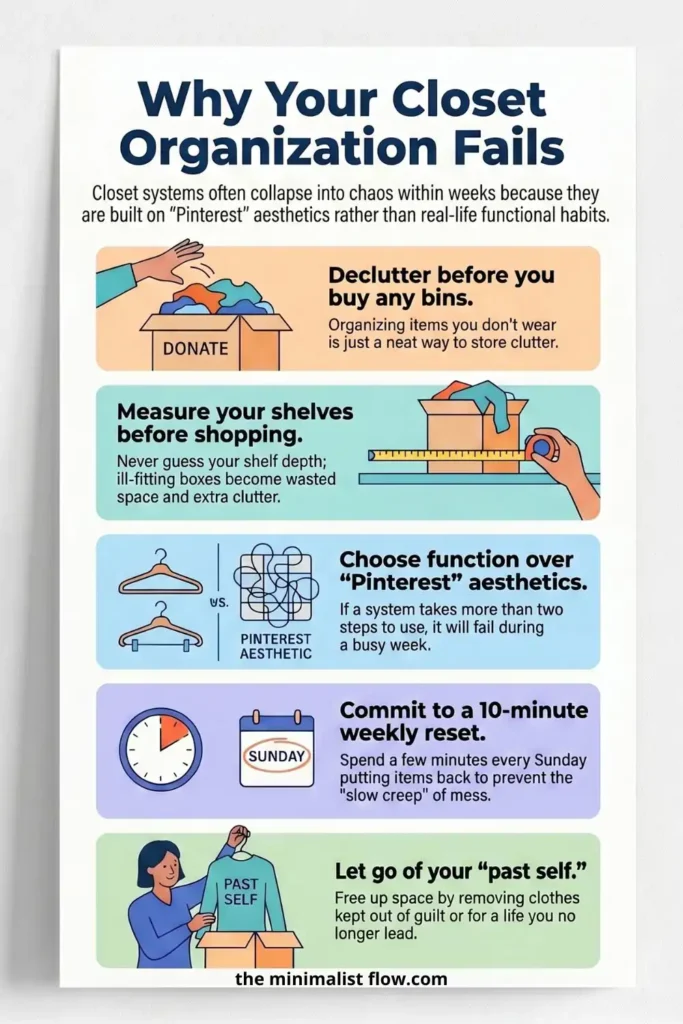
Have you ever spent an entire Saturday on a closet organizing project, stood back feeling proud of yourself, and then opened that same door three weeks later to total chaos again?
I have done this more times than I want to admit. The frustrating part is that it is rarely about effort.
Most closet organizing mistakes are small, almost invisible decisions that quietly undo all that hard work, things like the wrong shelf height, a storage box that looked cute but never fit your actual stuff, or a system built around the closet you wish you had instead of the one you actually own.
In this post, I am sharing the closet organizing mistakes that come up again and again, in my own home and in every closet remodel story my friends have told me over coffee.
We will go through small closet traps, walk in closet traps, and the kind of organization ideas that sound great on Pinterest but fall apart in real life with real kids, real laundry, and real Tuesday mornings.
What I have noticed, after going through this cycle myself more times than I would like to count, is that the actual size of your closet matters far less than people think. I have seen a tiny closet stay perfectly organized for years, and I have seen a massive walk in closet turn into chaos within a single month.
The difference was never the square footage.
It was always one or two specific habits, the kind that feel harmless in the moment but quietly add up. That is exactly what we are unpacking here, piece by piece, so you can actually spot which ones apply to your own space.
In This Post You Will Find
- Why most closet systems quietly fail within a month, even when you are not a messy person
- The closet organizing mistakes that apply whether you have a tiny closet or a dream walk in closet
- A practical, doable list of fixes you can actually start this weekend
- A saveable checklist for your next closet renovation
- Honest answers to the questions people actually ask me about this
A Quick Gut Check Before We Start
Before we get into the list, ask yourself these questions honestly.
– Do you own a label maker you have used exactly once?
– Do you have more matching storage boxes than actual matching outfits?
– Have you ever bought a closet organizer system before measuring your actual closet?
– Did your last closet makeover photo look incredible on day one and slightly tragic by day thirty?
If you nodded at even two of these, you are in exactly the right post, and you are definitely not alone.
Watch this video, you will definitely find many useful things in it.

My Honest, Slightly Unpopular Take
Here is my honest, slightly unpopular take after redoing my own closet system three separate times.
Pinterest is not lying to you, but it is not showing you the whole picture either.
Those gorgeous closet remodel photos are styled for a camera, not for a Tuesday morning when you are running late and need socks. My own closet went through a phase that looked stunning in photos and was nearly unusable in real life, because every single thing had to be folded a specific way to keep the look intact, and nobody in my house, including me, kept that up for more than a week.
The most useful closet organizing mistake I ever made was prioritizing how the closet photographed over how it actually functioned every single morning.
Once I flipped that order, the system finally stuck, and honestly the closet looks almost as good now, just slightly less perfect and a lot more lived in.
According to a UCLA study on home environments, the way we talk about our homes, cluttered versus restful, is closely tied to our daily stress hormone patterns, which tells me this is not just an aesthetics problem.
It is a real one, and it is worth taking seriously even though closets can feel like a small, silly thing to stress over.
What You Need Before You Start
You do not need a full closet renovation budget to fix most of these closet organizing mistakes.
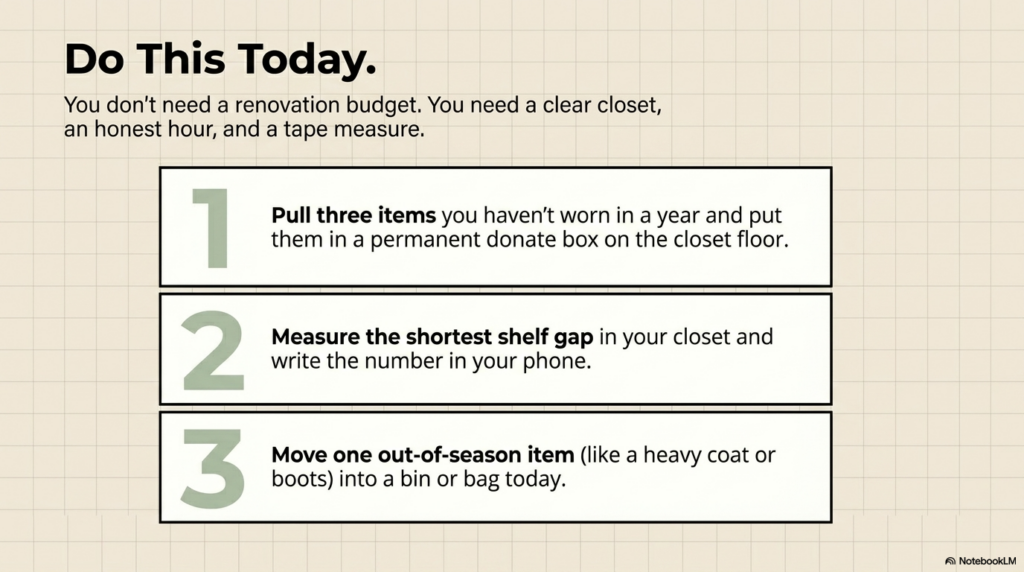
What you actually need is a clear closet, an honest hour, a tape measure, and a willingness to admit that the system you tried last year just was not built for how you actually live.
A few simple tools help:
- slim non slip hangers,
- a couple of clear storage boxes, and maybe
- a shoe rack if shoes are your specific chaos point.
That is genuinely it for most homes. The fancy closet design overhaul can wait until you know exactly what you need it to hold.
9 Closet Organizing Mistakes That Sabotage Every Closet Makeover
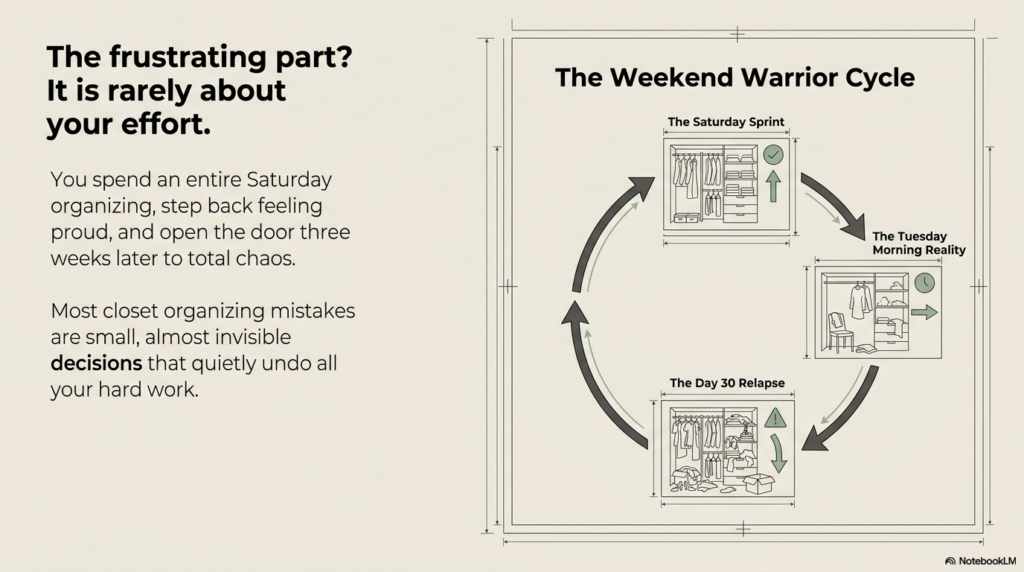
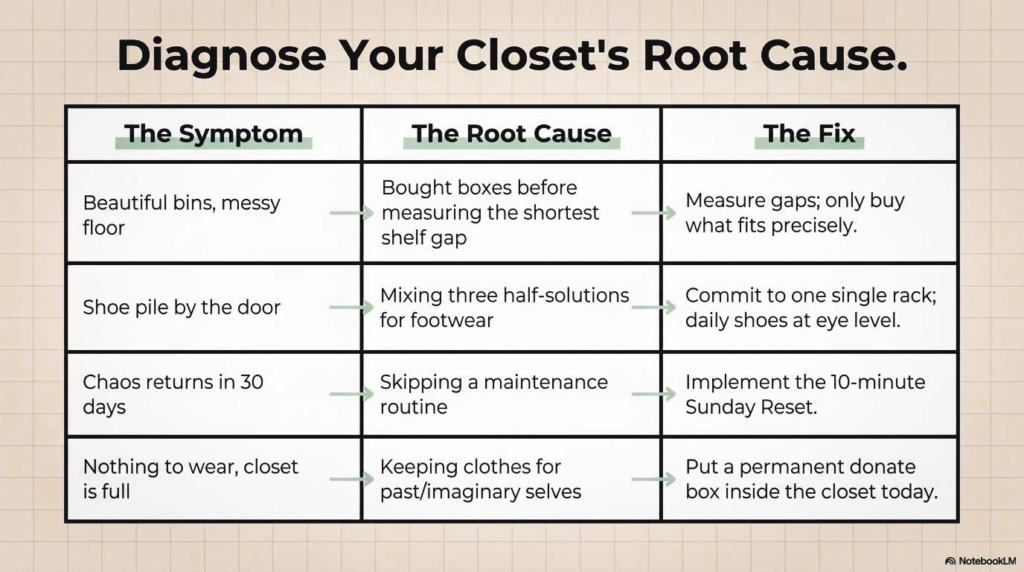
1. Organizing Before You Declutter
This is the one almost everyone does, myself included, more than once. You pull out the bins, the labels, the matching hangers, and you start sorting clothes into a system before you have actually decided what stays and what goes.
The result is a beautifully organized closet full of things you do not wear, which means it fills up again almost immediately.
Why is it useful for you? Decluttering first means every single item in your finished closet earns its spot. That is the difference between a closet system that lasts a year and one that collapses in a month.
How it works: pull everything out of the closet, every single item, and only let back in what you actually wore in the last twelve months or genuinely love. A closet organization breakdown from Talented Ladies Club makes this exact point, that skipping the decluttering step is one of the most common and costly closet organizing mistakes people make.
Extra tip: do this on a day when you have zero other plans. Decluttering with one eye on the clock always ends in I will deal with this later, and later never comes.
2. Buying Storage Boxes Before Measuring Anything
I have a small collection of beautiful storage boxes that do not fit a single shelf in my actual closet.
They looked perfect online. They are useless in real life. This closet organizing mistake costs real money and it is one of the easiest to avoid.
Why is it useful for you? Measuring first means every storage box, bin, and organizer you buy actually earns its place instead of becoming yet another thing cluttering your closet floor.
How it works: measure your shelf depth, your shelf height, and the width of every section before you shop, not after. Bring those numbers with you, written down, every single time.
Extra tip: measure the shortest shelf gap in your closet, not the average one, because that is the one that will reject your new bins if you guess wrong.
3. Using Mismatched Hangers
Wire hangers, plastic hangers from the dry cleaner, a few wooden ones from an old dresser, all hanging side by side. It looks chaotic because it is chaotic, even if every piece of clothing is technically clean and put away.
Why is it useful for you? One single type of slim hanger instantly makes a closet look twice as organized, and it usually creates more hanging space too, since mismatched hangers waste width unevenly.
How it works: pick one slim, non slip hanger style and switch your whole closet over in one sitting. Donate the rest immediately so they cannot sneak back in.
According to a roundup of expert closet organizing advice, mismatched hangers are consistently named as one of the top reasons a closet looks visually chaotic, even when it is technically tidy.
Extra tip: velvet flocked hangers grip clothes well enough that shoulders stop sliding off, which matters more than it sounds like until you experience it.
4. Folding Everything in a Small Closet
Folding feels neat and tidy, but in a genuinely small closet, stacks of folded clothes on deep shelves turn into leaning towers that topple the moment you pull from the bottom.
Why is it useful for you? Hanging more items instead of folding them keeps clothes visible, which means you actually wear more of your wardrobe instead of forgetting what is buried in a stack.
How it works: shift pants, cardigans, and even casual sweatshirts to hanging space wherever your closet allows, and reserve folded stacks only for items that genuinely hold their shape, like jeans or heavy knits.
A piece from Livingetc on outdated small closet rules makes this same case, that folding everything is one of the small closet ideas that quietly backfires the most.
Extra tip: a slim pull out pants rack solves this without needing any extra shelf space at all.
5. Keeping All Four Seasons of Clothing in One Place
Every single thing you own, all four seasons, crammed into one closet system, all year long. It feels practical until you realize half your hanging space is taken up by a parka in July.
Why is it useful for you? Rotating seasonal clothing frees up real, usable space for what you are actually wearing right now, which is the entire point of a closet.
How it works: pick a clear under bed bin or a single labeled storage box for off season clothing, and physically move it out of your main closet twice a year.
Extra tip: do the swap on a fixed date, like the first weekend of the month the seasons change, so it becomes a habit instead of a project you keep postponing.
6. Skipping a Maintenance Routine
You finish the big organizing weekend, it looks incredible, and then real life happens. Clothes get tossed instead of hung, shoes pile up by the door instead of the shoe rack, and within a month it looks like nothing ever happened. This is honestly the closet organizing mistake that humbled me the most, because I used to think a good enough system would maintain itself. It never does, not for me and not for anyone I have talked to about this.
Why is it useful for you? A tiny weekly reset takes minutes and prevents the kind of slow creeping mess that eventually requires a whole new closet makeover.
How it works: set a recurring ten minute slot, even just before bed on Sundays, to put back anything that drifted out of place during the week. The same closet organizing piece from Talented Ladies Club points out that life gets busy and these small lapses snowball fast if there is no regular system in place.
Extra tip: keep an empty hanger or two on hand specifically for I will deal with this tomorrow items, so even the chaos has a designated spot.

7. Treating Shoes as an Afterthought
Shoes end up on the floor, in a pile, by the door, anywhere except where they are supposed to be, because most closets are not actually designed with a real shoe storage plan from the start.
Why is it useful for you? A dedicated shoe rack or shoe storage solution clears floor space immediately and makes the whole closet feel more finished, even if nothing else changed.
How it works: pick one shoe storage method, a slim shoe rack, a hanging shoe organizer, or stackable boxes, and commit to it instead of mixing three half solutions.
Professional organizers interviewed by Homes and Gardens specifically recommend moving shoes to alternate storage in small closets, reserving the main closet for items you reach for daily.
Extra tip: store the shoes you wear most at eye level, not the floor, so you are not bending down every single morning.
8. Designing for an Instagram Photo Instead of Your Actual Life
This is the one that got me. A closet that looks flawless for a photo but requires a very specific folding method, color order, or styling that nobody in real life maintains past day three.
Why is it useful for you? A closet built around how you actually get dressed every morning will stay organized far longer than one built around how it looks in a single photo.
How it works: before finalizing your closet design, picture your actual rushed Tuesday morning routine and ask whether the system supports that version of you, not the relaxed weekend version.
Extra tip: if a system requires more than two steps to put something away, simplify it, because the extra steps are exactly where the system breaks down first.
9. Holding On to Clothes for a Different Version of Yourself
The dress from ten pounds ago. The heels you have not worn since a wedding three years back. The blazer for the job you do not have anymore. They take up real space for an imaginary future.
Why is it useful for you? Letting go of clothes tied to a past or imagined version of you frees up actual room for the wardrobe that fits your current, real life.
How it works: be honest during your next closet organizing session about which pieces you are keeping out of guilt or hope rather than genuine use, and let those go to someone who will actually wear them now.
A simple donate box kept right inside the closet makes this an ongoing habit instead of a once a year ordeal, something I wrote about in more detail in my piece on the only organizing container that actually matters.
Extra tip: try the hanger trick, turn every hanger backward at the start of the season, and flip it the right way only when you actually wear that piece. After three months you will see exactly what you never reach for.
If you want a deeper dive into letting go of things you are holding onto out of guilt, my post on the only organizing container that actually matters walks through exactly how a simple donate box changes the whole process.
And if your closet chaos is really a symptom of a bigger decluttering project you have been avoiding, the 30 day declutter challenge for busy moms breaks the whole house down into one small task a day, closet included.
| Organization Mistake | Why It Fails | Recommended Fix | Action Steps | Specific Tools Required |
| Organizing Before You Declutter | It results in a beautifully organized closet full of things you do not wear, leading to immediate overcrowding. | Declutter first so every item earns its spot. | Pull everything out of the closet and only re-enter items worn in the last 12 months or those genuinely loved. | Donate box |
| Using Mismatched Hangers | It looks visually chaotic even if tidy and wastes hanging width unevenly. | Switch to one single style of slim hanger for the whole closet. | Pick one slim style, switch everything in one sitting, and donate the old hangers immediately. | Slim non-slip velvet flocked hangers |
| Folding Everything in a Small Closet | Stacks on deep shelves become unstable toppling towers, and items at the bottom are forgotten. | Hang more items to keep them visible. | Shift pants, cardigans, and sweatshirts to hanging space; reserve folding only for jeans or heavy knits. | Slim pull-out pants rack |
| Skipping a Maintenance Routine | Lapses snowball quickly into a mess that eventually requires a full makeover. | Implement a recurring weekly reset. | Set a 10-minute slot (e.g., Sunday nights) to put back drifted items. | One or two empty hangers for “tomorrow” items |
| Treating Shoes as an Afterthought | Shoes pile up on the floor or by doors because there is no designated storage plan. | Commit to one dedicated shoe storage solution. | Store most-used shoes at eye level; move rarely worn shoes to alternate storage. | Slim shoe rack, hanging shoe organizer, or stackable boxes |
| Buying Storage Boxes Before Measuring Anything | Boxes may not fit the shelf height or depth, becoming useless clutter on the closet floor. | Measure your specific closet dimensions before shopping. | Measure shelf depth, height, and the width of every section; record the shortest shelf gap specifically. | Tape measure |
| Keeping All Four Seasons of Clothing in One Place | Half the space is taken up by off-season items, limiting daily usability. | Rotate seasonal clothing out of the main closet. | Move off-season items to under-bed bins or labeled boxes twice a year on a fixed date. | Clear under-bed bin or labeled storage box |
| Designing for an Instagram Photo Instead of Real Life | Complicated folding or color coding is unsustainable for a rushed daily routine and breaks down fast. | Build the system around how you actually get dressed every morning. | If a system requires more than two steps to put something away, simplify it. | Not in source |
| Holding On to Clothes for a Different Version of Yourself | Items kept out of guilt or hope for the future take up room needed for your real current life. | Let go of clothes that do not fit your current lifestyle or size. | Turn hangers backward at the start of the season; flip them only when worn to identify unused items. | Donate box inside the closet |
The European Angle Nobody Talks About
Here is something that surprised me. Growing up in a small village in Hungary, closets as Americans picture them, walk in closets with islands and built in lighting, simply were not part of life.
We had one closet, maybe two – although I wouldn’t call it a classic closet, more of a wardrobe – for the whole family, and somehow getting dressed in the morning was never the chaotic event it sometimes is in homes with three times as much storage space.
The size of the closet was never the real problem. It was always how much stuff we were trying to cram into it.
I’ve been thinking about this a lot lately, whenever I’m tempted to blame the small closet for something that’s actually too much stuff.
The thing is, we have too much stuff, and it’s not the closet that’s to blame, it’s us.
As painful as it may be to say, this is unfortunately the case in most households, minimalistic endeavors here or there.
Save This Closet Organizing Checklist for Later
- Pull everything out before you organize anything
- Measure every shelf gap before buying a single storage box
- Switch to one matching hanger style
- Move off season clothing out of the main closet
- Set a recurring ten minute weekly reset
- Choose one shoe storage method and stick with it
- Design around your real morning, not a photo
- Let go of clothes from a different season of your life
- Keep a donate box inside the closet at all times
- Revisit the whole system once a year, not just once ever
Pin this so you have it ready before your next closet makeover weekend.
Two Mini Checklists You Can Use This Week
Quick Shoe Storage Fix
- Pick one storage method only
- Put daily shoes at eye level
- Move rarely worn shoes to a bin out of the closet
- Add a small tray by the door for the shoes in constant rotation
Quick Hanger Swap
- Choose one hanger style
- Buy enough for your full wardrobe in one order
- Hang everything over from worst to best section
- Donate every mismatched hanger the same day
Closet Organizing Questions People Actually Ask Me
1. My closet is genuinely tiny. Is any of this still worth doing?
Yes, honestly even more so. Small closets show closet organizing mistakes faster than big ones because there is no extra space to absorb the chaos. Decluttering first and picking one shoe storage method matters even more here.
2. How often should I really declutter my closet?
Twice a year works for most people, once at each major seasonal swap. If you have kids whose sizes change constantly, every season might be more realistic.
3. Are walk in closet organizer systems actually worth the money?
They can be, but only after you have decluttered and measured. A walk in closet organizer built around clothes you do not actually wear is just an expensive way to store clutter more neatly.
4. What is the single biggest mistake you see in closet remodel projects?
Skipping decluttering and going straight to buying a system. It is tempting because shopping feels productive, but it almost always means redoing the whole project within a year.
5. I do not have room for a clothing rack. What else helps with overflow?
Look at the back of the closet door, a slim hanging organizer there can hold off season accessories without taking any floor or shelf space at all.
6. How do I get my family to actually use the new closet system?
Keep it simple. Anything that requires more than one or two steps tends to get skipped under time pressure, and that includes kids and partners just as much as it includes you.
7. Is it bad to keep clothes I am not currently wearing but might fit into again?
Not automatically, but be honest about the timeline. If it has been more than two years, it is worth asking whether you are keeping the item or the hope.
8. What is the cheapest fix on this whole list?
Switching to one hanger style and decluttering before buying anything. Both cost nothing beyond time, and together they solve a surprising amount of closet chaos.
9. Do storage boxes actually help or just create more clutter?
They help enormously once you have measured and decluttered first. Bought before that, they just become another thing taking up space.
10. How long does a proper closet organizing session usually take?
For one closet, plan on a full afternoon if you are doing it properly, including the decluttering step. Rushing it is exactly how old closet organizing mistakes sneak back in.
Recommended Reading
If this got you thinking about the bigger decluttering picture, you might enjoy the 30 day declutter challenge for busy moms, or my piece on why a donate box matters more than any storage bin. For more on simplifying spaces room by room, the deep cleaning hacks post pairs surprisingly well with a fresh closet, since both projects tend to happen in the same weekend in my house.
One Last Thing
If there is one thing I want you to take from this, it is that a closet falling apart again is not a sign you are disorganized by nature. It almost always traces back to one or two of these closet organizing mistakes, not a personal failing, and every single one of them is fixable starting this weekend. Which one of these closet organizing mistakes do you think is quietly happening in your own closet right now?