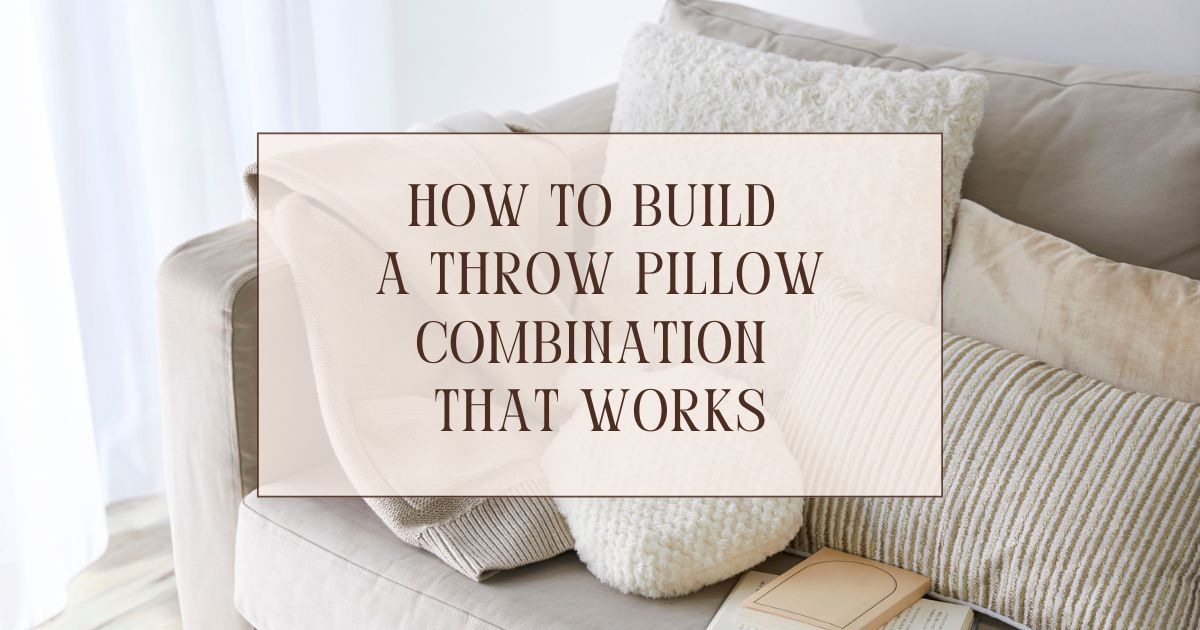
How to Choose The Best Throw Pillow Combinations That Actually Work in Your Home
The right throw pillow combinations can completely change how a room feels, and the wrong ones make even the nicest couch look like it is missing something.
This guide breaks down exactly how to mix, match, and layer pillows so the result looks intentional rather than accidental.
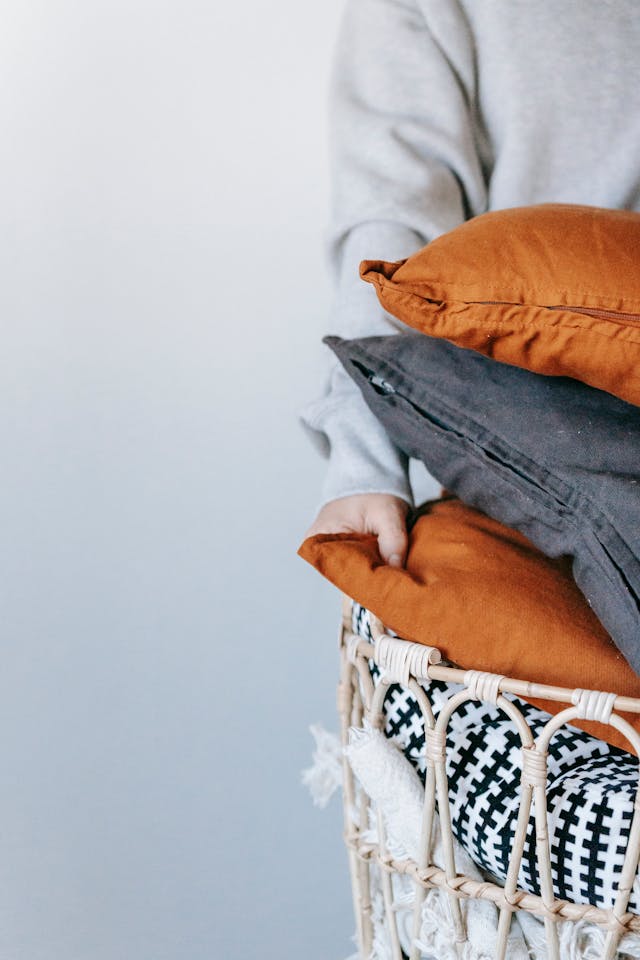
There is a common assumption that a minimalist home has no place for soft accessories. That a clean, pared-back space means bare surfaces, neutral tones, and nothing that moves or shifts with the seasons.
I disagree with that entirely. A minimalist space should work for the people who live in it.
Our home has a lot of decorative pillows. I change them when I feel like it. A different combination in autumn, something lighter in summer, a new cover when I get tired of the current one.
It does not add clutter. It adds a feeling of home that no perfectly styled empty sofa can replicate.
What I have learned over the years is that the difference between a pillow arrangement that looks good and one that looks like you grabbed whatever was on sale comes down to a few simple principles. Color, texture, size, and shape.
Get those four things working together and the result takes care of itself.
Why Throw Pillows Matter More Than You Think
Throw pillows are one of the lowest-cost, highest-impact things you can change in a room.
Unlike a new rug or a repainted wall, you can swap pillow covers in an afternoon and the room genuinely looks different. They set the tone of the space before anything else does.
They also do something practical: they add softness to a piece of furniture that is otherwise all hard lines and upholstery. A sofa without cushions looks like a waiting room.
The same sofa with the right combination of pillows looks like somewhere you actually want to sit.
For a broader look at how intentional home details build a space that feels genuinely livable rather than showroom-ready, the capsule wardrobe philosophy applied to interiors is worth reading.
The same logic applies: fewer, better, more intentional choices produce a better result than accumulation.
What You Will Find in This Article
- How to build a color palette that works with your existing furniture
- How to mix textures without making it look busy
- How to layer sizes and shapes for a professional-looking arrangement
- Specific throw pillow combinations for different sofa colors
- How to use pillow covers to refresh the look without buying new pillows
- The seasonal swap method that keeps things feeling fresh all year
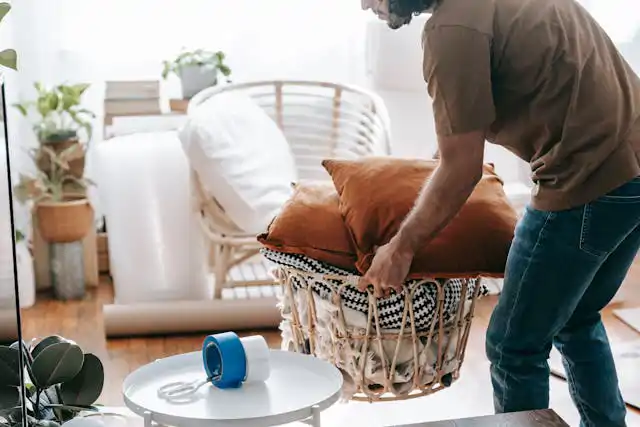
Start With the Color Already in the Room
Before you touch a single pillow, look at the room. What colors are already there? Your sofa, your rug, your curtains, a piece of art on the wall, even the color of the floor.
All of these are starting points for your pillow palette.
A good working rule is to pull two or three colors that already exist in the room and build your pillow combination from those. This is not about matching. It is about referencing.
A pillow that echoes the warm terracotta in a rug ties the room together without any extra effort.
If you are starting from scratch with no existing color story, decide on a palette of up to five colors total, counting your sofa as one of them. From there, lean into two or three of those colors across your pillows, with the others as accents.
Do this
Right now: identify the three main colors in your living room. Write them down. These are your anchor colors for every pillow decision you make from here.
The Minimalist Case for Decorative Pillows
I live with a minimalist approach to almost everything: the wardrobe, the kitchen, the way I shop. And I still have a sofa full of decorative pillows that I rotate regularly.
The argument that minimalism means bare and sparse is a misreading of the whole idea.
Minimalism means intentional.
It means owning things that earn their place. A decorative pillow that adds warmth, changes with the season, and costs five dollars to swap in a new cover earns its place every time.
What does not earn its place is a pile of random cushions in clashing colors that you bought at different times without a plan. That is the version people are reacting against when they say they do not like decorative pillows.
The answer is not fewer pillows. It is better chosen ones.
The same principle applies to every area of the home. For ideas on how to apply intentional thinking to the overall living space, the 30-Day Declutter Challenge for Busy Moms covers the whole process one manageable step at a time.
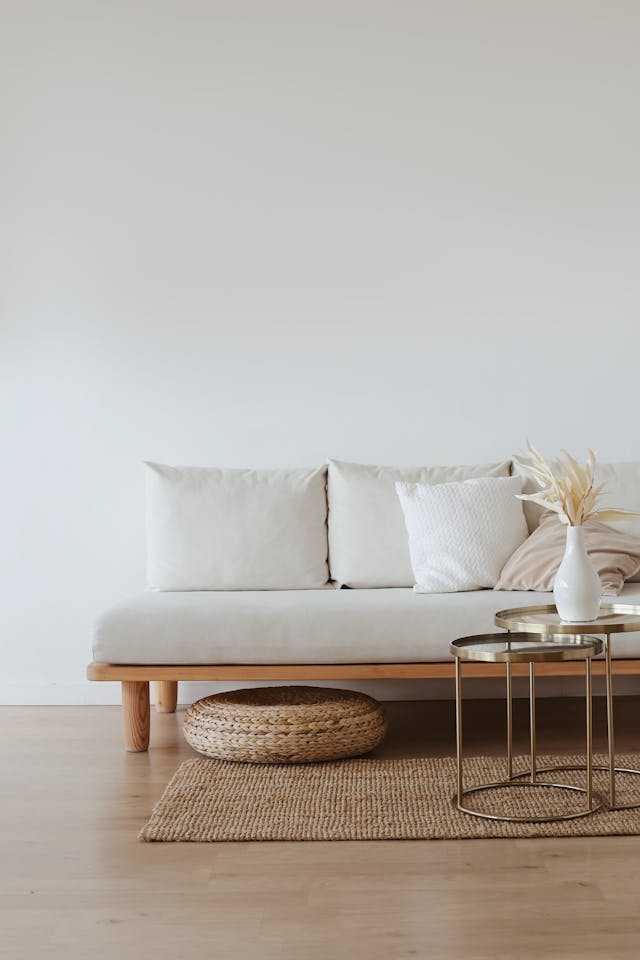
How to Build a Throw Pillow Combination That Works
Step 1: Choose Your Anchor Color
Every good pillow combination has one color that holds everything together. This is usually a neutral: warm white, natural linen, soft beige, dusty sage, or muted grey.
The anchor color appears in at least one pillow and keeps the combination from feeling chaotic.
If your sofa is a neutral, the anchor can be a richer color you want to bring into the room. If your sofa is already a color, a neutral anchor pillow is almost always the right move.
Studio McGee, whose approach to pillow styling is worth studying, notes that solid pillows do the hardest work in any combination: they give the eye a place to rest between patterns and keep even complex arrangements from looking cluttered.
Step 2: Add a Pattern at a Large Scale
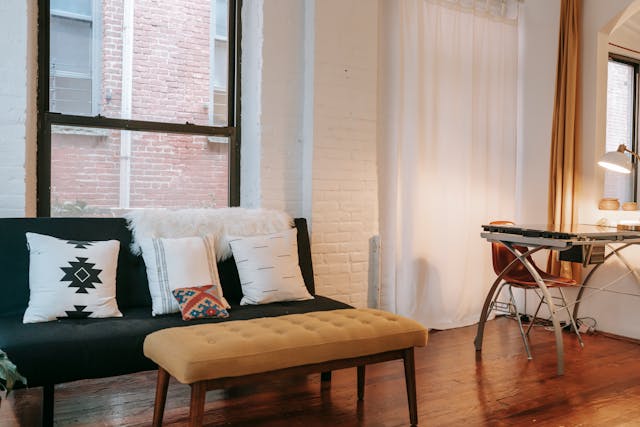
Once you have your anchor, introduce one pattern in a larger scale. Stripes, a simple geometric, a loose botanical print, an organic abstract.
This is the pillow that does most of the visual work. It sets the direction of the whole arrangement.
The key is scale. A large-scale pattern next to another large-scale pattern fights for attention. A large-scale pattern next to a solid anchor gives each room to breathe.
Step 3: Introduce a Second Pattern at a Smaller Scale
This is where most people stop, which is exactly why their arrangements look flat. Adding a second, smaller pattern is what gives the combination depth. A small geometric, a subtle stripe, a woven texture with a slight visual repeat.
It does not need to be obvious. It just needs to be there.
The rule for mixing patterns is simple: they need to share at least one color.
That shared color is the thread that makes different patterns feel intentional rather than random. As long as that connection exists, very different patterns can sit next to each other comfortably.
Step 4: Add a Lumbar or Round Pillow
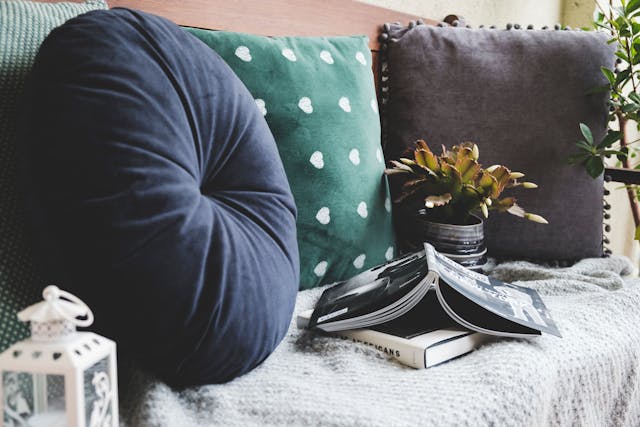
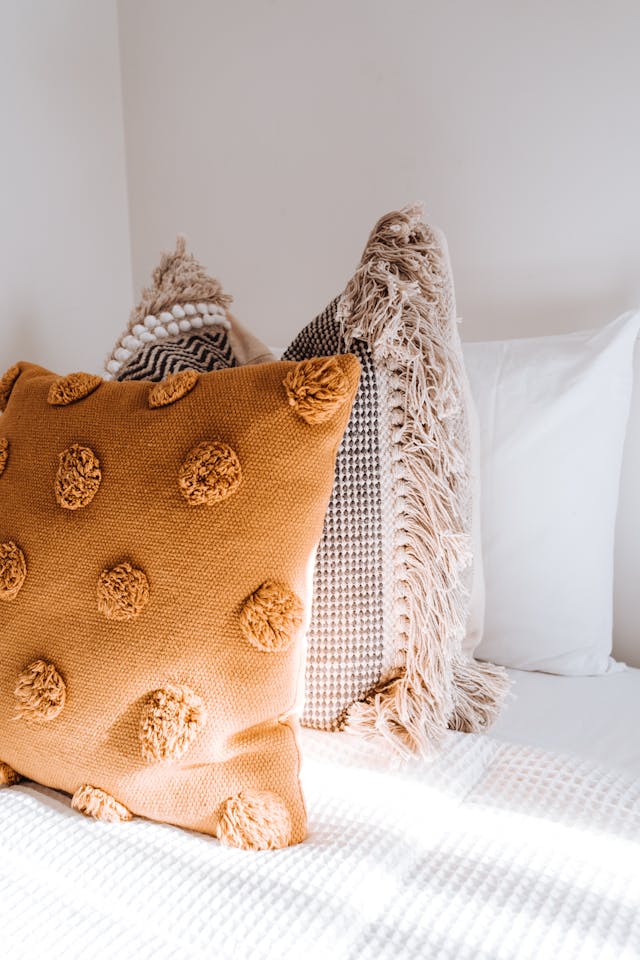
A lumbar pillow, the rectangular one, is the most underused shape in most homes. It breaks up the row of square cushions, adds visual variety, and gives the arrangement a finished quality that three matching squares simply do not have.
Place it in front, centered or slightly off-center.
A round pillow works the same way. It introduces a shape that does not appear anywhere else on the sofa and draws the eye in a way that adds interest without adding complexity.
Step 5: Vary the Size Front to Back
Layer your pillows by size. Largest at the back, medium in front of those, smallest or lumbar at the front. This is how you make sure every pillow in the arrangement is visible at the same time.
Standard throw pillow sizes to work with:
- 24 inches: back layer, acts as the base
- 20 inches: middle layer, the main combination players
- 18 inches or lumbar: front layer, the finishing detail
Parachute Home’s styling guide recommends starting with a 20-inch square as your base size for a standard sofa, then layering in complementary sizes. For oversized sectionals, move the base up to 22 or 24 inches.
Throw Pillow Combinations by Sofa Color
Neutral Sofa: Cream, Beige, or White
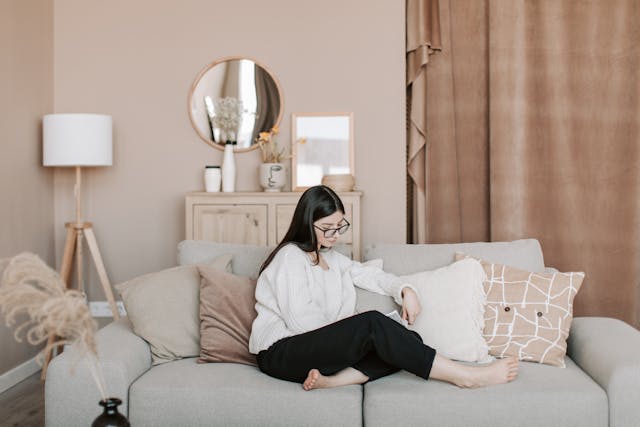
A neutral sofa is the most forgiving base to work with. Almost any color palette works here. The question is what mood you want the room to have.
For a warm, layered look: terracotta, warm rust, dusty pink, and natural linen.
Mix a terracotta linen pillow, a warm rust pillow with a subtle pattern, a natural linen lumbar, and one small pillow in a complementary muted pink.
Earthy, warm, feels lived-in without being heavy.
For a cooler, quieter look: soft sage, dusty blue, white, and warm grey. One sage linen, one white textured, one dusty blue with a geometric print, and a lumbar in grey.
Clean without being cold.
For a bolder approach: deep navy, warm cream, and a single pop of burnt orange. The navy does the work, the cream holds the center, and the orange appears once and only once.
Restraint in the accent color is what makes it land.
Grey Sofa

Grey can go either warm or cool depending on its undertone, and your pillow combination should follow the sofa’s lead.
Warm grey with warm tones. Cool grey with cool tones.
Mixing them tends to look off without you being able to say exactly why.
For a warm grey sofa: camel, rust, warm white, and soft sage. A camel velvet pillow, a rust pattern, a white linen lumbar, a sage textured square.
For a cool grey sofa: deep teal, slate blue, soft white, and charcoal. One teal solid, one slate blue with a pattern, a white lumbar, and a charcoal textured pillow at the back.
Dark Sofa: Navy, Charcoal, or Forest Green
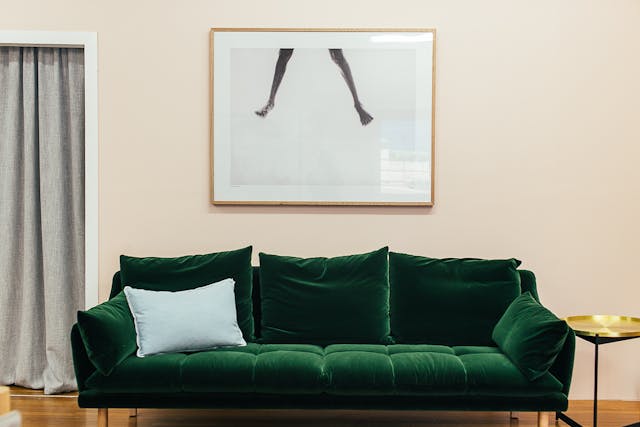
Dark sofas need light anchors.
Start with at least one cream, natural linen, or warm white pillow to keep the arrangement from disappearing into the sofa.
For a navy sofa: cream, soft gold, warm white, and a single rust or terracotta accent. The cream and white lighten the sofa, the gold adds warmth, and the rust gives the whole thing a point of interest.
For a forest green sofa: natural linen, warm rust, mustard yellow, and off-white. Green sofas look best with warm earthy tones. Cool blues and purples tend to fight the green rather than work with it.
Boucle or Textured Sofa
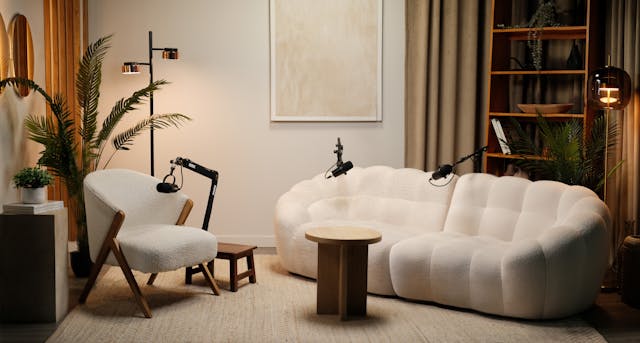
Boucle and heavily textured sofas already have visual interest built in. The pillows need to complement rather than compete. That means either very simple patterns or pillows that add a different texture rather than a pattern.
Velvet pillows on a boucle sofa. Linen on a velvet sofa. Smooth cotton on a chunky knit sofa.
The contrast between the textures is the design. Keep the colors simple and let the surface variety do the work.
How to Mix Textures Without It Looking Messy
Texture is the most overlooked element in pillow styling and often the difference between an arrangement that looks expensive and one that looks flat.
Different textures catch light differently, which gives the arrangement depth even when the colors are all within the same family.
Textures that work well together:
- Linen and velvet: the matte softness of linen against the sheen of velvet
- Boucle and smooth cotton: the nubby texture against something clean and flat
- Knit and woven: different fiber structures that both read as warm
- Embroidered and plain: the raised detail of embroidery against a simple background
The rule here is the same as for patterns: share one color, vary everything else.
Two velvet pillows in the same color family but different textures look intentional. Two pillows in completely different colors and completely different textures look like they came from different rooms.
Studio McGee’s approach to using solid textured pillows as anchors is one of the most useful frameworks for this: textural solids give patterned pillows space and allow the pattern to read clearly without competition.
Pillow Covers: The Most Practical Thing You Can Do
Buy good inserts once. Then buy covers. This is the approach that makes sense for anyone who wants to change things up seasonally or whenever a new color catches their eye. A quality pillow insert lasts for years. A cover costs a fraction of a full pillow and takes thirty seconds to swap.
One practical tip: buy your insert one size larger than your cover. A 22-inch insert in a 20-inch cover gives the pillow a full, structured look rather than a flat, underfilled one. The difference in how the pillow sits is immediate and significant.
For pillow covers, the best sources for well-priced options with genuine style range from Etsy sellers who produce small runs of interesting textiles to mainstream retailers like H&M Home and Zara Home, which carry good-quality linen and textured options at reasonable prices.
Avoid the cheapest options: the covers that pill within a month or lose their color after one wash are not worth the saving.
The Seasonal Swap
Changing pillow covers with the seasons is one of the simplest ways to keep a home feeling fresh without redecorating. It takes fifteen minutes and the room looks noticeably different.
A rough seasonal framework:
- Spring and summer: lighter fabrics, cooler tones, soft naturals. Linen, cotton, sage, dusty blue, warm white, sand
- Autumn: warmer tones, heavier textures. Rust, camel, deep green, mustard, boucle, velvet, knit
- Winter: the richest textures and deepest tones. Charcoal, deep navy, cream, burgundy, faux fur, chunky weaves
You do not need to replace every pillow. Swapping two or three covers in the arrangement shifts the whole palette.
Keep one or two anchor pillows consistent across seasons and change the accent ones around them.

Arranging Pillows on Different Sofa Shapes
Standard Sofa or Loveseat
The classic arrangement for a standard sofa: two larger pillows at either end, one medium pillow in front of each, and a lumbar centered in the middle. This gives you five pillows total, which is the interior design sweet spot for a sofa of average length.
For a more casual, asymmetrical look: three pillows grouped at one end, two at the other. Vary the sizes within each group.
The imbalance reads as relaxed rather than unfinished when the color and texture connections are there.
For a very clean minimal arrangement: one pillow at each end, same size, same or related color. Simple, intentional, and enough.
Not every sofa needs to be full of cushions. Two well-chosen pillows that belong there beat six that do not.
Sectional or L-shaped Sofa
Sectionals need the corner worked first. Start with one large pillow, 24 inches, in the corner of the L. That is your anchor.
Build outward from the corner, reducing size as you move toward the ends.
A typical sectional arrangement: one 24-inch at the corner, two 20-inch pillows flanking it, and smaller pillows or a lumbar at the open ends. The corner is the visual center, and everything else supports it.
Avoid spreading the pillows evenly across the whole length of the sectional.
Grouping them creates a sense of intention. Spreading them evenly creates a sense of coverage, which is different and less effective.
Decorative Pillows on a Bed
The same principles apply to decorative pillows on a bed, just scaled differently.
Euro shams, which are 26-inch square pillows, act as the back layer against the headboard. Standard sleeping pillows sit in front of those. Then decorative throw pillows layer in front of the sleeping pillows, smallest at the front.
For a made bed that does not require full reassembly every morning: keep the decorative pillows to two or three.
A pair of matching 20-inch pillows and one lumbar at the front gives the bed a finished look that takes ninety seconds to arrange.
4 Common Throw Pillow Combination Mistakes
1. Matching Everything
A set of six perfectly matching pillows looks like a furniture showroom, not a home.
Matching is safe. Coordinating is better. Coordinated pillows share a color story but vary in pattern, texture, and size. They look like they belong together without looking like they were sold that way.
2. Ignoring Scale
All small pillows on a large sofa looks underpowered. All large pillows on a compact sofa looks overwhelming.
Match the scale of the pillow to the scale of the furniture. A sectional needs bigger base pillows than a two-seater loveseat.
3. Overfilling
More is not better past a certain point. When there is no room left to sit because the sofa is entirely covered in pillows, the arrangement has gone past decorative and into something else.
Leave room for the people. The pillows are there to make the space feel welcoming, not to replace the function of the furniture.
4. Buying Covers That Do Not Fit Your Inserts
A pillow cover that is too large for the insert looks deflated and sad. A cover that is the right size or slightly smaller than the insert looks full and intentional.
Always size up your insert relative to your cover.
It is the simplest upgrade in pillow styling and almost nobody does it until they are told.
Throw Pillow Combination Checklist
Use this before buying a single new pillow.
- Identify the three main colors already in the room
- Choose an anchor color for the combination
- Pick one large-scale pattern that uses the anchor color
- Add one smaller-scale pattern or textured solid
- Include at least one shape that is not square: lumbar or round
- Layer sizes: largest at the back, smallest at the front
- Make sure every pattern shares at least one color with another
- Check the insert size: it should be one size larger than the cover
- Stand back and look at the whole arrangement before committing
- Ask: does this look like it belongs here, or does it look like it was chosen?
Save this list for the next time you are standing in a home store not sure which two pillows actually go together.
Do This Today
- Take every pillow off your sofa. Look at the sofa without anything on it. Then put back only the ones you actually like and that work together. Remove the rest. See what you are actually starting with.
- Write down the color palette of your room. Three colors. That is your framework for every pillow decision from here.
- Find one pillow cover online in a color or texture you have been wanting to try. Just one. Order it. See how it lands before committing to a full refresh.
Before You Buy
- Do you know your sofa’s base color and undertone
- Do you have an anchor color chosen
- Does the pattern you are considering share a color with what you already have
- Is your insert one size larger than the cover you are buying
- Are you adding a non-square shape to the arrangement

Q&A
1. How many throw pillows do I actually need?
For a standard sofa, three to five. For a large sectional, five to seven. Odd numbers tend to look more modern and less arranged. Even numbers look more traditional and symmetrical. Neither is wrong, just different.
2. Do throw pillows have to match the sofa?
No. They need to work with the sofa, which is different from matching it. Pillows that match the sofa exactly make the whole piece disappear. Pillows that complement and contrast it make the sofa look more deliberate.
3. Can I mix completely different patterns?
Yes, as long as they share at least one color. The shared color is the connection that makes the mix feel intentional. Without it, different patterns just look random.
4. What is the easiest pillow combination for a beginner?
Two textured solid pillows in different colors that both appear in the room, plus one lumbar in a neutral. Three pillows, no patterns, different textures. Hard to get wrong and looks clean and deliberate.
5. Is it worth buying pillow covers instead of full pillows?
Almost always yes. Good inserts last for years. Covers let you refresh the look seasonally, try new colors without committing, and store what you are not using without needing a huge amount of space.
6. How do I make pillows look full and not flat?
Buy inserts one size larger than the cover. A 22-inch insert in a 20-inch cover. The slight overfill gives the pillow structure and shape that a correctly-sized or undersized insert never achieves.
7. What fabrics work best for throw pillows?
For everyday use: linen, cotton, and boucle hold up well and look better over time. For accent pillows that get less wear: velvet, embroidered cotton, or woven textiles. The fabric should suit how the room gets used. A family living room needs covers that wash easily.
8. Can I use the same pillow arrangement on my bed?
The same principles apply, just with different proportions. Euro shams at the back, sleeping pillows in front of those, decorative throw pillows at the front. Two or three decorative pillows on a bed is usually enough.
9. How often should I change my pillow covers?
There is no required frequency.
Change them when the room starts to feel tired, or with the seasons if you enjoy that kind of refresh. Some people change covers twice a year. Others go years without changing them. Both are fine as long as you like what you are looking at.
10. My sofa is an unusual color. How do I find combinations that work?
Start with the undertone of the sofa color. Warm undertone sofa: build a palette from warm tones. Cool undertone sofa: build from cool tones.
Homes and Gardens has a well-researched breakdown of specific color combinations by sofa color in their guide at homesandgardens.com which is worth using as a reference before you shop.
Recommended Reading
- 15 Stunning Summer Casual Outfits for Women That Feel As Cool As They Look because the same principles that make a summer wardrobe feel cohesive apply to how a room comes together: a clear palette, deliberate texture choices, and restraint on the accent
- 11 Essential Secrets to Master Japanese Minimalist Fashion for the broader philosophy of intentional choices that earn their place, whether in a wardrobe or on a sofa
- Stop Buying Storage Bins You Don’t Need because the same instinct that creates a clutter of random pillows creates a clutter of unnecessary storage, and the solution in both cases is the same: choose fewer, better things
Last Thing
The sofa in our living room currently has a warm linen pillow at the back, a rust geometric in front of it, a sage boucle that I found in a secondhand shop last autumn, and a small cream lumbar in the center. None of them were bought together. All of them work.
It took me one afternoon and a color principle I could write on the back of a receipt: share a color, vary everything else. That is genuinely the whole thing.
Get the combination right and the sofa looks like it was designed. Get it wrong and even beautiful individual pillows look like they ended up there by accident. The difference between those two outcomes is usually one decision: did you start with the colors already in the room, or did you start with what caught your eye in the store?
Which combination are you working with right now, and what is the one piece that never quite fits?








One Comment