
Save Money: Stop Buying Decorative Couch Pillows Until You Check This First
Before you open a browser tab or walk into a store, your living room already has the answer to what throw pillow combinations it needs. You just have not noticed it yet.
Disclosure: This post contains affiliate links. If you make a purchase through these links, I may earn a small commission at no extra cost to you. Thank you for supporting my blog!

Most pillow advice starts in the store. Pick a pillow you love, they say, and build from there.
That approach is backwards. It puts the pillow first and the room second, and that is why so many people end up with cushions that looked perfect on a shelf and wrong the second they landed on the sofa.
I have been swapping the pillow covers in our living room for years. Not because I get bored easily, but because I enjoy the small seasonal shift. A different combination in early fall, something lighter when the days get longer. It costs almost nothing and changes everything about how the room feels.
What I have learned is that the right combination was never in the store to begin with.
It was always in the room, waiting to be noticed. This guide is about finding it there first, before you spend a dollar.
Why Most Couch Pillow Combinations Fail Before You Even Get Home
The typical sequence goes like this: see a pillow online, love it, buy it, get it home, put it on the sofa, feel vaguely disappointed without being able to say why.
The pillow is not wrong. The room is not wrong. The problem is that the two were chosen in completely different contexts and then expected to work together without any conversation between them.
Interior designers do not start in a shop. They start in the room. They look at the rug, the wall color, the curtains, the art, the floor, the light at different times of day. The shopping comes last, as a very specific errand with a very specific list.
That is the approach this guide follows. You are going to check the room first. Then you will know exactly what you need.
How to Check Your Room for the Right Throw Pillow Combinations
Step 1: Stand in the Doorway and Look at the Sofa Fresh
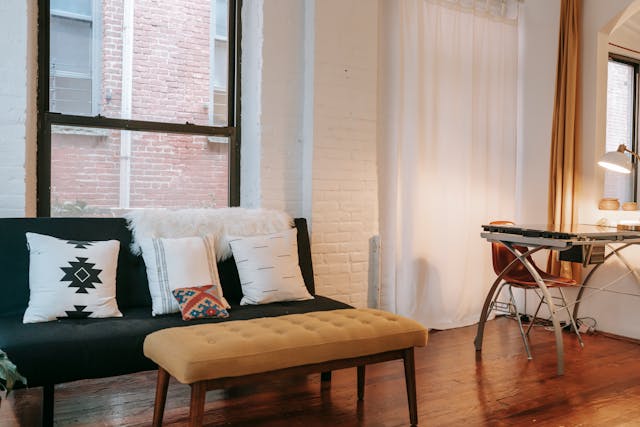
Walk out of your living room. Then walk back in and look at the sofa as if you are seeing it for the first time.
What is the first thing that feels missing? Not wrong, just absent. Warmth? A color that keeps catching your eye elsewhere in the room but never shows up on the sofa? A softness the room has everywhere else except there?
Write that feeling down in one word. Warm. Calm. Grounded. Lighter. That word is your brief. Every pillow decision you make should answer it.
Step 2: Find the Color That Works Best in the Room
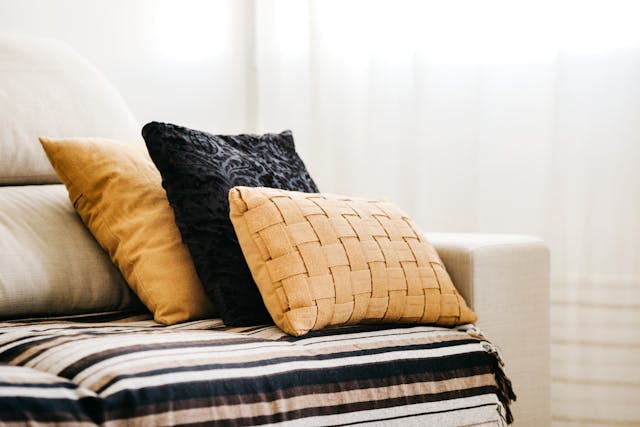
Look at everything that is not the sofa: the rug, the curtains, artwork, a lamp, a vase, a plant pot. Find the one color that appears most often or most prominently. That color wants to be on the sofa too.
This is not a rule someone invented. It is how rooms build coherence.
When a color appears in multiple places across a space, the eye follows it around and registers the space as intentional. A color that only appears in the rug reads as an accident. The same color in the rug and on one sofa pillow reads as a choice.
Step 3: Figure Out the Texture the Room Is Missing
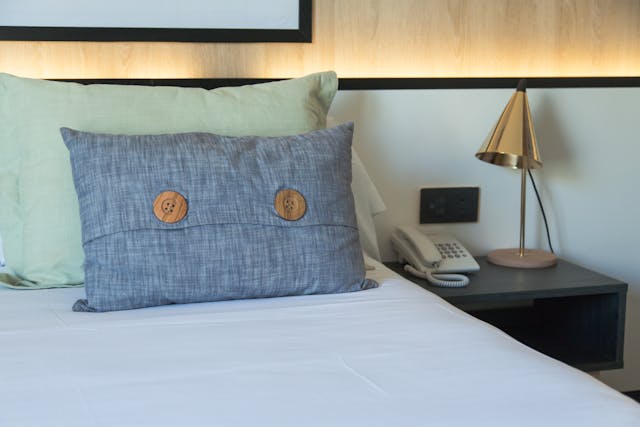
Look across the surfaces. Are most things smooth and flat? The room might want something nubby or tactile. Is everything already heavily textured, boucle sofa, woven rug, rough walls? Then it might want something crisp and smooth to give the eye a break.
Texture is the most underestimated element in pillow styling and the one that makes the biggest difference when it is right. A room where all the textures belong to the same family feels flat, even if the colors are perfect. A room where one surface is noticeably different from the others feels alive.
For a detailed breakdown of how texture works with specific sofa colors, Homes and Gardens’ guide to throw pillow color and texture combinations is one of the most practically useful resources out there.
Step 4: Notice What the Light Does
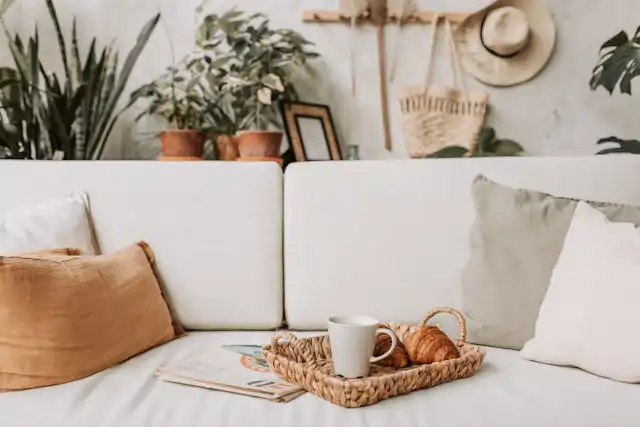
Look at the room at the time of day you actually spend most time in it. Morning light, evening lamp light, a grey November afternoon. The same pillow looks completely different in warm lamp light versus cold daylight.
Velvet in evening lamp light: rich and beautiful. The same velvet in flat daylight: heavy and dull. Pale linen in morning light: fresh and airy. The same linen under a warm lamp: almost gold.
Know your room’s light before you commit to any fabric.
Pillow Fatigue: Why Your Cauch Pillows Look Busy Even When They Are Nice
There is a specific kind of visual exhaustion that comes from a sofa with too much happening on it. Too many patterns competing for attention. Too many colors that all want to be noticed. It looks busy even when each individual pillow is beautiful.
Interior designers call this visual weight, and it is the main reason well-intentioned pillow arrangements fail. Each pillow was a good decision on its own. Together, they exhaust the eye.
The fix is not simpler pillows. It is intentional quiet. For every pillow that does something visually demanding, one should do almost nothing. A solid linen. A single-color velvet with no embellishment. Something that gives the eye a place to rest between the more interesting pieces.
Studio McGee makes this point well: solid textured pillows are the breathing room in any arrangement. They make everything around them look more intentional by giving patterns space to do their work.
Quick Task
Count the patterns currently on your sofa. If there are more than two, remove one and see if the arrangement immediately looks more settled. This single edit fixes pillow fatigue ninety percent of the time.
What Good Throw Pillow Combinations Actually Have in Common
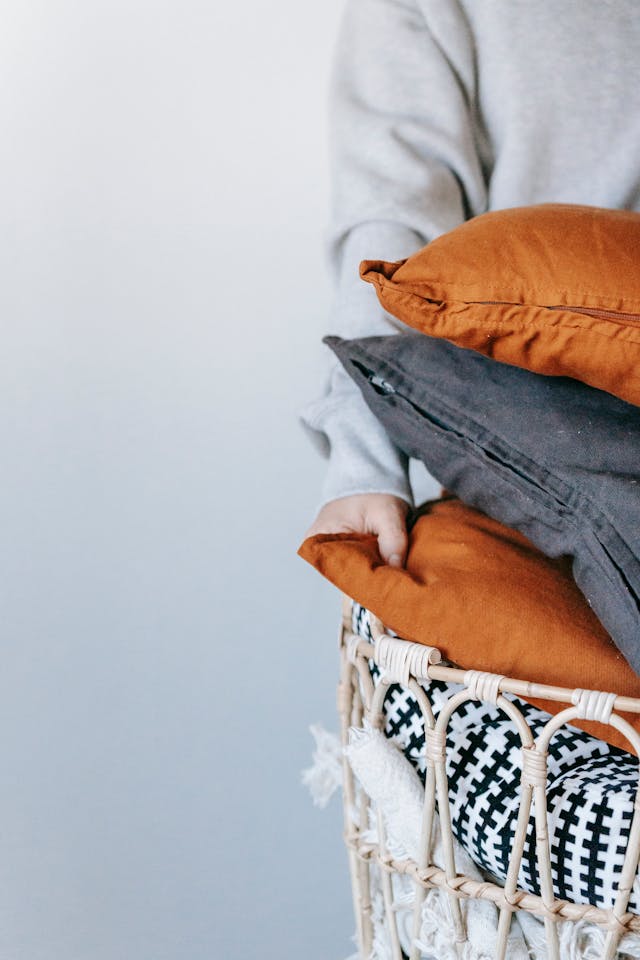
The combinations that look best in real rooms almost never sound impressive when you describe them out loud. Warm white linen, a dusty sage geometric, a rust lumbar. It sounds unambitious until you see it in a room where the rug has sage and the lamp is brass.
Good pillow combinations do not try to be the point. They support the room. They make the sofa look like it belongs in the space rather than like it was dropped there while the room happened around it.
The combinations that fail tend to be the ones chosen to be impressive on their own. Bright colors. Big patterns. Things that look great in a flatlay photograph and then compete with everything else in an actual room.
A Better Way to Think About Mixing Cauch Pillow Patterns
The standard advice on mixing patterns is about scale: one large, one medium, one small. That is fine. But there is a more useful frame that most guides skip.
Think about the personality of the pattern, not just its size.
Some patterns are assertive: they want to be looked at, they make a statement, they pull the eye immediately. Others are quiet: they add texture and interest but do not demand attention. Others are neutral: they look almost solid from a distance but have enough surface detail up close to be interesting.
A good pillow combination has one assertive pattern, one quiet one, and one neutral. Put two assertive patterns together and they fight. Put all neutrals together and the arrangement disappears.
Life on Cedar Lane puts it simply: pillows do not need to match, they need to share a thread. That thread can be a color, a mood, a texture family, or a scale. As long as it exists, very different patterns can sit together comfortably.
7 Couch Pillow Combinations That Work in Almost Any Living Room
These are not formulas. They are starting points based on combinations that hold up across a wide range of sofa colors, room styles, and light conditions.
1. Linen Neutral + One Textured Solid + Lumbar in an Accent Color
The simplest pillow combination that still looks deliberate. The linen does nothing, which is exactly its job. The textured solid adds depth without complexity. The lumbar is the only accent color in the whole arrangement.
Why it works: The linen gives the eye a place to rest. The textured solid adds dimension without noise. The single accent lumbar gets all the attention it needs because nothing else is competing with it. Three pillows, three minutes to arrange.
Extra Tip: Use a lumbar in a color you would not commit to on a larger pillow. A burnt orange lumbar is much easier to live with than a burnt orange 20×20. If you love it, go bigger next time. If not, a cover swap costs almost nothing.
2. One Bold Geometric + Two Tonal Solids
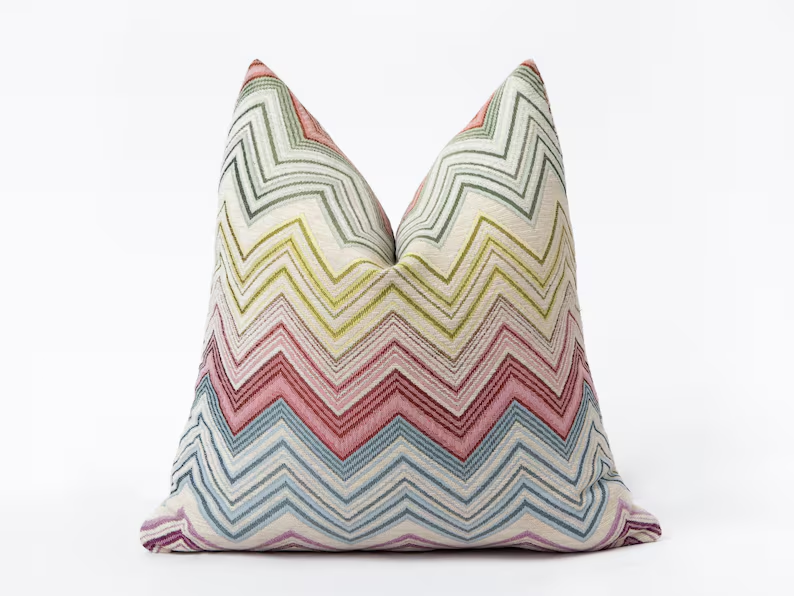
The geometric carries the combination. The two solids, in colors pulled directly from within the geometric’s palette, frame it on either side. This works especially well with dark sofas because the pattern gives the eye a focal point without overwhelming a surface that already has weight.
Why it works: Dark sofas absorb light and can feel heavy. A bold geometric breaks that up immediately. The tonal solids tie it back to the sofa rather than fighting it, and because they pull colors from the geometric itself, the whole arrangement feels like one decision rather than three.
Extra Tip: If your geometric has five colors in it, pick the two that appear least often in the pattern for the solids. Those secondary colors get elevated when they appear alone on a solid pillow, and the result looks far more considered than pulling the obvious dominant color.
3. All Textures, No Patterns
Boucle, washed linen, velvet, and a knit. All in the same color family, completely different on the surface. This is the combination for rooms that are already visually busy: interesting art, patterned rugs, strong wall colors. The pillows settle the sofa into the room rather than adding more noise.
Why it works: When the room is already doing a lot visually, the sofa needs to be calm. All-texture pillow combinations in one color family add depth without adding another thing to look at. The surface variation is enough interest on its own.
Extra Tip: This combination works best when you vary the temperature of the textures, not just the surface. A cool linen next to a warm knit next to a smooth velvet gives the group a range that one fabric family alone cannot achieve.
4. Two Patterns From Completely Different Eras
A modern abstract with a traditional block print. A classic stripe with a contemporary organic shape. When they share one color, the contrast between styles reads as interesting rather than chaotic. This is the combination that makes a room feel genuinely curated rather than trend-following.
Why it works: Mixing pattern eras creates a collected feel that is very hard to achieve with same-era pieces. It says the room was put together over time, with thought, not assembled from one shopping trip. The shared color is what keeps it from looking accidental.
Extra Tip: The older or more traditional the pattern, the more muted its colors tend to be. Use that to your advantage: pair a faded, low-saturation vintage-style print with a clean, graphic modern one. The contrast in color intensity adds another layer of interest beyond the pattern difference.
5. One Statement Pillow, Everything Else Quiet
One pillow that is genuinely beautiful and a little bold. The rest are solids or very subtle textures in colors that support it. The statement pillow gets to be exactly that. Nothing competes. This works especially well in smaller rooms where too much going on at once shrinks the space visually.
Why it works: One statement in a quiet room carries more weight than three statements in a busy one. Giving one pillow full permission to be the focal point, and making everything else step back, is the arrangement equivalent of a single piece of great art on a white wall.
Extra Tip: The statement pillow does not have to be expensive. A $15 cover with a genuinely interesting pattern or texture will hold the room if everything around it is calm. Quiet pillows are where you actually save money, not on the one that carries the combination.
6. Seasonal Texture Shift With a Permanent Color Base
Keep two or three pillow covers consistent year-round to anchor the color palette. Then swap one or two with the season. Lighter linen in spring and summer. Velvet and boucle in fall and winter. The base stays, the mood shifts, and the combination never feels stale.
Why it works: You are not changing everything, just the surface. Because the base colors stay constant, the seasonal swap feels like a refresh rather than a full redo. The room looks different but still recognizably itself.
Extra Tip: Store your off-season covers flat in a shallow bin under the bed. Folded in a drawer works too. Having them genuinely accessible is what makes the seasonal swap something you actually do rather than something you plan to do.
7. Pillows That Echo Something Unexpected in the Room
There is a terracotta pot in the corner. A blue stripe in the rug that most people do not notice right away. A warm amber tone in a piece of artwork.
Pull that overlooked element onto the sofa. Suddenly the room has a thread running through it that most visitors cannot name but everyone feels. This is the combination that makes a room feel designed rather than just decorated.
Why it works: Designers call this repetition with variation. When a color or texture appears in more than one place in a room, the eye starts connecting the dots without being told to. The room feels unified in a way that is hard to explain but immediately obvious.
Extra Tip: Before you go pillow shopping, photograph every object in your room that has a color you love. Lay those photos side by side. The color that appears across the most objects is the one to bring onto the sofa. You already know it belongs there, you just have not put it there yet.
The Best Throw Pillow Arrangement Might Already Be in Your Home
There is a version of this that costs nothing.
Go through every room. Collect every throw pillow and every cushion cover you own. Put them all on the sofa at once and take everything off that does not belong. What remains after that edit is often better than anything you could have planned in advance.
I have done this. Pulled the cushion from the bedroom chair, the small pillow from the reading corner, two from the guest bed. Arranged them on the living room sofa.
Three of them worked together in a combination I had never tried and immediately loved. None of them were new. All of them had been in the house for years, just in different rooms.
The pillow you are looking for is sometimes already here. It just has not met the right sofa yet.
For a broader approach to using what you already own before adding anything new, the 30-Day Declutter Challenge for Busy Moms applies the same logic to the whole house.
When to Actually Buy New Pillow Covers
After you have checked the room. After you have tried what you already own. After you know the specific thing that is missing.
Not a pillow you love. A pillow that does a specific job the room needs done. A lumbar in that exact warm rust because nothing else in the room sits at that height in that color. A boucle square because every other surface is smooth and the sofa needs one thing that is not.
That kind of shopping takes twenty minutes and produces results that last. Browsing until something catches your eye produces pillow covers that feel right for a week and then start to feel off in a way you cannot quite explain.
Parachute Home’s guide to choosing throw pillows like a designer is worth going through before you shop. It covers fabric choices, size decisions, and how to match pillow texture to sofa material, which most people skip entirely.
One practical note on buying: always size up your insert. A 22-inch insert in a 20-inch cover.
The slight oversize gives the pillow structure and fullness that a correctly-sized or undersized insert never achieves. It is the single most reliable upgrade in pillow styling and almost nobody does it until someone tells them.
The Pillow Cover Swap: Change Your Couch Pillows Without Buying New Ones
Buy quality inserts once. Then buy only covers going forward.
This is the approach that makes a seasonal refresh genuinely affordable and trying something new low-risk. A cover costs a fraction of a full pillow. If it does not work, you spent fifteen dollars learning something useful about your room.
If it works, you just changed the entire feel of the sofa for fifteen dollars.
The cover-first approach also means you can own a small collection and rotate. Three covers per insert position, one out at a time, two stored.
The sofa stays interesting. The home stays uncluttered. It is the most minimalist way to approach throw pillows and the one that produces the most consistently good results over time.
For good covers: Etsy’s smaller textile makers produce options that are completely different from what you find in chain stores. For inserts, Amazon’s pillow insert bestsellers cover every size with solid reviews, and the price per insert makes sizing up an easy call.
Before You Buy a Single New Couch Pillow: Checklist
Go through these first.
- Stand in the doorway and write down one word for what the sofa is missing.
- Find the most prominent color in the room that is not on the sofa.
- Check whether the room is missing a texture or has too many of the same one.
- Look at the room in the light you actually use it in most often.
- Count the patterns on the sofa and remove one if there are more than two.
- Collect every cushion and pillow cover in the house and try different combinations.
- Find the specific gap that remains after trying what you already own.
- Write a one-sentence brief: I need a pillow that does X in Y color with Z texture.
- Then, and only then, go shopping.
Save this before your next pillow purchase.
Do This Before Anything Else
- Stand in your doorway and look at the sofa. Write one word for what is missing. That is your brief.
- Pull every cushion and cover you own onto the sofa. Remove everything that does not belong. What stays is often better than anything you could have planned.
- If you still need something: write exactly what it is before opening a browser. Specific color, specific texture, specific shape. Then find that thing and only that thing.
The One-Minute Couch Pillow Check
- One word: what is missing
- One color: what does the room already have that the sofa does not
- One texture: what surface does the sofa need that nothing else in the room has
- One shape: are all the pillows square, and should one not be
- One question: how many patterns are there currently, and is one too many
Q&A: Throw Pillow Combinations
1. What if my room has no obvious color palette? Where do I start?
Start with the sofa and the floor. Even a neutral room has undertones: warm beige, cool grey, natural oak. Build from the undertone of what you already have and a palette emerges naturally. Warm undertones: camel, rust, cream, sage. Cool undertones: dusty blue, slate, white, charcoal.
2. Is there a rule about how many colors a pillow arrangement can have?
Not a rule, but a useful limit: three colors, one of which is a neutral. More than three tends to feel unresolved. Fewer than two tends to feel flat. Three with a neutral anchor is the range where most arrangements settle into something that looks intentional.
3. Do the pillows need to relate to the curtains or just the sofa?
To both, and to the rug. The combination works best when it references the whole room. A pillow that picks up a color from the curtain, a texture from the rug, and the undertone of the sofa makes the whole room feel pulled together, not just the sofa.
4. My sofa is a rental I did not choose. How do I work with a color I would not have picked?
Neutralize it rather than fight it. If the sofa is an aggressive brown, lean into warm neutrals that soften it. If it is a cold grey, bring warm tones into the pillows. You cannot change what the sofa is, but you can redirect what the eye notices about it.
5. What is the fastest way to refresh a sofa without buying anything?
Rearrange what is already there. Move pillows from other rooms. Try an asymmetrical arrangement if it was symmetrical. Remove two pillows and see if three looks better than five. Rotation is free and often more effective than replacement.
6. Is it okay to have the same pillow on both ends of the sofa?
Yes, and sometimes it is the best choice. Two matching pillows at either end with a different one in the center is one of the cleanest arrangements possible. Symmetry reads as deliberate when the rest of the room supports it. It only looks boring when the matching pillows are the only thing happening.
7. My pillows always look flat after a few months. What is happening?
The insert is too small for the cover, or the insert has lost its fill. Replace it with one that is one size larger than the cover. Fluff the inserts weekly: grab from two corners and pull outward to redistribute the fill. The difference in how the pillow holds its shape is immediate.
8. How do I know when a combination is actually working?
You stop noticing the individual pillows and start seeing the sofa. A combination that is working becomes invisible in the best way: the sofa just looks right, and you cannot immediately say why. When you are still aware of each pillow separately every time you look, the combination is not quite there yet.
9. Is it worth buying a lumbar pillow if I have never had one?
Yes. A lumbar is the most underused shape in most homes and the one that most reliably makes an arrangement look finished. Start with a neutral one, placed centered in the front layer. Most people who try one for the first time wonder why they waited.
10. What is the one thing that separates a great pillow arrangement from a mediocre one?
Quiet. A great arrangement has at least one pillow that does almost nothing: a solid, a neutral texture, something that gives the eye permission to rest. Mediocre arrangements have every pillow competing at the same volume. The one that steps back is the one that makes all the others look better.
Recommended Reading
- How to Choose Throw Pillow Combinations That Actually Work in Your Home for the color-pairing and sofa-specific guide that follows naturally from this one
- 11 Essential Secrets to Master Japanese Minimalist Fashion because the same philosophy of using what you already own intentionally applies to a wardrobe and to a sofa
- Stop Buying Storage Bins You Don’t Need for the broader case against buying new things before exhausting what you already have
Final Thoughts
The combination I have on the sofa right now is one I found by pulling cushions from three different rooms and trying them together on a slow Sunday afternoon. None of them were bought for that purpose. All of them turned out to belong there.
The room knew. It always does. You just have to stop looking at the store and start looking at the space.
Just a quick question for you: What is the one word your room would use right now if you asked it what the sofa is missing?
You May Also Like
-
Sweater Outfits: 11 Fresh Ways to Wear One Burgundy Sweater All Winter
In this post I’ll show you how to wear one burgundy sweater 11 different ways, from a Monday at the office to Christmas Eve dinner. You’ll also find color pairs, the mistakes that make a knit look tired, and simple care tips that keep it soft for years.
-
Christmas Savings Challenge: A Printable Tracker for Weekly and Biweekly Paydays
This christmas savings challenge turns the cost of December into small, planned amounts you set aside from now until the holidays. You’ll find 8 simple challenges with the real math for weekly and biweekly paydays, plus a free printable tracker to color in.
-
Christmas Mantle Ideas: 13 Calm Looks With Zero Clutter
These christmas mantle ideas help you build an elegant fireplace display that looks calm instead of crowded. You’ll find 13 looks, from a lush garland with burgundy velvet to a mantel with a TV above it, plus color pairs and the mistakes worth skipping.








One Comment