
75 Summer Bucket List Ideas With Kids That Actually Create Memories
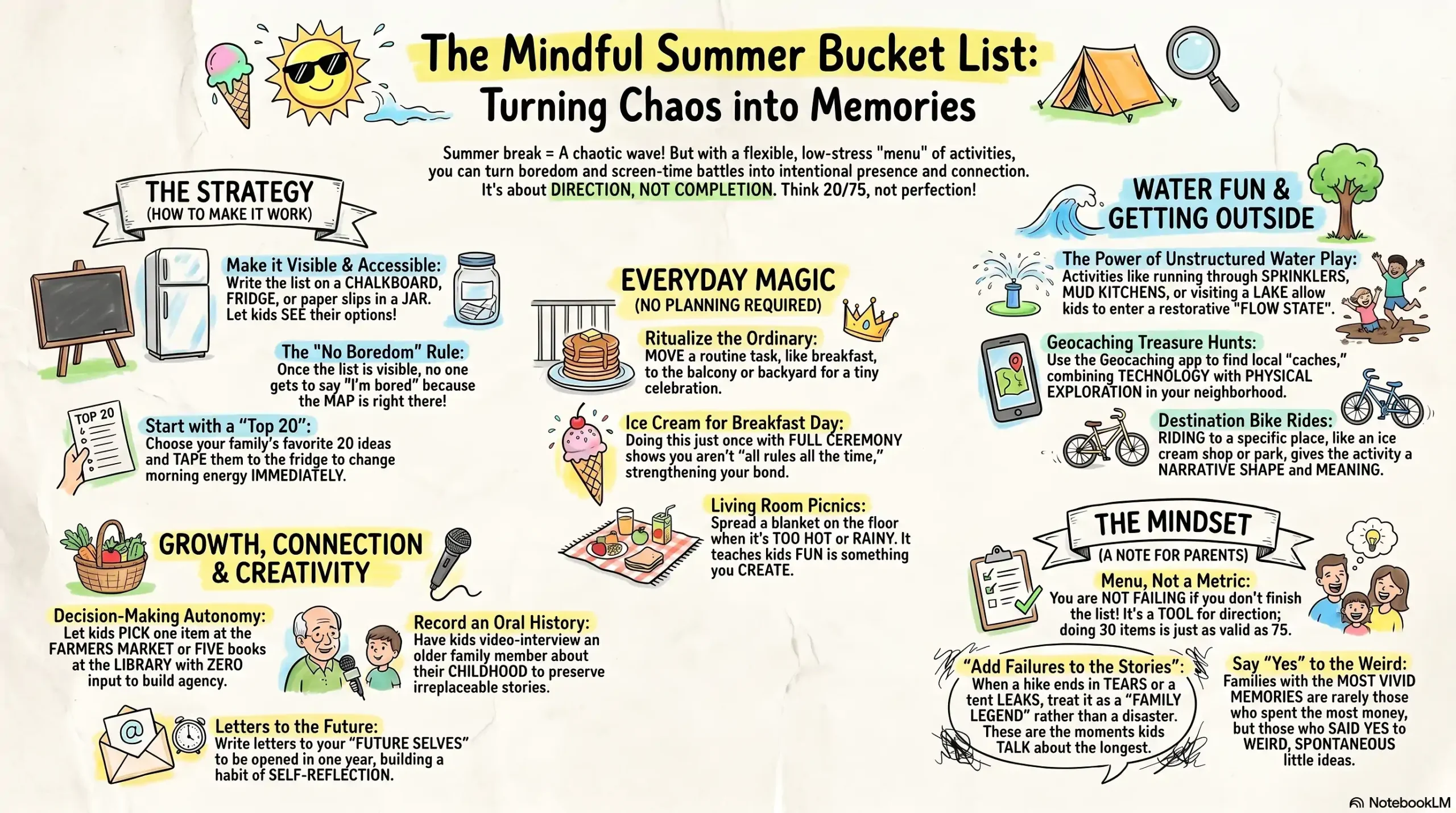
I’d like to offer you a truly helpful yet lighthearted guide to help you get through the long summer break with the help of a flexible “bucket list” and consciously create family memories together. Instead of a rigid schedule, create a practical list of activities that allows your children to choose their own adventures.
I’ve put together 75 varied summer bucket list ideas for you, ranging from simple, cost-free activities—such as breakfast outdoors—to more elaborate ones, like geocaching and day trips.
Instead of perfection, I recommend simply being present, because the smaller, spontaneous moments often have a deeper impact on children—and on us, as parents—than expensive, carefully planned events.
Summer is beautiful, golden, and gloriously long.
But also, if we are being honest, a little terrifying to plan when you have kids at home and real life still happening around you.
I live in Hungary, and every single year, summer break lands on our family like a warm, slightly chaotic wave. Two and a half months. No school structure. No automatic rhythm. Just us, the heat, and the question that keeps coming back every morning: so, what are we doing today?
The Question I Had to Stop Avoiding
For a while, I winged it. Some days were great. Some days ended with everyone melting into the couch by 10am, and me quietly questioning all my parenting choices.
What changed everything was giving my kids a list. Not a rigid schedule. Not a spreadsheet. Just a simple collection of ideas they could look at when inspiration ran dry.
The moment we had the list, the tone of the whole summer shifted. They stopped asking me what we were doing and started telling me which item they wanted to pick next.
Here is what I noticed: the list works because it has everything on it. The tiny things, like eating ice cream for breakfast just once. The bigger adventures, like a weekend road trip. The silly stuff that costs nothing, and the things that need a little planning. That mix is what makes it feel exciting rather than obligatory.
How It Works and What You Actually Need
You don’t need a laminated poster (though that is cute if you want it) and you don’t need a summer activities membership or a special budget.
What you need is:
- the list,
- a way to display it where your kids can see it, and
- one rule: no one gets to say I am bored if the list is right there.
Print it. Write it on a chalkboard. Make a simple jar with paper slips. However it looks in your home, the point is that it is visible, accessible, and theirs to use.
Quick Activity
Print or write out your top 20 ideas and tape them to the fridge today. Kids are far more likely to pick something if they can physically see the options in front of them. This takes five minutes and changes the whole energy of the morning.
A Thought Before We Get Into the List
I want to say something that might be slightly unpopular: you do not have to do all 75 things. You are not failing if you make it to 30. The point of a summer bucket list with kids is not completion. It is direction.
Summer without any plan feels like a road trip without a map. You might end up somewhere interesting, but you will also waste a lot of time going in circles. The list gives you the map. What you actually visit is up to you.
I also want to be honest: some of these ideas will land perfectly and some will flop spectacularly. My kids once refused to do a homemade slip-and-slide we spent an hour setting up, then spent forty minutes jumping in a puddle instead. The puddle was on the list. The puddle won.
What European Summers Actually Taught Me
Here in Hungary, summer break is nearly eleven weeks long. That is longer than in the US, longer than in most of Western Europe, and it means we have to be genuinely intentional about how we fill the time.
What I have noticed over the years is that kids do not actually need elaborate activities to feel like summer was special. What they need is presence, novelty, and a little bit of controlled chaos.
A spontaneous evening walk to get soft-serve counts just as much as a full beach day. Sometimes more, because nobody had to pack anything. The families I know who have the most vivid summer memories are not the ones who spent the most money. They are the ones who said yes more often to the weird little ideas.

75 Summer Bucket List Ideas With Kids
The Everyday Magic (No Planning Required)
1. Eat Breakfast Outside
There is something about moving a completely ordinary meal to the backyard or balcony that makes it feel like a tiny celebration. No special food required. Just your regular toast and the morning air.
Why it works: It resets the mood of the whole day before it has even properly started. Kids feel the novelty immediately, and it costs absolutely nothing.
2. Have a Picnic in the Living Room
Rain? Too hot? Nobody wants to go outside? Spread a blanket on the floor, pack everything into a bag as if you are actually going somewhere, and eat it there.
The ritual is the point, not the location. Why it works: It teaches kids that fun is something you create, not something you find. This one is genuinely beloved by every age group.
3. Stay Up Late to Watch the Sunset Together
Pick one evening per week where bedtime does not matter. Sit outside, watch the sky change, and just be there. No phones. No agenda.
Why it works: These are the moments kids remember. Not because anything happened, but because you were all together and unhurried.
4. Sleep in a Tent in the Backyard
Full camping experience minus the logistics. Set up the tent after dinner, bring snacks and a flashlight, and sleep out there. Even if everyone ends up back inside by midnight, it still counts.
Why it works: It delivers all the magic of camping without the packing, driving, or campground booking. Perfect for a spontaneous Tuesday.
5. Make Homemade Ice Cream or Popsicles
Blend frozen fruit with a little yogurt and honey, pour into molds, freeze. Done. You do not need a fancy machine. You need a freezer and about ten minutes of actual effort.
Why it works: Kids love making food even more than eating it. Letting them choose the flavor combinations makes them wildly invested in the result.
6. Have an Ice Cream for Breakfast Day
Just once. On purpose. Make it a thing. Let them order whatever they want and eat it at the breakfast table with full ceremony.
Why it works: The audacity of it delights them. It also proves that you are not all rules all the time, which does something genuinely good for the relationship.
7. Build the Biggest Blanket Fort You Have Ever Made
Every cushion in the house. Every blanket. Chairs, string, whatever it takes. Build it big enough to actually live in for the afternoon.
Why it works: It is tactile, creative, collaborative, and completely absorbing. Older kids suddenly become very helpful when fort architecture is involved.
8. Read a Book Outside Every Day for a Week
Pick a spot, pick a book, and make it a daily ritual for one week. Even twenty minutes counts.
Why it works: It builds a reading habit without it feeling like homework. The fresh air and change of scenery make it feel like a choice, not a requirement.
9. Start a Summer Journal Together
One shared notebook. Every evening, one entry: the best part of the day, one weird thing that happened, and one thing you are looking forward to. Takes five minutes.
Why it works: By the end of summer you have an actual artifact of the season. Kids love re-reading it in September when they miss the freedom.
10. Have a No-Screens Morning Once a Week
Pick one morning where the rule is: no phones, no tablets, no TV until noon. No negotiation. See what happens.
If you want more ideas for what to do in those morning hours, Common Sense Media’s screen-free summer guide has great age-by-age suggestions. Why it works: What usually happens is they initially complain, then get creative, and end up doing something genuinely fun they would never have chosen otherwise.
Water Fun
11. Run Through the Sprinkler
Classic. Timeless. Works every single time regardless of age, at least until they hit about thirteen.
Why it works: Free, immediate, and requires zero setup beyond turning on the hose. On a hot day this is a guaranteed win.
12. Make a DIY Slip-and-Slide
A long sheet of plastic, water, a tiny bit of dish soap, and a garden hose. That is the whole project.
Why it works: Kids will use it for hours. Fair warning: they will also immediately ignore the actual slip-and-slide in favor of whatever else they discover nearby, and that is fine too.
13. Go to a Public Pool or Water Park
This one takes planning but delivers enormous payoff. Pack light, arrive early, stay until they are genuinely done.
Why it works: Water parks have a way of using up energy at a pace that nothing else matches. You will have very quiet evenings after these days.
14. Have a Water Balloon Fight
Fill them the night before so you are not scrambling. Pick a side. Accept that you will get soaked.
Why it works: Inter-generational, hilarious, and one of those things they will specifically bring up years later when talking about good summers.
15. Catch Fireflies at Dusk
Wait until the light gets golden, go outside, and look. In Hungary this means heading somewhere a little more rural or to the edge of the city, but it is worth it.
Why it works: There is something genuinely magical about fireflies that lands differently for kids than any screen experience could. It is slow, quiet, and completely unexpected every single time.
16. Visit a Lake or River for the Day
Pack a bag, get there by mid-morning, and let them be water babies for as long as they want. My kids would stay until someone physically carried them out.
Why it works: Open water play is unstructured in the best possible way. There is no right way to do it, and that freedom is exactly what summer is supposed to feel like.
17. Float Down a Gentle River on Inflatables
If you have access to a calm river and some inner tubes or inflatable rings, this is one of the most peaceful summer activities that also happens to feel extremely adventurous to kids.
Why it works: It requires almost no effort from you while delivering maximum novelty to them. Pack snacks and a dry bag.
18. Make a Mud Kitchen or Play in the Mud
Let them get completely, enthusiastically, no-holds-barred muddy. On purpose. Put on old clothes and just let it happen.
Why it works: Sensory play at any age is calming and deeply satisfying. Also, the bath after is a whole event in itself.
19. Try Stand-Up Paddleboarding or Kayaking
Most lakes and coastal areas have rentals. Kids as young as five can manage a tandem kayak with a parent.
Why it works: It is one of those activities that feels like a big adventure and requires genuine skill, which kids love being recognized for developing.
20. Have a Watercolor Painting Session Outside
Set up on the porch or grass with watercolors and paper. Let them paint whatever they see, or just whatever comes to mind.
Why it works: Outdoor light changes how color looks, which is genuinely interesting even for very young kids. It is also quiet, which is useful by day fifteen of summer.
Food and Kitchen Adventures
21. Make Homemade Lemonade From Scratch
Real lemons, real squeezing, real simple syrup. Let them figure out the ratio.
Why it works: They drink approximately six glasses of it because they made it themselves, and the pride is palpable.
22. Cook an Entire Dinner Together
Let each kid own one part of the meal. One does the salad, one does the main, one does dessert.
Why it works: Cooking with kids builds competence and confidence in a way that is hard to manufacture with other activities. It also results in dinner, which is efficient.
23. Have a Backyard BBQ or Grill Night
Even if you grill regularly, make it feel like an event. Let the kids help choose the menu, set the table outside, and light the candles.
Why it works: Ritualizing ordinary things is how families build culture. This is what they will try to recreate when they have their own families.
24. Make Fresh Pasta or Pizza Dough Together
Flour on every surface. Dough that may or may not turn out correctly. Absolute chaos and a surprisingly good dinner.
Why it works: Hands-in-the-dough activities are satisfying for kids in a deeply physical way. Also, homemade pizza is hard to argue with.
25. Visit a Farmers Market and Let the Kids Pick One Thing
Give each kid a small amount of money or a single decision: they get to choose one thing from the whole market. It can be a vegetable, a jam, a piece of fruit, whatever catches their eye.
Why it works: Decision-making autonomy is genuinely exciting for kids. They will also be far more likely to eat or use whatever they chose.
26. Try a Food From a Country You Have Never Visited
Cook a simple dish from somewhere your family has talked about going: Japan, Mexico, Morocco. Make it a dinner event.
Why it works: It opens up conversations about the world that feel natural and interesting rather than like a geography lesson.
27. Have a Smoothie Bar Morning
Put out all the fruit, yogurt, nut butters, and toppings you have. Let each person build their own.
Why it works: Kids eat significantly more variety when they are the ones making the decisions about what goes in.
28. Make and Eat a Giant Charcuterie Board for Lunch
Lay out everything: cheeses, crackers, fruit, olives, whatever you have. Call it fancy. Eat it outside.
Why it works: It is impressive-looking with very little effort, and kids love grazing instead of having a traditional plated meal sometimes.
Creative and Indoor Ideas
29. Start a Summer Art Project
One ongoing project for the whole season. A collage, a painted rock collection, a scrapbook of the summer. Add to it weekly.
Why it works: Having something that builds over time gives kids a sense of continuity and intention. It is also a beautiful object to have at the end.
30. Make Tie-Dye T-Shirts
Old white t-shirts, rubber bands, and dye kits from any craft store. Do this outside and accept the mess as part of the deal.
Why it works: The reveal when you unwrap the rubber bands is genuinely thrilling every single time. They will wear those shirts all summer.
31. Build Something With LEGO With No Instructions
No kit. No booklet. Just a pile of bricks and an open brief.
Why it works: Constrained creativity is one of the most valuable things you can offer a kid. The results are always surprising.
32. Have a Movie Marathon Day
Pick a theme: all the movies from one franchise, all the animated films you have never seen. Make popcorn. Do it properly.
Why it works: Intentional screen time is completely different from passive scrolling. A movie marathon has a beginning, middle, and end, and it creates shared references and inside jokes.
33. Write and Illustrate a Short Story Together
Each person writes one sentence, then passes it to the next. Keep it short: five pages maximum.
Why it works: Collaborative creative work is genuinely bonding, and the results are often hilarious in the best way.
34. Try a New Craft: Origami, Friendship Bracelets, or Macrame
Pick one skill to learn together over a week. Watch a tutorial, practice it badly, improve slightly, feel very proud.
Why it works: Learning something new alongside your kid positions you as a fellow beginner rather than an authority. That dynamic is good for everyone.
35. Set Up a Pretend Shop, Restaurant, or Market
Let them build the whole concept: menu, prices, currency, and service. You are the customer. Take it seriously.
Why it works: Imaginative play at this level involves math, communication, planning, and narrative. It is also extremely entertaining to watch.
Getting Outside
36. Go on a Nature Scavenger Hunt
Make a list: a feather, a smooth rock, something red, something that makes a sound, an insect, a seed. Then go find them.
Why it works: It gives kids a purpose on a walk, which makes them approximately three times more willing to actually go on the walk.
37. Learn to Identify Five Local Birds
Get a simple field guide or download a free bird identification app. Spend one morning just noticing.
Why it works: Once they can name something, they notice it everywhere. It shifts how they see the world around them, and that shift is permanent.
38. Go Stargazing
Find a spot with low light pollution, bring a blanket, and stay long enough for your eyes to truly adjust. Download a free constellation app beforehand.
Why it works: The scale of the sky has a way of making even the most overstimulated child go genuinely quiet. That quiet is precious.
39. Hike a New Trail
Not the same one you always do. A new trail, even a short one, delivers novelty that a familiar path simply cannot. Use AllTrails to find a kid-rated beginner trail near you, sorted by distance and difficulty.
Why it works: Exposure to new environments builds confidence and curiosity. Kids who hike regularly develop a relationship with difficulty that translates into everything else.
40. Have a Backyard Olympics
Make up events: longest jump, fastest run to the tree and back, most accurate throw into a bucket. Award medals made of aluminum foil.
Why it works: Kids will play this all afternoon with minimal input from you. The competition is enough to keep them completely absorbed.
41. Go Geocaching
Free, available almost everywhere, and genuinely feels like a treasure hunt. Download the Geocaching app, pick a beginner cache nearby, and go find it. REI’s guide to geocaching with kids covers everything you need to get started in about ten minutes.
Why it works: The combination of technology and physical exploration hits differently than either one alone. Kids who try geocaching almost always want to do it again.
42. Have a Bike Ride to Somewhere Specific
Not just a ride. A ride to somewhere: a specific ice cream shop, a park you have never been to, a friend’s house.
Why it works: Destination rides give the activity a narrative shape. There is a beginning and an end, and the journey feels meaningful rather than circular.
43. Visit a Botanical Garden or Flower Market
Slow down. Walk around. Let them smell things and pick a favorite flower.
Why it works: Beauty is worth teaching as something worth noticing. This kind of visit cultivates that muscle gently.
44. Collect and Press Flowers or Leaves
Pick them on a walk, press them between heavy books for a few days, and then display them or put them in the summer journal.
Why it works: It gives a walk a purpose and creates a tangible souvenir of a specific day. Very low effort, surprisingly meaningful.
45. Go to a Local Festival or Street Fair
Whatever is happening in your area, go. Food, music, craft stalls, crowds: all of it.
Why it works: Local events are where kids develop a sense of place and community. They start recognizing faces and understanding that they are part of somewhere specific.
Learning and Growing
46. Learn Five Words in a New Language
Pick a language your family is curious about. Learn hello, thank you, please, how much, and one funny word.
Why it works: Language learning at this level is playful and confidence-building. It also makes any future travel to that country feel like it has context.
47. Visit a Museum You Have Never Been To
Every city has at least one museum that has been on the mental list for years. This summer, actually go.
Why it works: Museums slow the pace in a way that is genuinely different from other outings. Even reluctant kids usually find at least one thing that catches them.
48. Learn a Basic Magic Trick and Perform It
Find a simple card trick or coin trick on YouTube. Practice it until it works. Perform it for someone.
Why it works: The discipline of practicing something until it is actually good is a skill in itself. And performing it is a small act of courage.
49. Grow Something From Seed
One pot. One seed. Water it and watch what happens over the summer. If you want a starting point, KidsGardening.org lists the fastest-germinating seeds (sunflowers sprout in 4 to 5 days, which is practically instant for a kid).
Why it works: The pace of plant growth teaches patience in a completely concrete way. There is no shortcut and no hack. You just have to wait.
50. Do a Science Experiment at Home
Baking soda and vinegar volcano, homemade slime, or a density column with liquids from your kitchen. There are hundreds of options that need nothing you do not already have.
Why it works: Science at home is hands-on and messy and immediate. It also creates curiosity about how things work that formal education sometimes struggles to replicate.
51. Visit a Library and Let Each Kid Pick Five Books Completely on Their Own
No input from you on the choices. Whatever they pick, they read.
Why it works: Reading agency is one of the most reliable ways to create readers. The library visit itself can become a ritual they look forward to.
52. Try a New Sport Together
Badminton, frisbee golf, bocce, mini golf. Pick something none of you are good at and be bad at it together.
Why it works: Adults being beginners at something is genuinely helpful for kids to witness. It normalizes the discomfort of being new at things.
53. Write a Letter to Your Future Self to Open in One Year
Each person writes one: what they are looking forward to, what they are worried about, what they hope happens. Seal it and put it somewhere safe.
Why it works: It builds self-reflection as a practice. Opening it a year later is one of the most interesting conversations a family can have.
Adventure and Day Trips
54. Visit a Town or Village You Have Never Been To
In Hungary, there are extraordinary small towns an hour or two from Budapest that most families have never explored: Eger, Koszeg, Holloko. Pick one. Go for the day.
Why it works: Local travel builds appreciation for where you live in a way that international trips often cannot. Kids start seeing their own country as interesting.
55. Take an Overnight Trip Somewhere New
Just one night. One new place. Pack light and go.
Why it works: Overnight trips have the magic of a full travel experience with half the logistics. The novelty of sleeping somewhere different is genuinely exciting.
If packing light is hard for you, Stop Overpacking: 10 Vacation Outfits That Actually Fit in Your Bag might help. Traveling with less is genuinely one of the best things you can do for your own enjoyment of a trip.
56. Go to a Farm and Pick Your Own Fruit or Vegetables
Strawberries, cherries, sunflowers depending on the season. Find a pick-your-own farm and spend a morning there.
Why it works: Understanding where food comes from is a slow, important education. It also results in the best jam you will ever make.
57. Spend a Day at the Beach or Lakeside With No Agenda
No scheduled activities. No hourly check-ins. Just show up, find a spot, and see what happens.
Why it works: Unstructured time near water is one of the most restorative things a family can do. Kids go into a state that looks a lot like flow.
58. Watch an Outdoor Movie or Concert
Check what is happening in your area over the summer. Outdoor film screenings and free concerts are often available in most cities.
Why it works: The combination of being outside and doing something culturally interesting creates an experience that feels more special than it needs to.
59. Do a City Scavenger Hunt in Your Own Town
Pretend you are tourists. Find three things you have never noticed before. Photograph them. Look up what they are.
Why it works: Familiarity makes us stop seeing things. The tourist lens brings it all back.
60. Visit an Aquarium or Zoo
Yes, you have probably been before. Go again. They see it completely differently every year.
Why it works: Kids’ relationship with animals deepens as they grow. What was exciting at five becomes genuinely interesting at eight in a completely different way.
Connections and People
61. Have a Cousin or Friend Sleepover
Plan it in advance, let the kids stay up late, and do not hover. Just let them have the experience.
Why it works: Peer relationships at this age are some of the most formative. Giving them unstructured time with friends is more valuable than most organized activities.
62. Write and Send an Actual Physical Postcard
Buy a postcard. Write something on it. Put a stamp on it. Mail it.
Why it works: In a world of instant messages, a physical letter arriving in a mailbox is genuinely exciting to receive. And the act of writing it is a small, meaningful practice.
63. Interview an Older Family Member on Video
Ask grandparents what their childhood was like, what their first job was, what they were afraid of at your age. Record it.
Why it works: This is oral history, and it is irreplaceable once it is gone. Kids also find out things about their family that genuinely surprise them.
64. Have a Neighborhood Lemonade Stand
Old-fashioned, slightly chaotic, and completely wonderful.
Why it works: It is an early lesson in entrepreneurship, customer service, and how terrifying it is to approach strangers. All valuable.
65. Volunteer or Do Something Kind for Someone Else
Bring food to a neighbor, help with a community clean-up, donate things to a local shelter.
Why it works: Getting outside of your own experience is good for everyone, and summer provides the time and space to actually do it thoughtfully.
Nighttime and Wind-Down Rituals
66. Make a Summer Playlist Together
Each family member adds five songs. No vetoing anyone else’s choices. Listen to it on every drive.
Why it works: Music becomes memory in a very specific way. Years later, those songs will immediately bring back this summer.
67. Have a Bonfire or Fire Pit Evening
Marshmallows, stories, and sitting in the dark watching the fire. Even a small fire in a backyard pit counts.
Why it works: Fire creates a conversational atmosphere that screens cannot. People talk differently around a fire.
68. Play Board Games or Card Games One Night a Week
Actually commit to it. Put it in the calendar. Treat it like a standing date.
Why it works: Game nights build a specific kind of relationship: competitive, funny, collaborative, and completely present with each other.
69. Stargaze and Make Up Your Own Constellation Stories
You do not need to know the real names. Look up at the sky and invent your own stories about what you see.
Why it works: Storytelling and imagination under the actual stars is one of those experiences that is hard to describe to someone who has not done it with their kids.
70. Do a Summer Solstice Celebration
Midsummer is a real thing in European culture. Mark it. Light candles, stay up late, celebrate the longest day.
Why it works: Rituals create meaning. Marking the seasons builds a sense of time and rhythm that is genuinely grounding for children.
The Bigger Adventures
71. Plan a Road Trip Together, Even a Short One
Get a map out (a real one, if possible). Let the kids help decide where to go, which route to take, and where to stop.
Why it works: The planning is half the adventure. Kids who participate in the decision-making are dramatically more engaged on the actual trip.
72. Try Camping for at Least One Night
Real camping: sleeping bags, a tent, cooking over a fire. It does not need to be far from home.
Why it works: Camping strips away comfort in a way that is immediately clarifying. Kids discover a version of themselves they do not meet anywhere else.
73. Visit a Water Park for a Full Day
All day. No rushing. Let them ride every slide until they are done with it.
Why it works: Some days the whole point is just maximum fun with no educational component whatsoever. Those days matter too.
74. Take a Train Trip Somewhere Just for the Experience
Pick a destination that requires a train. Let the journey be part of the point.
Why it works: Train travel is its own kind of adventure that kids find inherently exciting. There is something about moving through a landscape at speed that gets everyone looking out the window.
75. Create Your Own Family Summer Tradition and Commit to Doing It Every Year
Pick something small and repeatable: a specific hike, a particular meal on the last day of summer, an annual photo in the same spot, a tradition that is only yours.
Why it works: Traditions are the architecture of family identity. And the best ones are the ones you accidentally started without realizing it and then decided to keep.
Your Summer Bucket List Checklist
Save this for the season ahead.
- Pick 10 ideas from the list and write them somewhere visible
- Do at least one water activity per week
- Cook or bake something together at least twice a month
- Take one day trip somewhere you have never been
- Do one nighttime activity: stargazing, bonfire, or late sunset watch
- Write at least one entry in the summer journal together
- Have one no-screens morning per week
- Plan one overnight trip, even just one night somewhere new
- Do one act of kindness or volunteer activity as a family
- Create one tradition to repeat every summer from now on
Pin this so you can come back to it when you need a fresh idea mid-July.
Do This Right Now
- Write down three ideas from this list that made you think yes, we are definitely doing that this summer. Just three. That is your starting point.
- Find where you are going to display the list in your home. Fridge? Chalkboard? Whiteboard in the hallway? Pick the spot.
- Tell one of your kids one idea from the list and ask them what they think. Watch what happens.
Mini Checklist: Before Summer Actually Starts
- Decide how you will display the bucket list
- Stock up on basic supplies: sunscreen, good water bottles, a reusable picnic bag
- Check local event calendars for festivals, outdoor movies, and markets
- Identify two day trip destinations you want to try this year
- Set up the summer journal or notebook somewhere accessible
- Talk with your kids about which five ideas they are most excited about
Resources Worth Bookmarking Before Summer Starts
Before we get into the list, a few places worth knowing about. If you want honest, research-backed ideas for keeping kids off screens without turning it into a battle, Dolly Dowsie’s 100 screen-free summer activities is one of the best roundups I have come across. She gets what slow, intentional summer actually looks like with real kids.
For finding family hikes near you, AllTrails has a dedicated kids filter that shows difficulty ratings and reviews from other families. You can search by distance, terrain, and age-appropriateness, which makes picking a new trail a five-minute job instead of an hour of Googling.
And if geocaching is on your list (which it should be), the REI beginner’s guide to geocaching with kids walks you through everything you need to get started. The official Geocaching.com app is free, and there are almost certainly several caches within walking distance of wherever you are right now.
For growing things from seed with kids, KidsGardening has a detailed Q&A on indoor seed starting with children. They even list the fastest-germinating seeds (sunflowers sprout in 4 to 5 days, which is basically instant gratification).
And for keeping the summer intentional and a little bit lighter, the 30-Day Declutter Challenge for Busy Moms on this blog is a great way to clear the house before the season actually starts. Calmer space, calmer summer.
Q&A: Real Questions About Making a Summer Bucket List Work
1. My kids are very different ages. How do I make one list that works for everyone?
Make it a long list, which is exactly why 75 items works well. A list this size has something for a four-year-old and something for a twelve-year-old. Let each kid mark their top ten, then look at the overlap. You will find more common ground than you expect.
2. What if we only manage to do 20 things all summer?
Then you had 20 experiences you might not have had otherwise. The list is not a performance metric. It is a menu. Nobody feels bad about not ordering every item.
3. How do I keep the list feeling exciting in week six when everyone is tired?
Rotate in some of the smaller, lower-effort items during the flat weeks. Save a few big-ticket ideas for mid-August when energy typically dips. And let the kids pick. When they choose, they are more invested.
4. We do not have a yard or outdoor space. Can the list still work for us?
Absolutely. Most of the ideas here work in parks, on balconies, in community spaces, or indoors. Living in an apartment is not a barrier to any of this.
5. My partner is not very enthusiastic about structured summer activities. How do I get buy-in?
Start with the tiny things that require nothing from them: ice cream for breakfast day, reading outside, the summer playlist. Once they see how low-effort it actually is, they usually come around.
6. How do I handle it when something on the list fails or is a disaster?
You add it to the stories. The water balloon fight where the balloons would not break. The hike where everyone cried. The camping night that ended in a hotel. Those are the ones they will talk about the longest.
7. Is it too late to start if summer is already halfway through?
No. Start today. Even six weeks of intentional summer is more memorable than ten weeks of drifting.
8. How do we track what we have done without it feeling like homework?
Keep it visual and low-key. Check off items with a marker on a printed list, add a photo to the summer journal, or drop a slip of paper with the date into a jar. Make the tracking feel like a celebration, not a report card.
9. What if my kids do not want to do any of the things on the list?
Let them add their own ideas. A good bucket list should have things that came from them too. If they feel ownership over it, they will use it.
10. Should the list be different every year?
Yes and no. Keep the traditions, the annual hikes, the rituals that have become yours. Add new things. Remove the ones that never really worked. It should evolve as your kids do.
Recommended Reading
A few more posts from The Minimalist Flow that pair well with a summer like this:
- 66 Realistic Summer Bucket List Ideas for Maximalist Women because if you are building your own list anyway, this one is full of ideas sorted by effort level, from a five-minute win to the trip you have been postponing for years
- Stop Overpacking: 10 Vacation Outfits That Actually Fit in Your Bag for the day trips and overnight stays on your bucket list, so you can actually enjoy the trip instead of managing your luggage
- Realistic Summer Evening Routine Ideas for Highly Sensitive Women because after a full day of activities with kids, you need a wind-down routine that actually works, not just another generic suggestion
One More Thing
Summer is not something that happens to us. It is something we build, one morning, one afternoon, one slightly chaotic evening at a time.
The years when my summers felt the most full were not the years when we did the most. They were the years when we were present for what we did do, when we noticed it, when we talked about it afterward. The bucket list helps with that. It gives us language for what we are doing and a reason to choose it on purpose.
Pick your list. Start with one thing. See what it leads to.
And honestly, what is the one item you already know is going on your list this summer, the one you have been quietly meaning to do for years?
You May Also Like
-
Sweater Outfits: 11 Fresh Ways to Wear One Burgundy Sweater All Winter
In this post I’ll show you how to wear one burgundy sweater 11 different ways, from a Monday at the office to Christmas Eve dinner. You’ll also find color pairs, the mistakes that make a knit look tired, and simple care tips that keep it soft for years.
-
Christmas Savings Challenge: A Printable Tracker for Weekly and Biweekly Paydays
This christmas savings challenge turns the cost of December into small, planned amounts you set aside from now until the holidays. You’ll find 8 simple challenges with the real math for weekly and biweekly paydays, plus a free printable tracker to color in.
-
Christmas Mantle Ideas: 13 Calm Looks With Zero Clutter
These christmas mantle ideas help you build an elegant fireplace display that looks calm instead of crowded. You’ll find 13 looks, from a lush garland with burgundy velvet to a mantel with a TV above it, plus color pairs and the mistakes worth skipping.







2 Comments