How to Fall Asleep Quickly Without Screens, Pills, or Pressure
Disclosure: This post contains affiliate links. If you make a purchase through these links, I may earn a small commission at no extra cost to you. Thank you for supporting my blog!
Do you ever lie there wide awake at midnight, completely exhausted, but your brain refuses to switch off? If you want to fall asleep quickly without a screen, a pill, or a mental pep talk, here’s the honest truth: your body already knows how.
It just needs the right signals.
In this article, I’m sharing the exact habits, small tools, and mindset shifts that actually help you fall asleep quickly, night after night, without turning bedtime into one more task on your to-do list.
I used to be the woman scrolling at 1 a.m., promising myself I’d put the phone down in five more minutes. Then my daughter came into our lives a little later than most, at 41, and sleep stopped being a nice-to-have. It became survival. What changed things for me wasn’t one big fix.
It was a handful of small, boring, repeatable habits that work with how our bodies are wired, not against them.
Sleep researchers have known for years that there are real, natural ways to fall asleep quickly, and most of them have nothing to do with willpower. They have to do with temperature and light, and honestly, most of all, with what your nervous system decides is safe. Once I understood that, bedtime stopped feeling like a fight I kept losing.
If you think trouble falling asleep gets worse with age, the latest CDC numbers say otherwise: adults ages 18 to 34 struggle to fall asleep quickly more than any other age group.
years
years
years
years
I also had to accept something a little humbling. No app, no fancy gadget, and no amount of reading about sleep hygiene at 2 p.m. was going to fix what I was doing to myself every night at 11 p.m. The fix had to happen in the actual thirty minutes before I closed my eyes, not in a wellness app I opened once and forgot about.
Falling asleep is not something you force. It’s something that happens once your body feels calm enough to let it go.
Your brain checks a few boxes before it hands over control for the night. Is the room dark enough? Is the body cool enough? And underneath both of those, is the mind actually quiet, or just pretending to be?
Ask yourself honestly. When was the last time you gave your body all three of those things at once?
Most of us never do, and then we lie there wondering why sleep won’t come. That gap, between what your body needs and what your bedtime routine actually gives it, is where almost all of this starts.
A useful self-check before we get into the list: notice whether you’re tense right now, reading this, shoulders up near your ears, jaw tight. If the answer is yes, that same tension is probably still there when you climb into bed later tonight, and no amount of blackout curtains will undo it on their own.
Quick Win
Tonight, before anything else, drop your bedroom temperature to somewhere between 65 and 68 degrees Fahrenheit. Cooling the room is one of the fastest, most physical signals you can send your brain that it is safe to fall asleep quickly, and it costs you nothing but adjusting a thermostat.
Take this 30 second quiz to find out what is actually keeping you from falling asleep quickly, and exactly which section of this post to read first.
15 Realistic Ways to Fall Asleep Quickly Tonight
These are the methods I actually use, in roughly the order I’d reach for them on a rough night. Some take two minutes. A couple take a bit of setup. None of them require you to overhaul your whole life by Friday.
1. Try the Military Sleep Method First
This one was developed to help pilots fall asleep sitting upright, in loud rooms, before high-stakes missions, and it still holds up as one of the fastest natural ways to fall asleep quickly. You relax your face, drop your shoulders, breathe out, then relax your legs one at a time from the thighs down.
Why it works: it forces your body out of alert mode by physically releasing tension your brain associates with being awake and on guard. The Cleveland Clinic breaks down the exact steps and the research behind them if you want to try it tonight. My tip: do it lying flat on your back, not on your side, the first few times.
A quick example: I use this on nights after a long car trip, when my body is tired but my mind is still replaying the highway. Working down from my face to my toes gives my brain something specific to do instead of spiraling.
2. Breathe With the 4-7-8 Pattern
Inhale quietly through your nose for four counts, hold for seven, exhale slowly through your mouth for eight. Repeat four times.
This is one of the simplest ways to fall asleep quickly because it interrupts racing thoughts by giving your brain a counting task instead.
A small clinical study on the technique found it measurably reduced pre-sleep anxiety in participants, and the Cleveland Clinic has a clear walkthrough of how to do it correctly. Try it lying in the dark, eyes closed, before you reach for your phone one last time.
It feels a little silly the first time you count out loud in your head. Stick with it anyway. By the third round, most people notice their exhale getting longer and heavier on its own, without forcing it.
3. Cool the Room Down for Real
Your core body temperature needs to drop for sleep to start, and a warm bedroom fights that process every single night. This is different from a hot bath before bed, which actually helps because your skin releases heat afterward and cools you down faster.
How it’s useful for you: if your thermostat sits above 70 at night, this alone could be the fix you’ve been missing. Crack a window, use a fan, or lower the setting before you brush your teeth so the room has time to catch up.
A quick comparison worth knowing: a room that’s too cold works against you almost as much as one that’s too warm, since shivering keeps your nervous system alert. The sweet spot really is that narrow 65 to 68 degree window, not colder for the sake of colder.
4. Block Out Every Bit of Light
Even small amounts of light through curtains or from a charging phone can quietly delay melatonin release. A properly blackout curtain changes this in one weekend, no lifestyle overhaul required.
I like these thermal blackout curtains, they’re affordable and genuinely block streetlights.
If new curtains aren’t in the budget right now, an old dark towel over the rod works surprisingly well as a stopgap.
How it’s useful for you: even a phone charging light across the room can register on a sensitive sleeper’s brain. Cover it with a small piece of tape or turn it to face the wall, it sounds silly until you notice the difference the very first night.
5. Put Screens Away a Full Hour Before Bed
I know, I know. This is the one everyone skips. But the science here isn’t vague marketing talk. Blue light from phones and laptops suppresses melatonin, the hormone that tells your body it’s nighttime, and it does this in a dose-dependent way, meaning more exposure means more delay.
The Sleep Foundation explains exactly how blue light affects your sleep cycle, and the effect was first measured in a widely cited clinical study on melatonin suppression from light exposure. Swap the scroll for a paper book or a warm shower instead, your eyes and your nervous system will both thank you.
If cutting screens out completely feels unrealistic tonight, start smaller.
Dim the brightness all the way down and switch on night mode at least. It’s not a perfect fix, but it’s a real step toward falling asleep quickly instead of an all-or-nothing rule you’ll abandon by Wednesday.
6. Try Progressive Muscle Relaxation
Starting at your toes, tense each muscle group for five seconds, then release. Work your way up to your face.
It sounds almost too simple to be one of the more effective ways to fall asleep quickly, but the physical release matters more than we give it credit for.
How it works: your body can’t stay tense and let go at the same time, so this method forces relaxation in a way that pure willpower can’t. A lot of women I hear from say this is the one that finally worked when nothing else did.
A relatable example: try it the next time your shoulders have been up near your ears all day from stress. By the time you get to your calves, the tension in your jaw and neck has usually already let go, even though you never told it to.
7. Use a Weighted Blanket on Anxious Nights
There’s a reason weighted blankets became so popular so fast. The gentle, even pressure mimics a hug and can genuinely lower a racing heart rate before bed, which matters most on the nights your mind won’t stop replaying the day.
I use a chunky knit weighted blanket that also looks nice thrown over the couch during the day, which matters to me since I don’t love clutter.
Related post: If anxious, wired-but-tired nights are a regular thing for you, this post on better sleep habits for sensitive women goes much deeper into why that happens and what actually helps.

8. Turn On White Noise or Sleep ASMR
A steady, low hum covers the small sounds that would otherwise pull you out of the early stages of sleep, a creaky floor, a passing car, sometimes just a partner breathing a little too close.
Sleep ASMR videos work on a similar principle for some people, giving the brain something gentle and predictable to focus on instead of the day’s leftover thoughts.
A simple white noise machine is often more consistent than an app, since it won’t buffer, ping with a notification, or tempt you to check the time. Set it up once and forget it exists.
How it’s useful for you: this is especially helpful in shared bedrooms or apartments with thin walls, where unpredictable noise, not silence, is the actual problem keeping you from drifting off.

9. Consider Magnesium Glycinate Before Bed
Magnesium plays a role in regulating the nervous system, and glycinate is generally considered gentler on the stomach than magnesium citrate, which can have the opposite effect you want at bedtime.
This isn’t medical advice, so talk to your doctor before adding any supplement, especially if you take other medication.
I keep a bottle of magnesium glycinate capsules on my nightstand for the nights my legs feel restless.
A small glass of water and one capsule, about thirty minutes before bed, is the whole routine.
How it’s useful for you: if you notice you fall asleep fast but wake up around 3 a.m. wired for no clear reason, low magnesium is one of the more common, overlooked culprits worth asking your doctor about.
10. Do a Brain Dump Before You Lie Down
Keep a notebook by the bed and write down everything looping in your head, tomorrow’s to-do list, that email you forgot, the thing you said that you’re still replaying.
Getting it out of your head and onto paper tells your brain it doesn’t need to hold onto it while you sleep.
Related post: If journaling doesn’t come naturally to you, these shadow work journal prompts are a good place to start, even just borrowing one question a night is enough.
11. Get Out of Bed If You’re Still Awake After 20 Minutes
This feels backwards, but it’s one of the most well-supported ways to fall asleep quickly over time.
Lying in bed wide awake trains your brain to associate the bed with frustration instead of sleep. Get up, sit somewhere dim and boring, and go back only once you feel drowsy.
How it’s useful for you: after a couple of weeks of doing this consistently, your brain relearns that bed equals sleep, and falling asleep quickly stops feeling like a battle every single night.
I resisted this one for years because getting up felt like giving up. It’s the opposite. Staying in bed frustrated is what actually teaches your brain that bed is a place for lying awake, not for sleep.
12. Read an Actual Book, Not Your Phone
A few pages of a physical book does something scrolling never will, it gives your eyes a warm, still light and your mind a single, slow-moving thread to follow instead of forty tabs of stimulation.
It doesn’t need to be a page-turner. Honestly, a slightly boring book works even better.
Recommended Article: If your bedroom doesn’t have a cozy spot for this yet, I put together some reading nook ideas that don’t require a renovation, just a chair, a lamp, and five free minutes to set it up.
13. Build a Ten-Minute Wind-Down Ritual
Your brain responds to repetition. The same three or four small steps every night, in the same order, become a cue that sleep is coming, the same way a lullaby cues a baby. This matters more than any single trick on this list.
I wrote a full breakdown of night routine ideas that actually stick if you want a ready-made bedtime routine for better sleep instead of building one from scratch.
Mine is almost boring on purpose: wash my face, dim the lamps, five minutes with a book, lights off. The order barely matters. What matters is that it’s the same order, most nights, so my body stops needing to guess what comes next.
14. Try a Soft Sleep Mask
For anyone who can’t fully block light with curtains, a hallway nightlight, a partner’s phone screen, streetlights through a thin blind, a mask solves it in seconds without renovating your whole bedroom.
I use a soft cotton sleep mask with an adjustable strap so it doesn’t press on your eyes.
Keep one in your travel bag too, hotel curtains are almost never as dark as they should be.
15. Stop Trying So Hard to Fall Asleep
This is the strangest one on the list, and also maybe the most important.
The harder you try to force sleep, the more alert your brain becomes, because trying is an active, waking state. Paradoxical as it sounds, giving yourself permission to just rest quietly, even if sleep doesn’t come immediately, often removes the exact pressure that was keeping you awake.
Self-check: are you lying there trying to fall asleep, or are you lying there just resting? They feel different once you notice the difference, and only one of them actually leads to sleep.
The next time you catch yourself checking the clock and doing mental math about how many hours are left, try saying, silently, that resting quietly is enough for right now.
It sounds almost too simple to work, and yet it’s one of the more consistently reported natural ways to fall asleep quickly among people who struggle with anxiety at bedtime.
The One Thing Nobody Tells You About Sleep
Here’s a thought that might sting a little. The sleep industry wants you to believe you need more stuff to fall asleep quickly.
I grew up in a small village in Hungary, right by the Tisza river, where my grandparents worked the land and nobody owned a phone to scroll at midnight. Their evening routine was almost embarrassingly simple. Eat dinner early, sit outside while the air cooled off, then sleep. That’s all.
No sound machines, no blackout curtains, no supplements, no forty open browser tabs about sleep hygiene.
I’m not saying tools never help. Some genuinely do, and I recommended a few.
But the biggest shift for most of us isn’t buying something new. It’s removing the noise, literally and figuratively, that we’ve piled onto a process that used to be automatic.
I think about that a lot now that I’m raising my own kids in a much busier city than the village I grew up in. My son is a teenager glued to his phone most evenings, and I catch myself wanting to hand him a list of gadgets to fix his sleep.
What actually helps him fall asleep faster, though, has nothing to do with a gadget. It’s the same three boring steps, every night, that his great-grandparents would have recognized without a single word of explanation.
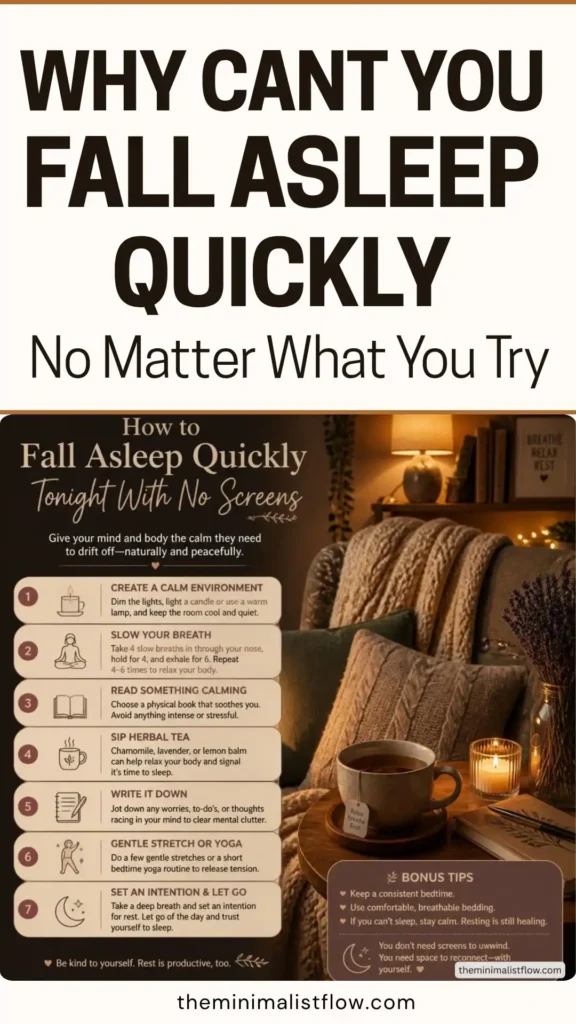
Your Fall-Asleep-Quickly Checklist
You don’t need to do all fifteen things above every night, that would be exhausting in its own way. This shorter checklist pulls out the ones that matter most, so you have something simple to glance at on the nights you’re too tired to think it through.
- Save this so you can come back to it the next time your brain won’t slow down.
- Bedroom temperature between 65 and 68 degrees
- Screens away a full hour before bed
- Curtains or a mask blocking outside light
- Same three wind-down steps, every single night
- Water and any supplements finished thirty minutes before lying down
- A notebook nearby for a quick brain dump
- White noise or a fan running if your space is noisy
- Out of bed if you’re still awake after twenty minutes
- A physical book within reach instead of your phone
- Permission to rest even if sleep takes its time
Do This Tonight
Set your thermostat before you start your evening routine, not after.
Charge your phone outside the bedroom, even if it’s just in the hallway.
Write down tomorrow’s first three tasks so your brain can let them go.
Pick one technique from this list, just one, and try it before adding a second.
The Two-Minute Reset
If you only have two minutes and nothing else, do these in order: dim the lights, breathe in for four and out for eight three times, then lie down and simply notice your breathing without trying to change anything else.
It’s not fancy, but on the nights you’re too tired to do anything more complicated, it’s often enough.
Keep this one in your back pocket for hotel rooms, guest beds, or any night your usual routine simply isn’t possible. It travels with you, no curtains or gadgets required.

FAQ – Questions You Might Still Have
Recommended Reading
If tonight’s list helped, these go even deeper into the same topic. I wrote 10 more ways to fall asleep quickly that are a little less obvious if you want a second list to pull from.
For the evenings when heat or stress make things worse, this post on realistic summer evening routines for highly sensitive women is worth a read too.
My Final Thoughts
Falling asleep quickly isn’t really about tricks. It’s about finally giving your body the handful of quiet, boring signals it’s been asking for the whole time. Cool the room down. Put the phone somewhere else. Let your mind rest instead of racing to prove something before dawn.
None of this needs to be perfect tonight, or even this week.
You don’t need every item on the checklist working at once, you just need one habit that sticks longer than the last one did. Pick one thing from this list and try it before you reach for anything else.
I hope tonight is the night you finally sleep tight without needing to try so hard for it. Which one will you try first?