Why Do I Always Want to Buy Something? 9 Common Triggers
It’s 9 pm. The house is quiet, and your thumb is already opening a shopping app.
Nothing is broken and nothing is missing. And still the question comes back: why do I always want to buy something?
Is it boredom, or is it that pretty lamp you saw on your feed this morning? Do you really need it, or does your brain just want the little lift that comes with a new thing?
I know that feeling, and I think many of us do. It’s a puzzle we all face now and then, too.
To me, the urge is a signal. And every signal has something that sets it off.
If you keep asking yourself why you always want to buy something, the short answer is that the wanting starts before the thinking does, and a specific trigger usually sets it off. In this post I show you 9 everyday triggers and one small swap for each, so the urge has somewhere else to go.
Disclosure: This post contains affiliate links. If you make a purchase through these links, I may earn a small commission at no extra cost to you. Thank you for supporting my blog!
In this article you’ll find
- why the urge shows up before you’ve decided anything,
- 9 common triggers, from boredom to a tired evening brain,
- a one page trigger map,
- a 10 minute script for the moment the urge hits,
- a Maybe list that lets real needs through,
- a short phone setup and a checklist you can pin.
A buying trigger is anything that sets off the urge to buy before you’ve decided you need something. It can be a feeling, a time of day, a notification or even a room.
It usually shows up first, and the thinking comes later. The goal isn’t to kill the urge. It’s to learn the trigger, so you can answer the real need behind it.
If the urge to buy shows up almost every day, you’re far from alone. Here’s what two recent surveys found.
Sources: PartnerCentric consumer survey, 2026, more than 1,000 US respondents, via Retail Brew (81%, 62%); CouponFollow, The Real Cost of Late-Night Online Shopping, June 2026, 1,010 Americans (71%).
The Urge Shows Up Before the Decision
Here’s the part that’s worth knowing. Wanting comes first, and thinking comes second.
In 2007, a team led by Brian Knutson put people in a brain scanner and showed them products and then prices, before they decided whether to buy. The study was published in the journal Neuron.
When people saw something they liked, the reward anticipation area of the brain, the nucleus accumbens, switched on. When the price felt too high, a region linked to anticipating a loss switched on, and an area at the front of the brain went quiet.
Each of those signals predicted whether the person would buy, and they did it right before the decision.
An urge tells you about your state, not about your shelves. It only says that part of your brain expects something good.
That’s why the urge to shop can feel so sudden. It’s also useful, because triggers repeat. And what repeats can be spotted.
9 Common Triggers Behind the Urge to Buy Something
I sorted these impulse buying triggers by where they start. You’ll probably spot 2 or 3 of them right away. You don’t need to fix all 9. Finding your top 2 already changes a lot.
Think about the last thing you bought and didn’t really need. What were you doing in the hour before? Where were you sitting, and how did the day feel? That hour usually holds your trigger.
Triggers That Start Inside You
1. Boredom: the 10 Empty Minutes
A line at the pharmacy, or a pot that takes forever to boil. Then the kids are finally asleep and the evening has nothing left in it.
Boredom doesn’t feel like boredom. It feels like a tiny itch, and shopping when bored is the nearest way to scratch it. Numerica Credit Union lists boredom and scrolling among the most common emotional triggers for impulse spending.
Here in Hungary, plenty of people go to the mall just to walk around, with no plan to buy anything. And somehow a bag always comes home!
You know it’s this one when: you open the app with no item in mind.
✦ SHOP IT ON AMAZON ✦
One puzzle can take the place of a lot of Tuesday night browsing. Check your shelves first, you may already own one.
Jigsaw puzzles for adults→Keep one thing that needs your hands within reach, like a puzzle or a book. When the itch comes, give it 10 minutes first.
2. A Hard Day and the Need for Control
After a bad day, a full cart feels like a small win. There’s some logic behind that.
Researchers at the University of Michigan found that people who made shopping choices after a sad movie clip felt less sad than people who only browsed. Their idea is that choosing gives us back a sense of control. And control is exactly what a hard day takes away.
It didn’t work for anger, by the way. So a cart is a poor answer to a fight.
You know it’s this one when: the item is a comfort, not a need, and the day was rough.
Make a different choice that gives you the same feeling of control: pick tomorrow’s outfit or clear one surface. Then check if the urge is still there.
3. A Good Day and the Reward Reflex
Bad days aren’t the only ones. Celebrating is on the same list, and it’s just as much emotional spending.
A finished project or a payday. “I earned this” is a strong sentence, and it fits almost any price tag. Psychologist Regan Gurung writes in Psychology Today that people often use purchases to reward themselves for achievements.
The trouble is that the reward and the object get glued together. Then every good week means a new thing.
You know it’s this one when: you hear “I deserve this” in your own head.
Pick your non-buying reward before the good week starts, like a long bath or a slow coffee on the balcony. Write it on the first page of your notebook.
Related post: If you’d like a calmer way of thinking about wanting things, I wrote about how to stop wanting new things and start living a simple life.
4. The Task You’re Avoiding
Researching the perfect planner is so much more fun than writing the plan. Browsing storage boxes is easier than sorting what goes inside them.
Gurung also points out that shopping can be a way to put off unpleasant tasks. It’s shopping as procrastination, and it looks very productive from the outside. There are reviews to read and sizes to compare.
You know it’s this one when: the research keeps going and the task hasn’t moved.
Set a 5 minute timer and do the first tiny step of the task you’ve been avoiding. The cart stays closed until the timer ends.
5. A Tired Evening Brain
Think about when you shop. Probably not at 8 am after a good night’s sleep. More likely it’s late in the evening, after a day full of decisions, with the laundry folded and nothing left in the tank.
In 2007, Kathleen Vohs and Ronald Faber ran three studies in the Journal of Consumer Research. People whose self-control had been used up felt stronger urges to buy, and they spent more.

A tired brain follows rules it already has far better than it makes new ones at 9 pm.
You know it’s this one when: it’s after 8 pm and the cart holds things you couldn’t explain tomorrow.
Researchers still argue about how self-control “runs out”. Some studies from that period have been hard to repeat, so take the exact mechanism lightly. The evening pattern still rings true for many of us, and adding a little friction costs nothing and gives the urge time to pass.
Give your cart a bedtime. Move the shopping apps to the last screen of your phone and take the saved card out of at least one of them.
Triggers That Start in the Room or on the Screen
6. The New Thing That Makes Everything Else Look Old
You buy a new throw pillow, and suddenly the sofa looks tired. Soon the rug is next.
This pattern has a name. In 1769, the French philosopher Denis Diderot wrote that after he got a beautiful new dressing gown, his old belongings started to look shabby next to it, and he began replacing them. The term Diderot effect comes from the anthropologist Grant McCracken, who described it in the late 1980s.
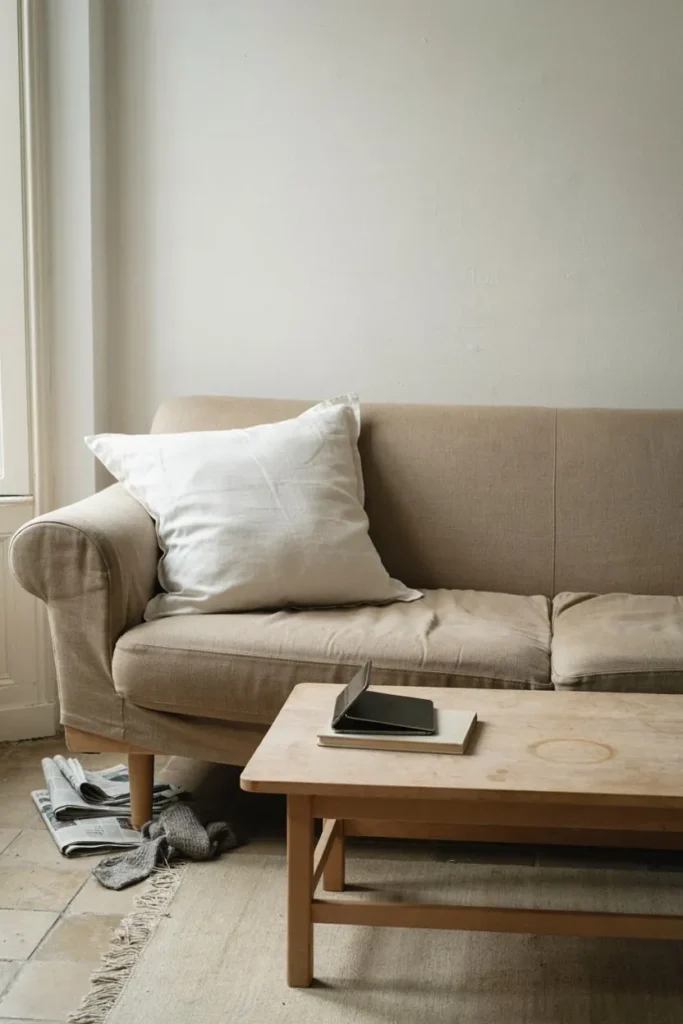
In a home that’s slowly becoming calmer, this one is sneaky. One pretty object arrives, and the whole room starts asking for a promotion.
You know it’s this one when: the list for the new thing already has 3 matching items on it.
Live with the first new object for 2 weeks before you buy anything to go with it. If the room still bothers you after that, buy one more piece, never the whole set.
7. Little Nudges That Finish Your Look for You
“Complete the look.” “Customers also bought.” Free shipping above a certain amount. A pop-up that reminds you about the cart you left yesterday. Numerica lists all of these among the retailer tactics that play on the fear of missing out.
Shops build these nudges on purpose, and the free shipping one is the sneakiest. Say your cart is $41 and free shipping starts at $50. A $9 filler item “saves” you a $6 fee. That’s paying $9 to avoid $6.
You know it’s this one when: you’re adding something just to reach a number.
Look at your cart as if the “customers also bought” row didn’t exist. Cover it with your hand, and remove anything you only added to reach a threshold.
Related: The same trick works on sale emails. My post on 10 questions to ask before buying clothes you’ll actually wear has a quick test for each one.
8. Your Own Things Stopped Being Exciting
The sofa you loved in March is just a sofa in October. Nothing is wrong with it. You simply got used to it.
Psychologists call this habituation, and Gurung’s article describes how newness brings back the excitement that familiar things lost. Most of us answer that with a purchase. A cheaper answer is a small rearrangement.

Back home we have a saying that it’ll come in handy for something someday, and that sentence has filled a lot of attics. A rotation box is different. It has a lid and a label with a date on it.
You know it’s this one when: you feel bored with a room, but nothing in it needs fixing.
Shop your own home. Move one lamp or swap the pictures between two rooms, and put a few things in a rotation box for 3 months so they come back like new.
9. Feeds That Turn Inspiration Into a Shopping List
Pinterest boards and “get the look” videos. We save a room because of how it feels, and then the product links are right there. It’s the urge to shop wearing an inspiration costume.
The same Psychology Today article mentions research by Dodoo and Wu from 2019, which found that personalized social media ads can make a product seem newer and boost purchasing.
A room you love is rarely a pile of products. It’s mostly light and space, plus a few things that mean something.
You know it’s this one when: you saved 20 pins and can’t name the feeling you were after.
Split your boards in two: one for feelings, one for things. Be strict about what goes into the second one, and ask whether you want the room or the object.

Your Trigger Map on One Page
Here are all 9 in one table, and it’s the honest answer to why you keep buying things you don’t need. Screenshot it, or print it and tape it inside a cupboard door. Your top 2 triggers are the only rows you need to learn first.
| Trigger | Where it hides | Your first swap |
|---|---|---|
| 1. Boredom | Waiting rooms, school pickup, the 10 empty minutes | A puzzle or a book within reach |
| 2. A hard day | The evening after a rough day | Pick tomorrow’s outfit |
| 3. A good day | Payday, a finished project | A reward chosen in advance |
| 4. An avoided task | Right before the thing you keep delaying | 5 minutes on the first step |
| 5. A tired evening | After 8 pm | A bedtime for the cart |
| 6. One new thing | After any new purchase at home | 2 weeks of living with it |
| 7. Shop nudges | Cart pages and pop-ups | Cover “customers also bought” |
| 8. Used to it | A room you have looked at for months | Shop your own home |
| 9. Feeds | Pinterest boards and home tours | Split boards: feelings and things |
A 10 Minute Script for the Moment the Urge Hits
Knowing your trigger helps most in the moment itself. Here’s a short script. Keep it in your notes app.

Minute 0 to 1: Name it
Say it out loud or in your head: this is an urge. Nothing more.
Minute 1 to 3: Find the trigger
Look at the map above. What happened in the last hour?
Minute 3 to 6: Change the scene
Stand up and drink a glass of water, or step into another room. A new place breaks the loop.
Minute 6 to 9: Ask one question
Do I want this thing, or do I want the feeling of buying it?
Minute 9 to 10: Send it somewhere
If it’s on your list and you need it, buy it. If not, it goes on the Maybe list or gets deleted. Both are good results.
The Maybe List: A Waiting Room With 3 Doors
People often ask how to stop impulse buying, and the 24 hour rule is the popular answer. It’s a good start. A small upgrade is to let the wait depend on the price.
| Price | Wait | Then ask |
|---|---|---|
| Under $25 | 24 hours | Do I still remember it tomorrow? |
| $25 to $100 | 7 days | Where will it live? |
| Over $100 | 30 days | What does it replace? |
Write down the item and the price, and put the date next to it. A small notebook in your bag does the job, and so does a notepad on the fridge.
Some items will have vanished from your mind by the time the wait is over. Those cost you nothing.
✦ SHOP IT ON AMAZON ✦
A small notebook for your bag or a notepad on the fridge is all this list needs. Check your drawers first, you may already own both.
Pocket notebooks→Magnetic notepads→Real Gap or Passing Urge? A Quick Comparison
Buying isn’t the enemy. Some things are real gaps, and a calm home still needs a good winter coat.
| Passing urge | Real gap | |
|---|---|---|
| How long | It appeared in the last hour | It’s still on the Maybe list after 30 days |
| Where it lives | “I’ll find a spot” | You can name the shelf |
| What it replaces | Nothing | Something worn out or broken |
| After the wait | You’ve forgotten it | You still want it, and nothing else solves it |
| How it feels | A rush | Calm |
Mending is my first step. I mend everything I think can still be worn, so a loose button gets a few minutes of my evening before it ever lands on a wish list.
If it can’t be saved, that’s a real gap, and a good replacement is fine.
Related post: If the sales emails are your loudest trigger, my Black Friday shopping tips show how to keep a list that the deals have to match.
Set Up Your Phone So the Urge Hits a Wall
Willpower works best in the afternoon, when you set the rules. At 9 pm you only follow them. If you want to stop buying things you don’t need, make buying slightly harder.
- Remove saved cards from your shopping apps and your browser
- Turn off push notifications from every shop
- Unsubscribe from the 3 senders whose emails you open the most
- Move shopping apps to the last screen of your phone
- Keep a separate Pinterest board for things, away from your feelings board
Every extra step gives the urge more time to pass. Two minutes of typing in a card number is often enough.
Mistakes That Keep the Urge Coming Back
Even good minimalist shopping rules fail when they’re too strict. These are the usual reasons.
| Mistake | Do this instead |
|---|---|
| Deleting every shopping app and then shopping in the browser | Log out and remove saved cards, so every purchase takes extra steps |
| Setting a strict no-buy month with no exceptions | Keep a Maybe list, so real needs have a door |
| Fighting the urge with willpower at 9 pm | Set the rules in the afternoon and let the evening you follow them |
| Swapping shopping for a treat that costs money too | Pick swaps that are free or already live at home |
| Feeling guilty after every urge | Write down the trigger as information and move on |
Related: If the holidays are your loudest trigger, my Christmas savings challenge gives that money a job before the sales start.
And if boredom is yours, my list of 20 free summer bucket list ideas has plenty of things to do instead that cost nothing.
Which of the 9 triggers did you recognize first? Write its number on the back of your hand, or at least in your notes app, and start with that swap this week.
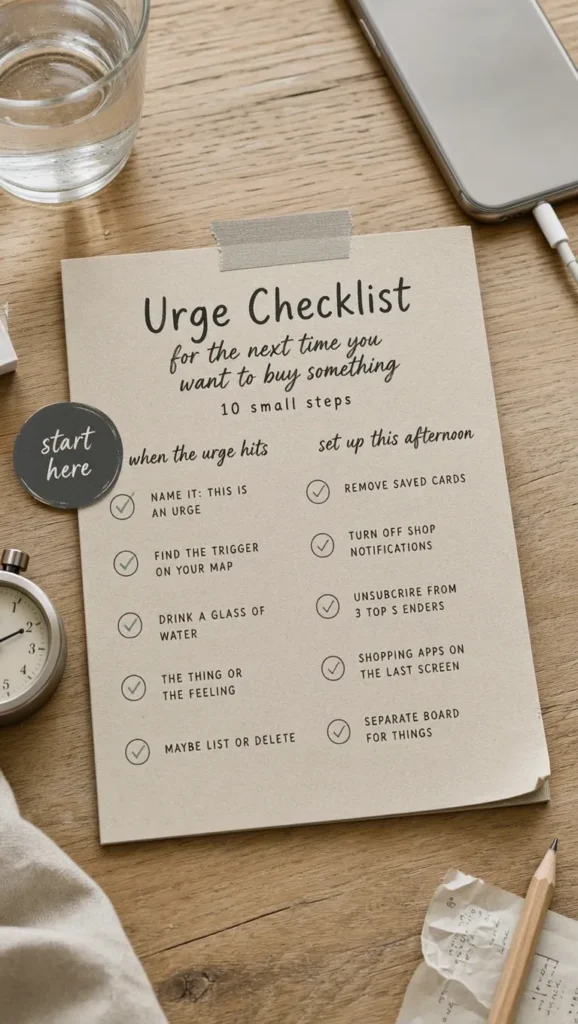
Your Urge Checklist for the Next Time You Want to Buy Something
Save this pin for later on your Pinterest board!
Why Do I Always Want to Buy Something? Questions Readers Ask
Why do I always want to buy something even when I have everything I need?
Wanting to buy something even when you have everything you need usually comes from a trigger, not from a missing item. Boredom, a rough day, a tired evening or a scrolling session can all start the urge before you’ve thought about it. Name the trigger first, and the urge often loses some of its pull.
Is it normal to want to buy things all the time?
It’s normal to feel the urge to buy things often, because the brain gets a small reward from just anticipating something new. That doesn’t make every urge a need. If the wanting leaves you stressed or in debt, it’s worth talking to a doctor or a counselor, not only changing habits.
What triggers impulse buying the most?
No single trigger wins for everyone, but boredom, stress, celebrating, tiredness and shop nudges like “customers also bought” come up again and again. Credit union guides list most of them. The quickest way to find your own is to write down what you were doing in the hour before your last unplanned purchase.
How do I stop wanting to buy things?
To stop wanting to buy things so often, start with the trigger instead of the item. Use the 10 minute script when the urge hits, and send everything unplanned to a Maybe list. Urges tend to get quieter once they have to wait. My post on how to stop wanting new things goes deeper.
Why do I want to shop when I’m bored?
Shopping when you’re bored gives you a small burst of novelty with almost no effort. Money writers list boredom and scrolling among the common triggers of impulse spending. Keep something that uses your hands within reach, like a puzzle or a book, and give it 10 minutes before you open the app.
Does the 24 hour rule actually work?
The 24 hour rule works because it lets the first rush of wanting fade before you pay. I don’t know of a single study that proves a specific number of hours, so treat it as a practical habit, not a science fact. A tiered wait, 24 hours for small things and longer for big ones, gives you more room.
How do I stop online shopping at night?
To stop online shopping at night, add friction in the afternoon. Remove saved cards from shopping apps and turn off shop notifications. A tired brain follows rules it already has much better than it invents new ones at 9 pm. Two minutes of extra steps is often enough for the urge to fade.
How do I know if I really need something or just want it?
You can tell a real need from a passing want by time and by place. A real need is still there after the Maybe list wait and has a shelf you can name. A passing want shows up fast and usually fades when you look away.
Is retail therapy always a bad thing?
Retail therapy isn’t always bad, and a small treat after a hard day can lift your mood. In a University of Michigan study, people who made shopping choices felt less sad afterward than people who only browsed. The risk is a big purchase meant to fix a feeling that has nothing to do with shopping.
Recommended Reading
How to Stop Wanting New Things and Start Living a Simple Life
10 Questions to Ask Before Buying Clothes You’ll Actually Wear
Mental Sunday Reset: How to Clear Your Mind Weekly
The Question I’d Ask Before Every Cart
If I could keep only one thing from this post, I’d keep the question from the 10 minute script.
Do I want this thing, or do I want the feeling of buying it?
Sometimes the answer is the thing. A good winter coat, or a pan that finally replaces the burnt one. And sometimes it’s the feeling, which is worth knowing too, because a feeling usually has a cheaper way in.
For me, that’s what makes a home truly calm: everything in it arrived on purpose.
What’s the next thing you’ll put on your Maybe list?
Which trigger is the strongest for you?
Pick the one you recognized first. Your answer quietly shapes my next post.
You Might Also Like
-
Almond Nails: 17 Elegant Designs to Screenshot for Your Nail Tech
In this post I’ll show you 17 almond nails that stay simple, elegant and easy to explain at the salon, with the exact words to tell your nail tech. You’ll also find 4 color pairs for a minimalist wardrobe, a short aftercare routine and a checklist for your next appointment.
-
14 Last Minute Homemade Christmas Gift Ideas You Can Make Tonight
In this post I’ll show you 14 homemade christmas gift ideas you can still make in the last days before Christmas, sorted by the time you have, from 15 minutes to one evening. You’ll also find who gets which gift, wrapping pairs that make a jar look finished, what to write on the tag and…
-
Why Do I Always Want to Buy Something? 9 Common Triggers
Why do I always want to buy something, even when nothing is missing? These 9 triggers explain where the urge starts, and each one comes with a small swap and a 10-minute script for the moment it hits.