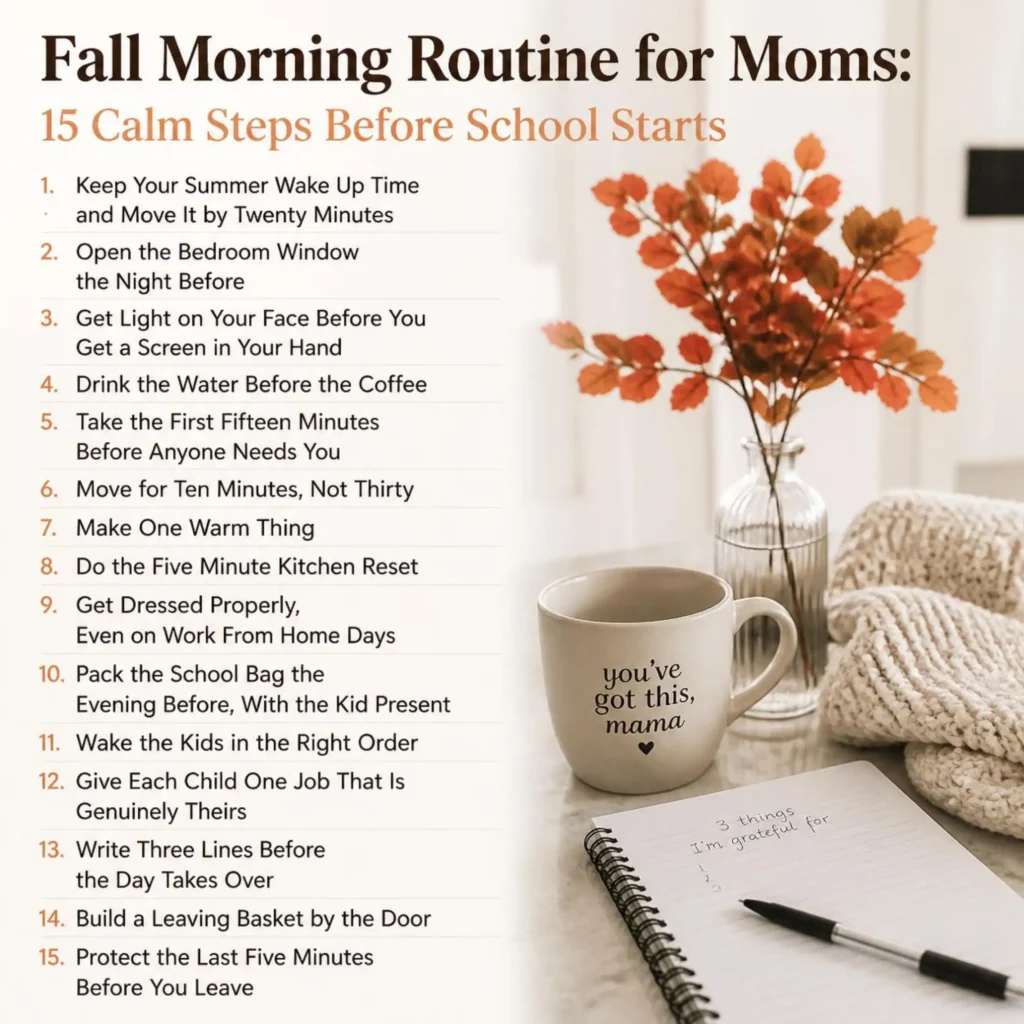
Fall Morning Routine for Moms: 15 Calm Steps Before School Starts

Most of us moms put together the same fall morning routine year after year. We wait for school to start. Wait for it? Let us just say we see it coming.
On a Sunday evening we write out a beautiful plan for how smoothly the mornings are going to go. Then a few days pass, and we hit the snooze button more and more, because getting up is hard and we are already tired of the whole thing.
Fall is my favorite season. Summers here in Central and Eastern Europe have gotten so hot in the last few years that by mid August I am quietly counting the days until the nights cool down again.
In September I do not build new routines. I adjust the one I already have. I keep my summer routine and change only a few small things, and in this post I am sharing exactly which ones.
I am not doing this to be the most productive woman on my street. I do it because I got used to it, and because I feel better on the days I keep it.
Fall actually makes it easier on us. The nights get cooler, we sleep more deeply, and waking up early somehow goes easier too, even without the coffee.
Honestly, by now the whole thing runs like a well practiced mechanism. I do not have to think about it, I just do it. And that is the very best part of it.
Before you read the list, ask yourself two quick questions:
- What time do you need to leave the house?
- What is the one thing that usually puts you at risk of being late?
Disclosure: This post contains affiliate links. If you make a purchase through these links, I may earn a small commission at no extra cost to you. Thank you for supporting my blog!

15 Steps for a Fall Morning Routine That Holds Up Once School Starts
These go roughly in the order they happen, starting the night before. You do not need all fifteen. Pick four or five that fit your house, your kids, and your leaving time.
1. Keep Your Summer Wake Up Time and Move It by Twenty Minutes
If you woke up at 6:40 in July, don’t jump to 5:30 on the first day of school just because a Pinterest graphic showed that disciplined women wake up at that time.
Here’s why it might work for you:
Your biological clock is slowly adjusting to a different wake-up time. A twenty-minute change is perfectly acceptable, and most of us can handle it without a problem.
A ninety-minute change, however, is completely unacceptable, it’s just too much of a contrast. It won’t work precisely because of that big change.
Set your alarm clock twenty minutes earlier this Sunday, and then wake up at the same time every morning.
2. Open the Bedroom Window the Night Before
This one costs nothing and it is the reason fall mornings are so much easier than summer ones. A cooler bedroom means deeper sleep, and deeper sleep is the actual foundation under every early wake up.
The Sleep Foundation puts the ideal bedroom temperature around 65 to 68 degrees Fahrenheit, which is finally achievable in October without air conditioning running all night.
Recommended: If cool air alone is not enough, the sleep habits piece is worth its own read. I wrote about that in detail in 111 better sleep habits for sensitive women.
Crack the window an hour before bed instead of the moment you get in, so the room is already cool when you lie down.
3. Get Light on Your Face Before You Get a Screen in Your Hand
It’s okay if there’s no bright sunshine on a fall morning.
Light is just as important as it is in summer. Morning light signals your brain that the day has begun, so first of all, go outside for a few minutes in natural light (on a balcony, patio or just by an open window) and don’t pick up your phone as an alarm clock.
Research backs this up more strongly than most morning advice. A study on morning bright light exposure found improvements in nighttime sleep and next morning alertness, and a larger Scientific Reports paper on daytime light exposure connects it to steadier daily rhythms and mood.
Tonight, put your phone charger on the other side of the room so that the window is closer than the screen, and don’t reach for your phone right after waking up.
4. Drink the Water Before the Coffee
This is really important, and I can’t say it enough. I know, because it took me years to understand why this is good for my body.
Think about it: if you’re lucky, you’ve spent seven to eight hours of sleep without a sip of water. This is one of the reasons why you feel heavy at 6 in the morning, often just plain thirsty because you’re tired.
Drink a glass of water before you make your first coffee. I always drink lukewarm water, it’s good for your stomach. Wait about 20 minutes and then drink your coffee.

Why it’s good for you: After a night’s sleep, you hydrate your body and drinking water is gentle on your stomach.
You can also prepare your glass the night before, so you won’t forget. By the way, this is also a habit that takes at least 2-3 weeks to become automatic, so be very patient with yourself.
5. Take the First Fifteen Minutes Before for Yourself
This is the part of my routine that I protect the most. (At least) fifteen minutes when no one asks where your sweater is.
I sit down with a cup of tea. Because I love to read, I sometimes read four pages at a time. But there are also times when I just look out the window at the garden and the birds and think about nothing. It’s a bit like a short Zen meditation, it clears the mind.
Here’s what’s changed for me: the quality of my entire day depends less on how early I wake up and more on whether the first thing I do is my choice or whether it’s required of me.
Set your alarm clock for fifteen minutes earlier and don’t do anything useful during that time.
6. Move for Ten Minutes
Fall is the season when the ambitious workout plan appears and quietly dies around the second week of October. Ten minutes survives but forty five does not.
How it works: you are not chasing fitness here, you are chasing body temperature and blood flow. A small amount of movement in the first hour wakes you up more reliably than a second coffee.
On the days it does not happen, I do not treat it as a broken streak. I just do it the next morning, and that flexibility is the actual reason it lasts.
Related post: I unpacked that idea more in a flexible morning routine that holds up when life gets chaotic.
Choose the five movements now, write them on a sticky note, and stop redesigning them.
7. Make One Warm Thing
In the summer, we crave cold things, but in the fall, we tend to gravitate toward warm things.
Why this is good for you: Warmth is a cue, and a cue builds a routine. Your body starts to associate this particular smell and this particular mug with the start of the day, and after two weeks, the association does half the work for you.
My daughter has warm tea with honey. It helps her start her mornings and we slowly (sometimes very, very slowly) get ready for school.
Choose one warm thing and make the same thing every morning for two weeks. If you want something different after that, or it doesn’t work, change it.
8. Do the Five Minute Kitchen Reset
Walking into a kitchen with last night’s pots in the sink sets the tone before anyone has spoken. Five minutes the night before removes that entirely.
How it works: you are moving the decision, not the work. The work is the same five minutes either way, but at 9 p.m. it costs you almost nothing and at 7 a.m. it costs you the calm you were trying to protect.

This is the single habit I would keep if I had to drop the other fourteen.
Set out tomorrow’s bowls and mugs while the dishwasher is loading tonight.
9. Get Dressed Properly, Even on Work From Home Days
Fall makes this genuinely enjoyable, because fall clothes are the good ones. A soft knit, real trousers, a scarf that makes the whole outfit look considered.
Why it works: getting dressed is a boundary between rest and the rest of the day, and a boundary that you can see and feel is stronger than one you decided about in your head.
A small fall capsule makes this take ninety seconds instead of eleven minutes of standing in front of the wardrobe.
Related post: If you have never built one, start with a simple capsule wardrobe for every season.
Choose tomorrow’s clothes tonight, including the shoes, and hang them on one hook.
10. Pack the School Bag the Evening Before, With the Kid Present
Back to school mornings fall apart over objects, almost never over feelings. The library book. The gym shoes. The permission slip that was on the fridge.
Pack the night before, and pack it with your child standing there rather than for them while they watch cartoons.
Why it is useful for you: when they load the bag themselves, they know what is inside it, which means the 7:40 panic about the missing folder simply stops happening.

Ask one question instead of giving five instructions: what do you need in the bag for tomorrow?
11. Wake the Kids in the Right Order
This sounds fussy until you try it. In most houses one child gets going quickly and one needs a longer runway.
Wake the slow starter first, give them ten minutes of quiet before the fast one arrives at full volume, and the whole kitchen gets calmer.
How it works: you are separating two energies that do not mix well at 6:45. The slow child gets to surface without an audience, and the quick child gets to be loud without being told off for it.
Structure like this matters more than we tend to think. Penn State researchers found that consistent family routines help children adjust to school, and Seattle Children’s makes a similar point about predictability lowering daily conflict.
Write the wake up order on the fridge for a week so nobody has to negotiate it at dawn.
12. Give Each Child One Job That Is Genuinely Theirs
Feeding the cat, opening the curtains in the living room and putting the lunch boxes in the bags.
Why it works: a single repeated task becomes automatic in about three weeks, and once it is automatic it is genuinely off your list. Fourteen tasks never become automatic, they just become a source of arguing.
My daughter opens all the curtains downstairs. It takes her forty seconds, she is proud of it, and I have not thought about curtains since April.
Pick one job per child tonight and do not add a second one for a month.
13. Write Three Lines Before the Day Takes Over
Fall is a reflective season, and there is a reason so many people start journaling around September. The light changes, the year starts feeling finite, and things surface.
Why it is useful for you: writing the third line is how you find out that your huge overwhelming day contains two real tasks and a lot of noise.
I’ve been keeping a diary since I was a little girl. Not much has changed since then in why I do it. I love to write – that’s why I have this blog – and it’s good to write down my thoughts, to empty my mind in this way.
Keep the notebook and pen physically next to the kettle so writing happens while the water boils.
14. Build a Leaving Basket by the Door
Keys, wallet and the sunglasses that you will still need in October. The gloves that appear in November.
One basket, one place, everything that goes out of the house with you.
How it works: you are removing the search, and searching is what actually makes families late. The average frantic hunt for keys costs three or four minutes, and it costs them at the worst possible moment, when everyone already has their coat on.
Empty the basket every Sunday so it stays a launch pad instead of turning into a junk drawer with better lighting.
Calculate It!
We never count these minutes because three here and four there can seem like so little. So, let’s add them up: move the sliders below and see how much a school year of searching really costs.
How much of your school year goes to looking for things
Four minutes hunting for a shoe never feels like anything. Stretch it across a school year and the number gets your attention. Move the two sliders to see yours.
That is close to a full day of your year spent searching, almost always in the worst five minutes of the morning. The time matters, and so does the mood everyone leaves the house in.
Based on a 36 week school year. Try this: put one basket by the door tonight for keys, wallet, and sunglasses, and empty it every Sunday so it stays a launch pad.
15. Protect the Last Five Minutes Before You Leave
This is where a good morning most often falls apart. Everything went well, and then somebody remembers the science project and the last five minutes become a sprint.
Aim to be ready five minutes early and spend those five minutes doing nothing. Standing by the door. Talking about something that is not logistics.
Why it works: those five minutes are your buffer, and a buffer is what turns a small problem into a non problem. A missing shoe at minus five minutes is an inconvenience. The same missing shoe at zero is a bad morning for everyone.
Set a second alarm for five minutes before your real leaving time and treat it as the real one.
The Part Nobody Puts on the Aesthetic Morning Videos
Here is my honest opinion, and it goes against most of what fall routine content shows.
The wake up early aesthetic that fills Pinterest every September, the linen robe, the ceramic mug on the wooden table, the perfectly lit journal, is genuinely lovely to look at.
I save those pins myself. But that image is the result of a routine, never the cause of one.
And here is the European angle I keep coming back to. In the village where I grew up, near the Tisza river, nobody called it a routine.
My grandparents got up when it got light because the animals needed feeding and the garden needed watering, and the day had a rhythm nobody had to design.
We lost that rhythm and now we are rebuilding it with alarm clocks and habit trackers. That is not a tragedy, it is just worth naming, because it explains why the routines that stick are the ones tied to something real.
A person who needs feeding. A door you actually have to walk out of.
Ask yourself which parts of your morning have a real anchor and which parts you added because they looked good on a screen.
What I Actually Use on Dark Fall Mornings
I am careful about recommending things, because the whole point of a minimalist morning is that it should work without buying anything. These are the few items that genuinely earn their place in my house once the mornings get dark.
A Philips SmartSleep wake up light or a Hatch Restore sunrise alarm makes the biggest difference of anything on this list from mid October onward, when you are waking up in genuine darkness.
And a one line a day journal is the least intimidating notebook I have found, because three lines is the maximum it will let you write.
A simple woven basket by the door costs very little and solves the leaving problem from step fourteen. That is the whole list.
Save for Later This Fall Morning Checklist
The evening before
- Kitchen counter wiped and breakfast bowls set out
- School bags packed by the kids and standing by the door
- Tomorrow’s clothes chosen and hanging on one hook
- Water glass filled and left on the counter
- Bedroom window opened an hour before bed
The morning itself
- Drink the water before touching the coffee
- Open the curtains or step outside for two minutes of light
- Fifteen quiet minutes before the first kid alarm
- Ten minutes of movement, the same five every day
- Ready five minutes before you actually need to leave
Pin this so you can come back to it in the first week of September, which is exactly when you will need it.
3 Micro Actions for This Week
- Do the twenty minute alarm shift on Sunday, not on the first day of school. Starting on a school day is how a routine gets associated with stress.
- Put one basket by the front door tonight, even if it is a laundry basket you already own. You can buy a nicer one later or never.
- Choose one morning job per child and tell them it is theirs. Do not explain the system, just hand over the job.

The One Minute Fall Reset for Bad Weeks
Some weeks the routine collapses completely. Somebody gets sick, a work deadline lands, and by Wednesday you are back to hitting snooze twice.
When that happens, do not restart the whole thing. Do these three things and let the rest go until Monday.
- Water first, before anything else
- Curtains open within five minutes of getting up
- Leave the house five minutes early
That is the minimum viable version, and it is genuinely enough to keep the habit alive through a rough patch. There is more on that idea in you are not lazy, you just need a different kind of morning routine.

Q&A
Most of it does, because none of these steps depend on the clock. They depend on order. Light first, water before caffeine, quiet time before demands, and it works whether your morning starts at 5:50 or at 1 p.m.
Twenty to forty minutes before the first child needs you, and no earlier until that feels easy. The number that matters is not the time on the clock, it is how much unclaimed time you have before someone speaks to you.
Move the negotiation to the evening, where you are both calmer. Agree on a wake up time and a consequence when they are not tired and defensive, and then simply follow it in the morning without repeating the argument.
Waking up early is not morally superior to waking up late. What helps is waking up at a consistent time and getting light soon after, and that is true whether your consistent time is six or eight thirty.
Skip the early wake up entirely and keep only the evening preparation steps. Set out the bowls, pack the bag, fill the water glass, and let the morning be whatever it needs to be. Sleep matters more than routine right now.
Assume it will, because it does for all of us, and plan for the reset instead of the streak. Go back to the three step minimum above and add things again when the week calms down.
Three weeks for the small automatic tasks like curtains and water. Closer to two months for the wake up time, especially as the mornings get darker in November.
Divide by task, not by time. One of you handles breakfast and one handles bags and shoes, and neither of you comments on how the other one does their half. Read more about this topic here.
You do not need one in September. From late October, when it is fully dark at your wake up time, it stops being a gadget and starts being useful. Try the routine without it first.
Changing eight things on the same Monday. Pick two, run them for two weeks, and add more only when the first two happen without you thinking about them.

Recommended Reading
- If you want the summer version of this routine to compare, read how to build a summer morning routine when you are not a morning person.
- For very short mornings, the 10 minute daily routine for tired moms is the stripped down version that still works.
- And if your Sundays are what set up your whole week, the 21 item Sunday reset checklist for overthinker women pairs well with everything above.
One Last Thing
Fall does not ask us to become different people. It just gives us cooler nights, better sleep, and a reason to tighten up what we were already doing.
My routine in October looks almost identical to my routine in July. Same tea, same fifteen quiet minutes, same glass of water on the counter. The only real difference is that I am wearing socks and the sun comes up later.
That is the whole secret, and it is a slightly boring one. We are not building something new every season, we are keeping one thing and letting it change shape.
So which single step will you try tomorrow morning, and what is the one that you already know will be hardest for you?